Moment bias correction
Bias correction divides a zero-initialized EMA by the total weight accumulated through its current step.
On this page 8 sections
- Overview
- Understand the idea
- If gradients are supplied instead of the raw moment, compute the recurrence first
- With a constant gradient, correction recovers that constant exactly
- Adam applies this correction separately to its first and second moving moments
- Key takeaway
- Sources & further reading
- Concept connections
01Understand the idea#
An exponential moving average started at zero initially gives its observations less than total weight 1. Even a constant nonzero signal is pulled toward that artificial starting zero. Bias correction divides by the accumulated observation weight to remove this initialization effect.
A zero-initialized exponential moving average starts with missing weight. With decay β and step t≥1, its accumulated weight is 1−βᵗ.
Assume 0≤β<1 and a zero start.
With β=0.5 at t=2, accumulated weight is 0.75. A raw moment of 9 becomes a corrected moment of 12.
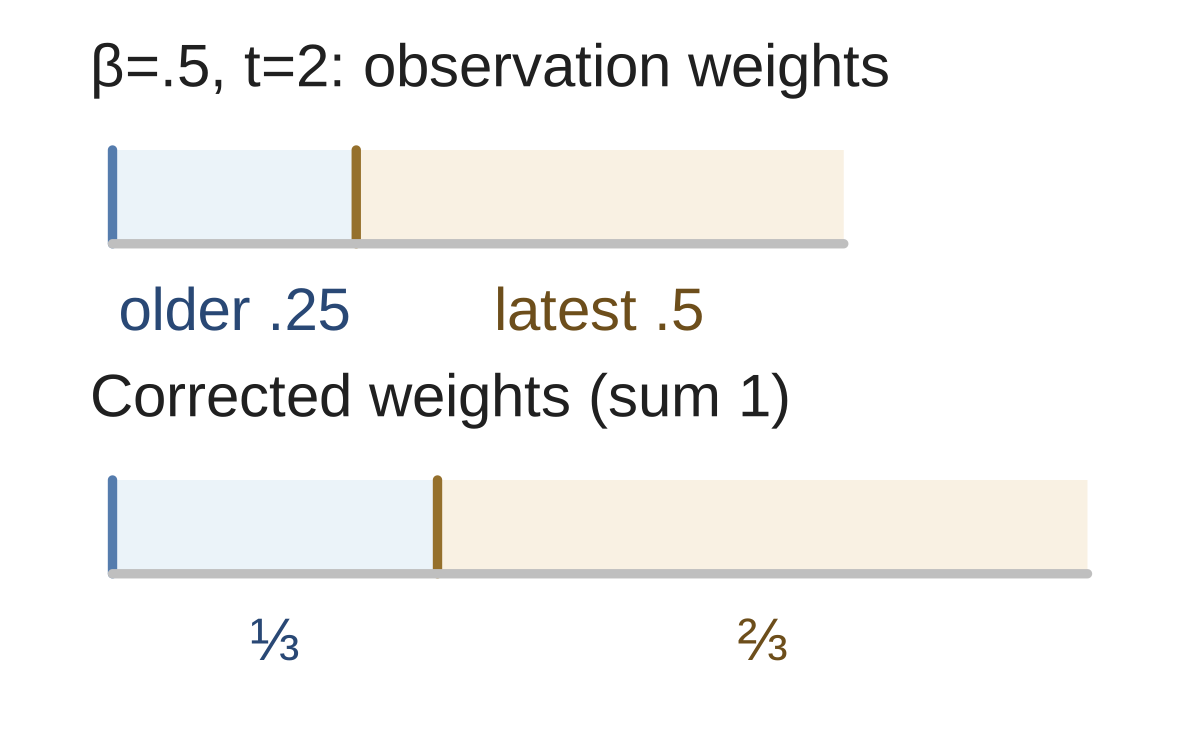
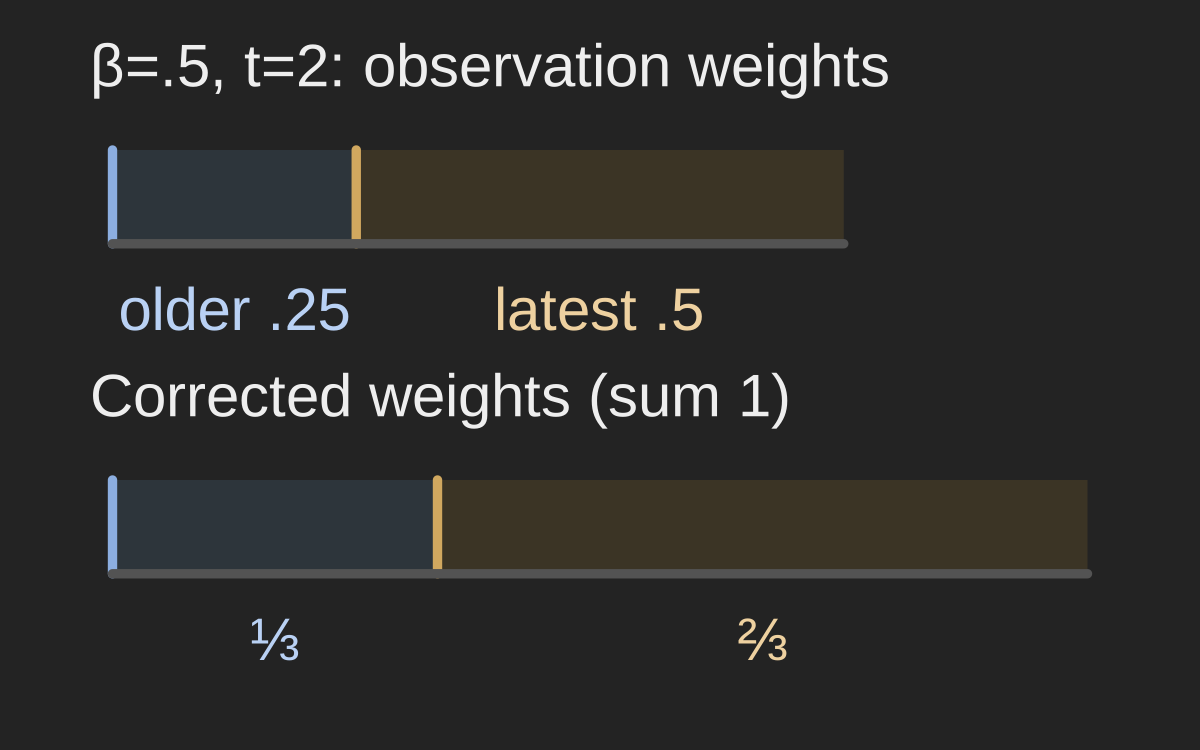
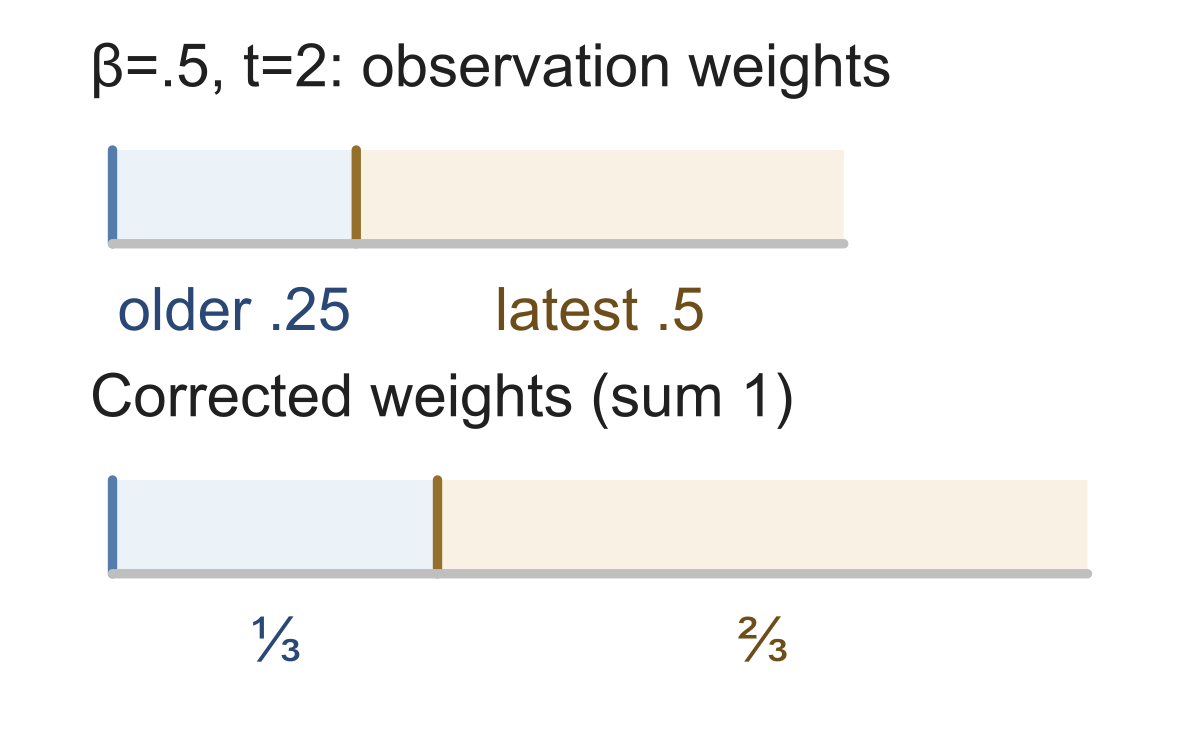
With decay 0.5 and constant gradients 12, the first raw moment is 6. The second is . At step 2, accumulated weight is . Dividing recovers 12. Dividing by instead would use the wrong update count.
Zero-initialized EMA: m_t=5.25, β=0.5, t=3. Find m̂=m_t/(1−β^t).
Show answer and explanation
Divide by 0.875: 6.
02If gradients are supplied instead of the raw moment, compute the recurrence first#
If gradients are supplied instead of the raw moment, compute the recurrence first:
Divide the final raw moment by its accumulated weight, using the actual update count.
Start m0=0. Use m_t=βm_(t−1)+(1−β)g_t with β=0.5, (g1,g2)=(3, 6). Find m̂2=m2/(1−β²).
Show answer and explanation
m1=1.5, m2=3.75; corrected=5.
03With a constant gradient, correction recovers that constant exactly#
With a constant gradient, correction recovers that constant exactly. The smaller raw value reflects missing initial weight.
For changing gradients, correction normalizes their accumulated weights. It does not promise to equal the current gradient or remove bias from a drifting target.
Zero-start EMA, β=0.5; gradients all 8 for 2 steps. Draft reports raw m=6 as corrected. Give m̂=m/(1−β^2).
Show answer and explanation
Raw 6 has weight 0.75. Correction gives 8.
04Adam applies this correction separately to its first and second moving moments#
Adam applies this correction separately to its first and second moving moments. A corrected average still combines past observations; with a changing gradient, it need not equal the current gradient. Correction removes the zero-start weighting effect, not every source of estimation error.
Compute the raw EMA if needed, then divide by 1−βᵗ using the actual step count.
- Correct a zero-initialized exponential moving average using a supplied formula.
Sources & further reading
- [1]Kingma & Ba Algorithm1 and §3 ↗Kingma & Ba Algorithm1 and §3 · Article