Skip to content
Glacius
Linear algebraConcept reference

Matrix scaling

Scalar multiplication multiplies each matrix entry by the same number and preserves the matrix shape.

On this page 7 sections
  1. Overview
  2. A scalar is one number
  3. The scalar applies to every position, including the upper-right and lower-left entries
  4. A uniform copy count scales a table
  5. Key takeaway
  6. Sources & further reading
  7. Concept connections

01A scalar is one number#

A scalar is one number. Multiplying a matrix by a scalar multiplies every entry by that number, leaving rows and columns in place.

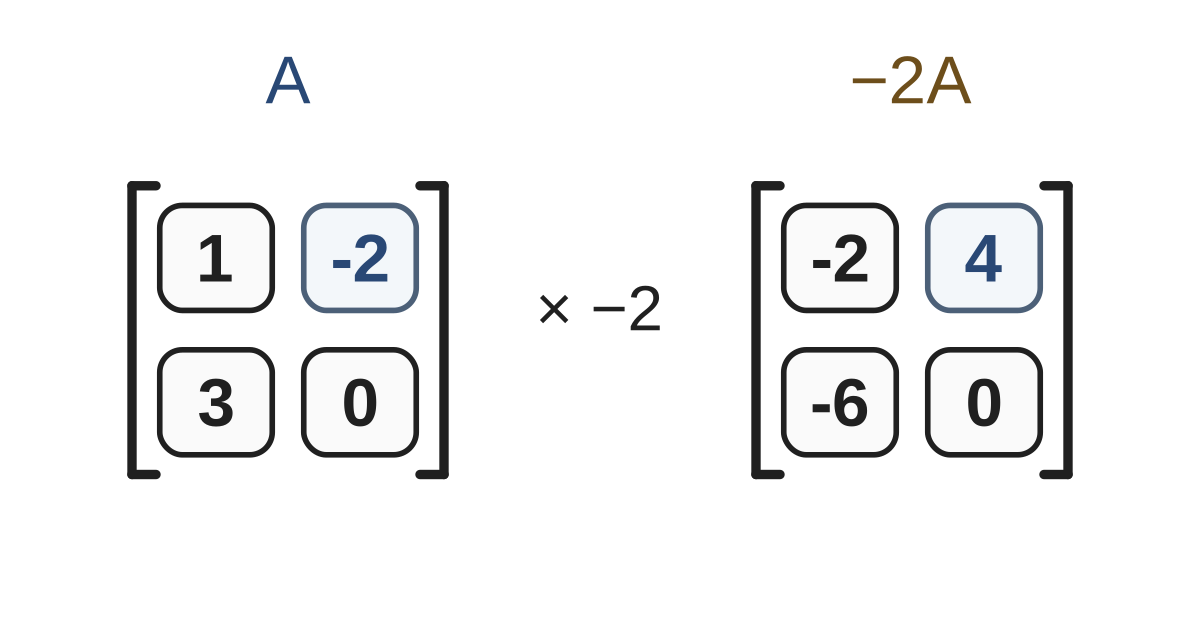
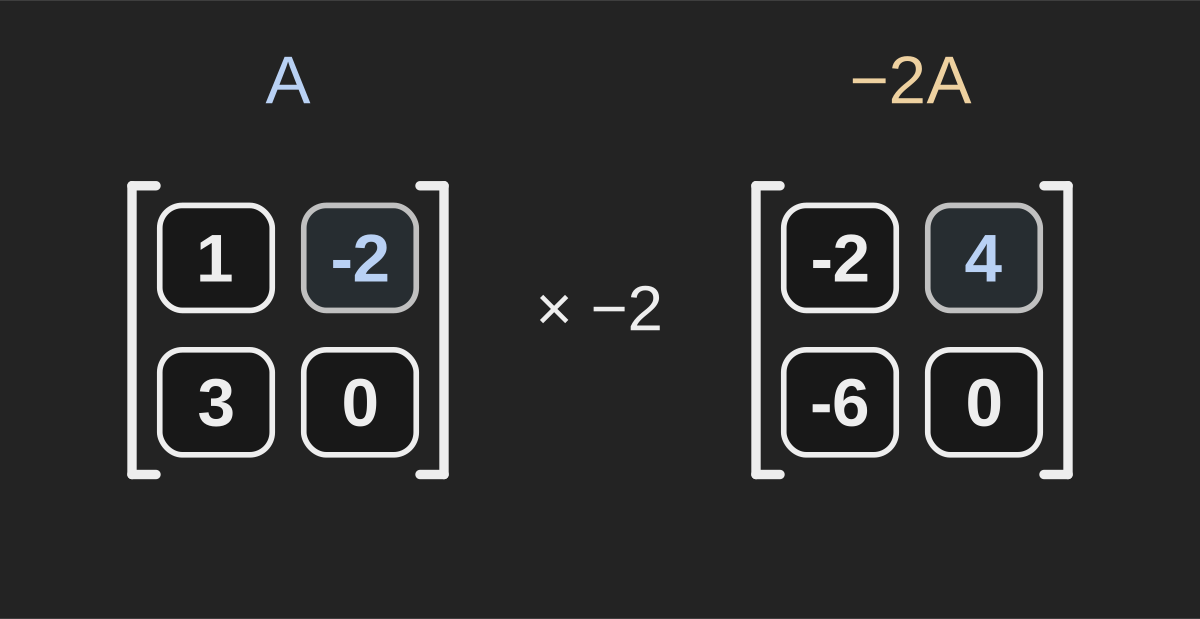
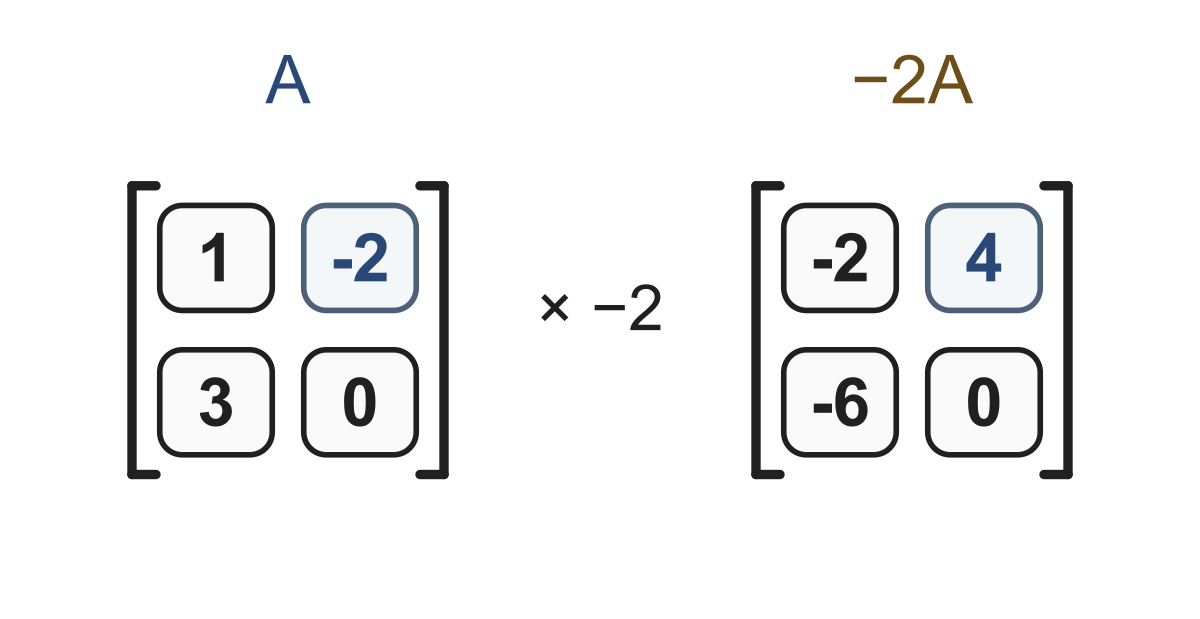
For the displayed matrix, multiplying by −2 gives 2(1)=2-2(1)=-2, 2(2)=4-2(-2)=4, 2(3)=6-2(3)=-6, and 2(0)=0-2(0)=0.

A has rows (1, −2), (3, 0). Multiplying every entry by −2 gives rows (−2, 4), (−6, 0). The upper-right entry changes from −2 to 4; off-diagonal positions are scaled too.A has rows (1, −2), (3, 0). Multiplying every entry by −2 gives rows (−2, 4), (−6, 0). The upper-right entry changes from −2 to 4; off-diagonal positions are scaled too.
Figure 1A has rows (1, −2), (3, 0). Multiplying every entry by −2 gives rows (−2, 4), (−6, 0). The upper-right entry changes from −2 to 4; off-diagonal positions are scaled too.
Link to this figure ↗Download SVGDownload PNG
Check your reasoning

Find 3A3A for A=[21]A=\begin{bmatrix}2&-1\end{bmatrix}.

  1. A[52]\begin{bmatrix}5&2\end{bmatrix}
  2. B[63]\begin{bmatrix}6&-3\end{bmatrix}
  3. C[61]\begin{bmatrix}6&-1\end{bmatrix}
Show answer and explanation
[63]\begin{bmatrix}6&-3\end{bmatrix}

Multiply both entries by 3.

02The scalar applies to every position, including the upper-right and lower-left entries#

The scalar applies to every position, including the upper-right and lower-left entries. A zero scalar turns all entries into zero; it does not remove rows or columns.

Check your reasoning

For B=2AB=-2A, find b12b_{12}. A=[1320]A=\begin{bmatrix}1&-3\\2&0\end{bmatrix}

Show answer and explanation
6

Multiply the upper-right −3 by −2: 6.

03A uniform copy count scales a table#

A uniform copy count scales a table. For three identical kits, multiply each material count by 3. Keep every material in its original position.

Check your reasoning

One kit needs (bolts, nuts): [24]\begin{bmatrix}2&4\end{bmatrix}. Find counts for 3 kits.

  1. A[64]\begin{bmatrix}6&4\end{bmatrix}
  2. B[57]\begin{bmatrix}5&7\end{bmatrix}
  3. C[612]\begin{bmatrix}6&12\end{bmatrix}
Show answer and explanation
[612]\begin{bmatrix}6&12\end{bmatrix}

Three times each count: (6,12)(6,12).

Key takeaway

Multiply every entry; keep every position.

  • Multiply each matrix entry by a scalar.

Sources & further reading

  1. [1]

Reference this concept

Link to this page, a section, or an individual figure.

Glacius. “Matrix scaling.” Math behind ML. /learn/la-matrix-scale