Matrix transpose
The transpose exchanges every entry’s row and column positions, turning an m-by-n matrix into an n-by-m matrix.
On this page 7 sections
01Transposing moves each row into a column#
Transposing moves each row into a column. The values stay the same, and their order within that row is preserved.
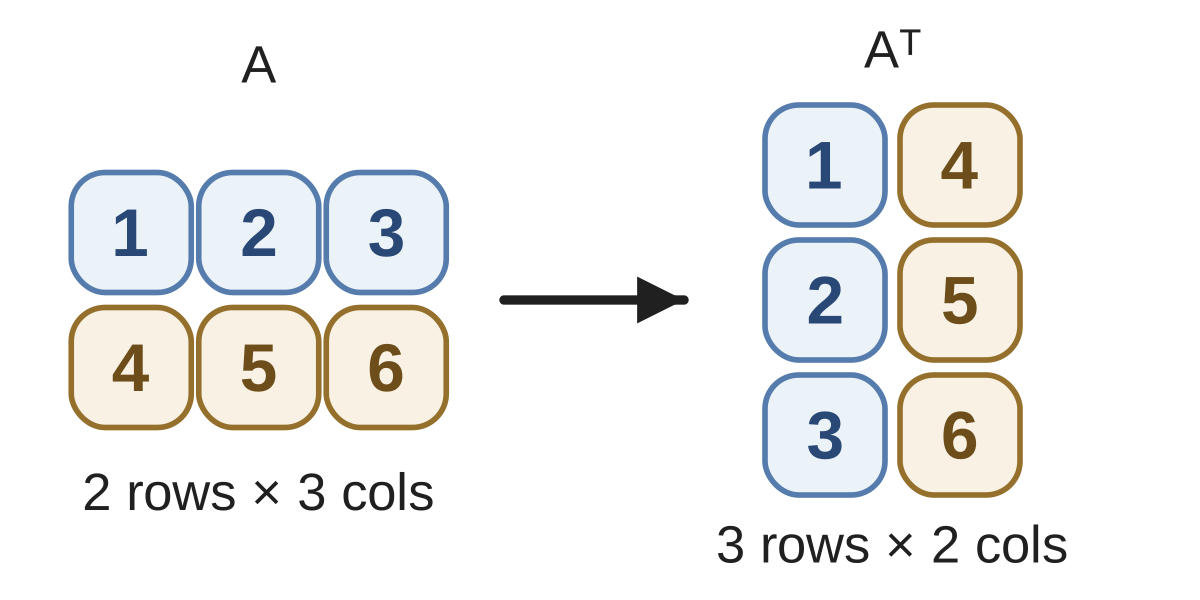
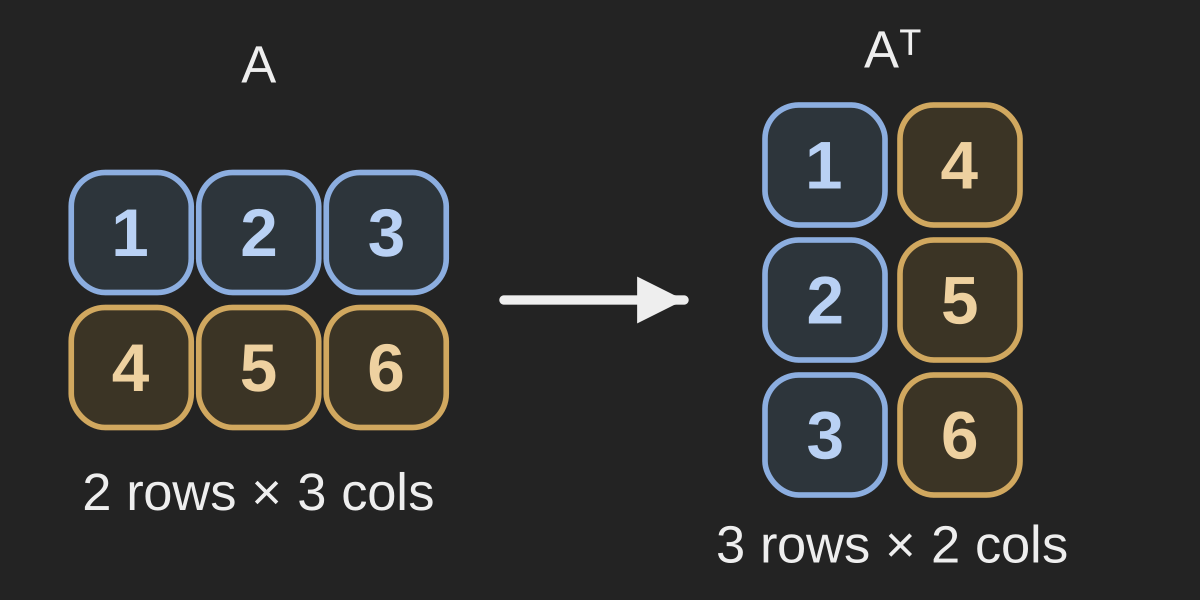
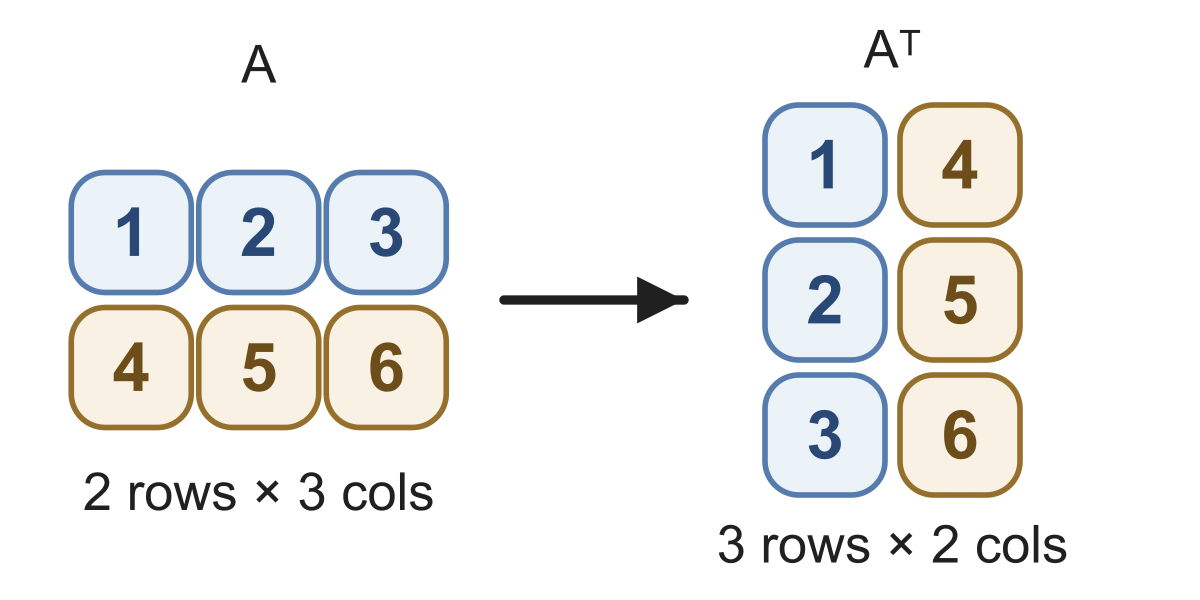
For , the first row becomes the first column. The second row becomes the second column.
Transpose the single row . Choose the new rows.
Show answer and explanation
Keep the order: 2 above 5.
02The superscript T names the transpose#
The superscript T names the transpose. Entry starts in row i, column j. In the transpose it occupies row j, column i, so a value at (1,3) moves to (3,1).
A has 2 rows and 3 columns. What shape should replace a claimed transpose?
Show answer and explanation
The three original columns become three rows.
03A table can store items as rows and measurements as columns#
A table can store items as rows and measurements as columns. Transposing makes each measurement a row, with the item values still in their original order. No averaging or arithmetic is needed.
Columns: hits, misses. Rows: U (3,1); V (2,0). Choose the transposed rows, hits first.
Show answer and explanation
Keep U, V order: hits (3,2); misses (1,0).
Move entry (i,j) to (j,i). Each original row becomes a column in the same order.
- Transpose a rectangular matrix.
Sources & further reading
- [1]Goodfellow, Bengio and Courville: Deep Learning, 2.1–2.2 ↗Goodfellow, Bengio and Courville · Book