Descent directions
A negative gradient-direction dot product identifies first-order descent at a differentiable interior point.
On this page 8 sections
01Understand the idea#
A descent direction is a proposed movement that decreases a differentiable objective locally. The gradient tells you how the objective responds to a small move. Taking its dot product with the proposed direction combines the effect of changing all coordinates together.
A direction’s first-order change is the gradient dot product with that direction. At a differentiable interior point:
For positive step size η, a negative dot product gives descent when the step is sufficiently small.
With gradient (3,−2) and direction (−1,2), the products sum to −7.
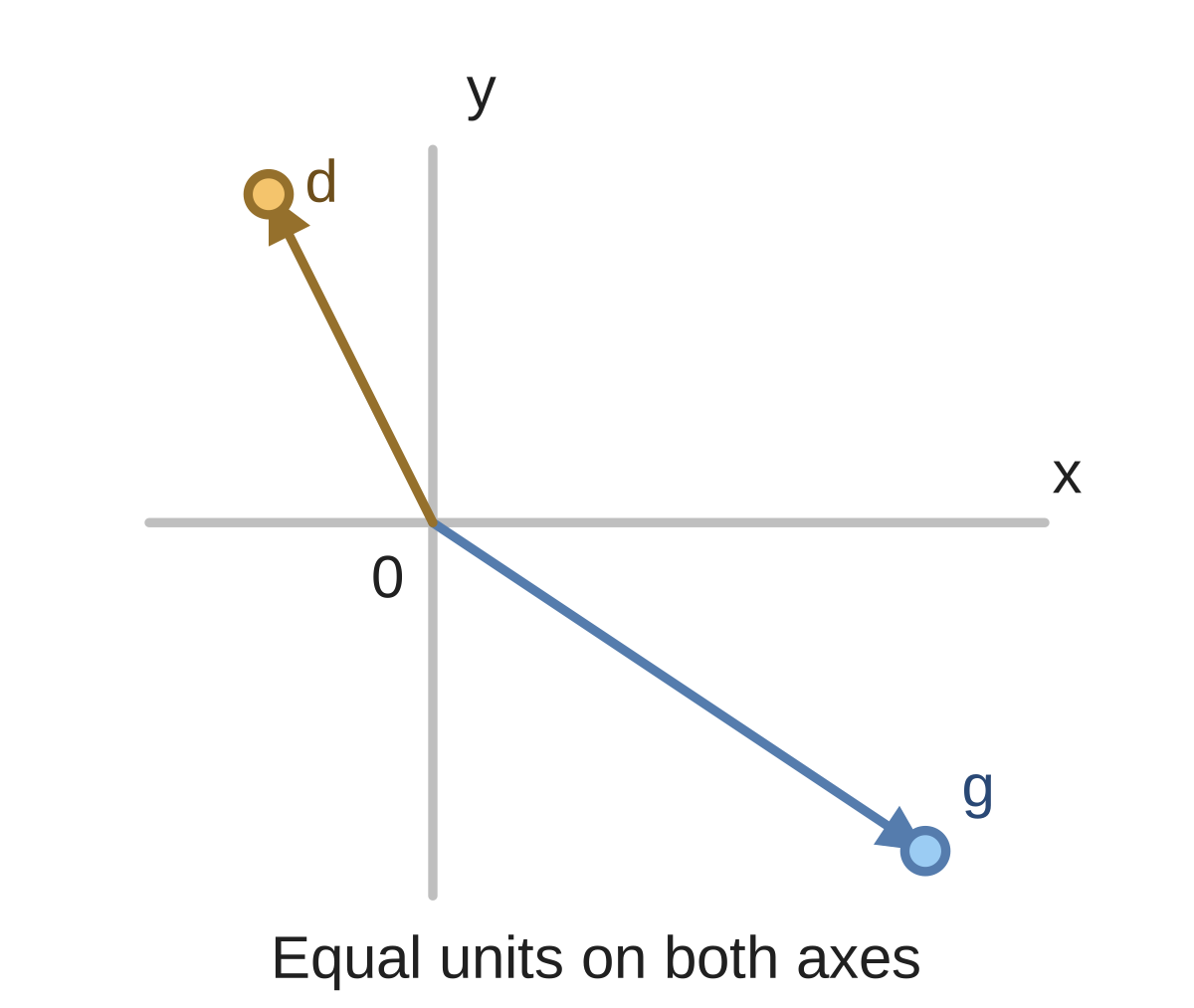
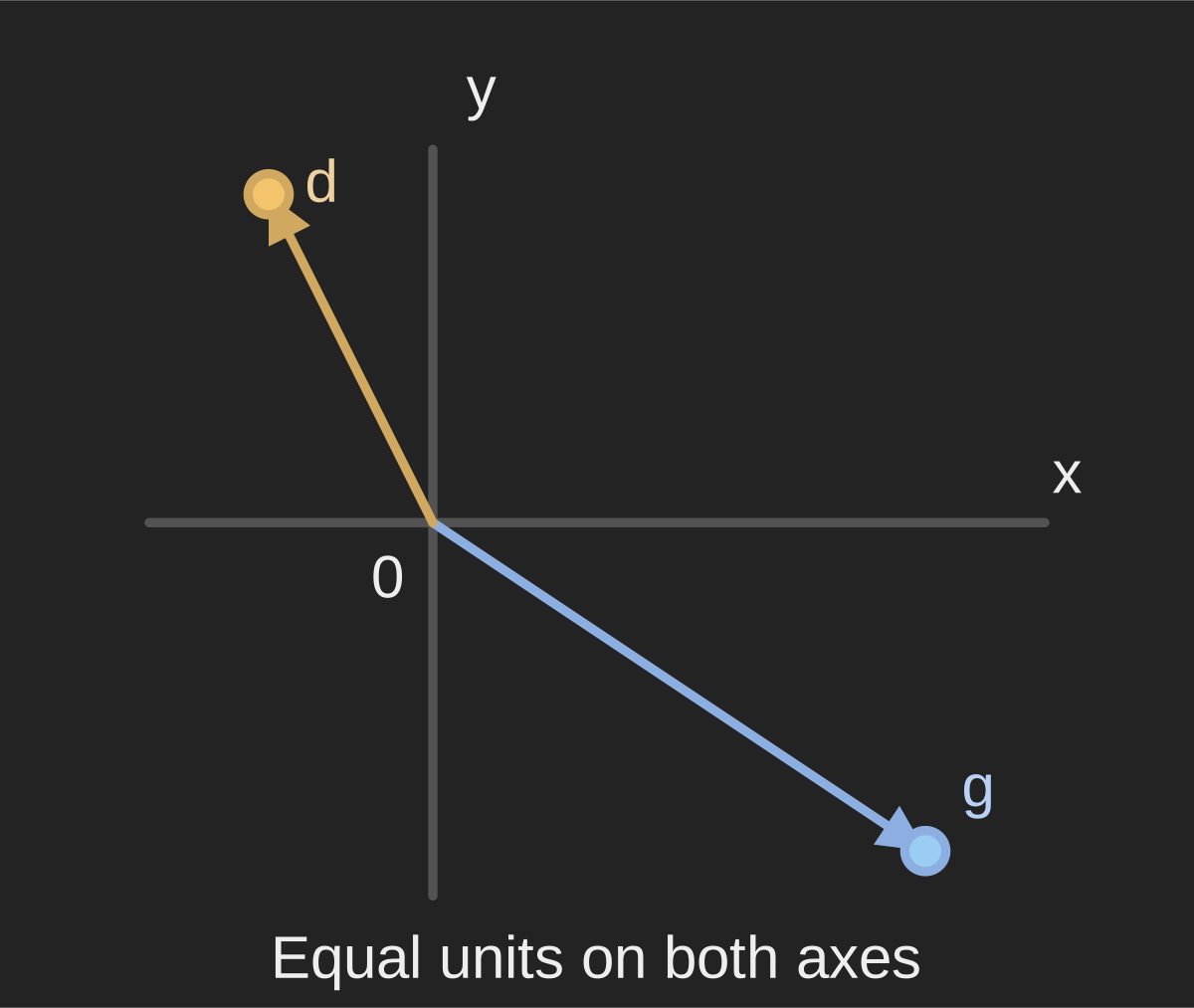
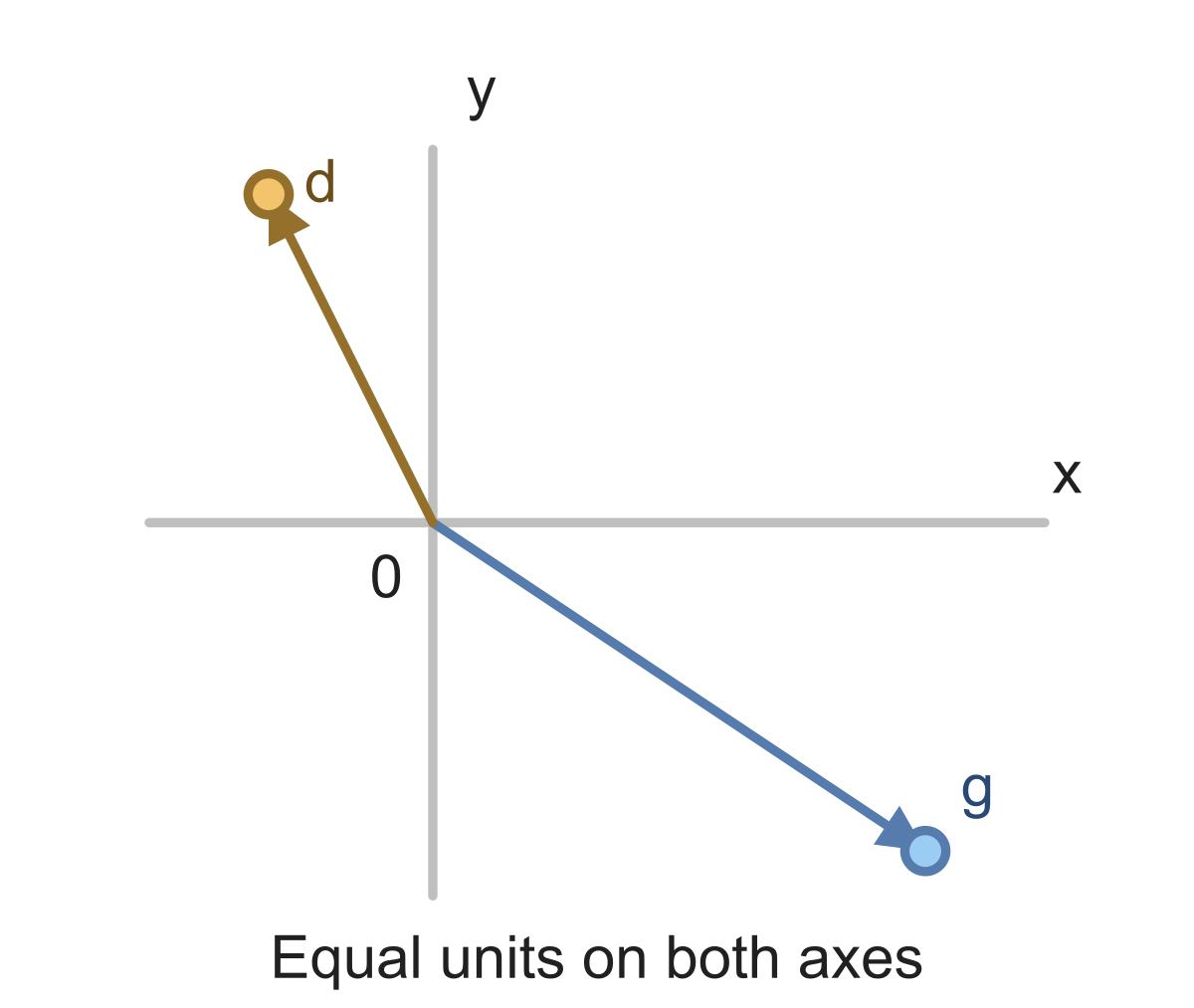
For gradient and direction , . The negative value predicts a decrease for a sufficiently small positive step. Reversing gives a positive dot product and predicts an increase. A zero dot product leaves the first-order test inconclusive.
At a smooth interior point, gradient , direction . Compute .
Show answer and explanation
4×(-1)+(-2)×(-1)=-2.
02In a local linear model, the variable coefficients are the gradient components#
In a local linear model, the variable coefficients are the gradient components. Its constant term contributes no change.
Pair each coefficient with the matching direction component, then sum the products.
Local linear model: . For , find its change per unit step.
Show answer and explanation
2×(1)+(4)×(-1)=-2.
03Zero dot product makes this directional test inconclusive#
Zero dot product makes this directional test inconclusive. Curvature may still raise or lower the objective along that direction.
A descending direction guarantees improvement only for sufficiently small positive steps. A large step can overshoot.
At a differentiable interior point, , . Draft: no decrease. For positive steps?
Show answer and explanation
Dot product: −3.
04A closer look#
This test helps decide whether a proposed update points downhill before choosing a step length. It does not say every distance along that direction is safe. Curvature can make a large step increase the objective even when its initial direction is downhill.
Compute the dot product: negative gives small-step descent, positive gives increase and zero is inconclusive.
- Check whether a direction has a negative first-order objective change.
Sources & further reading
- [1]Dive into Deep Learning §12.3.2 ↗Dive into Deep Learning §12.3.2 · Article