First-order optimality
A differentiable interior local minimum must have zero gradient.
On this page 8 sections
01Understand the idea#
At a smooth unconstrained local minimum inside the domain, no sufficiently small movement can improve the objective to first order. The gradient must therefore be zero. This gives candidate points to investigate, rather than an automatic certificate of a minimum.
At a differentiable interior local minimum, the gradient must be zero. Each partial derivative must vanish.
This condition supplies candidates. You still need evidence to classify a stationary point.
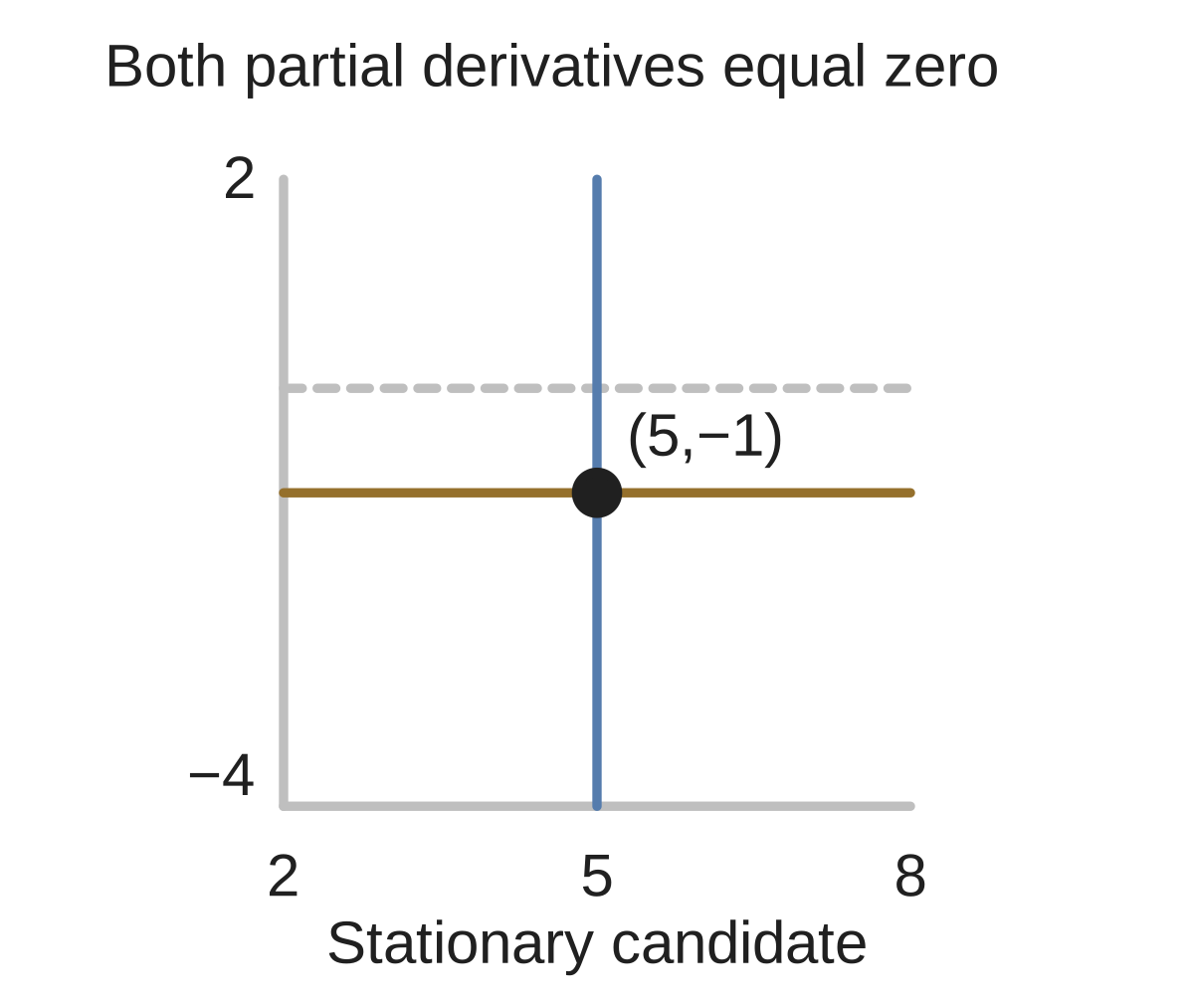
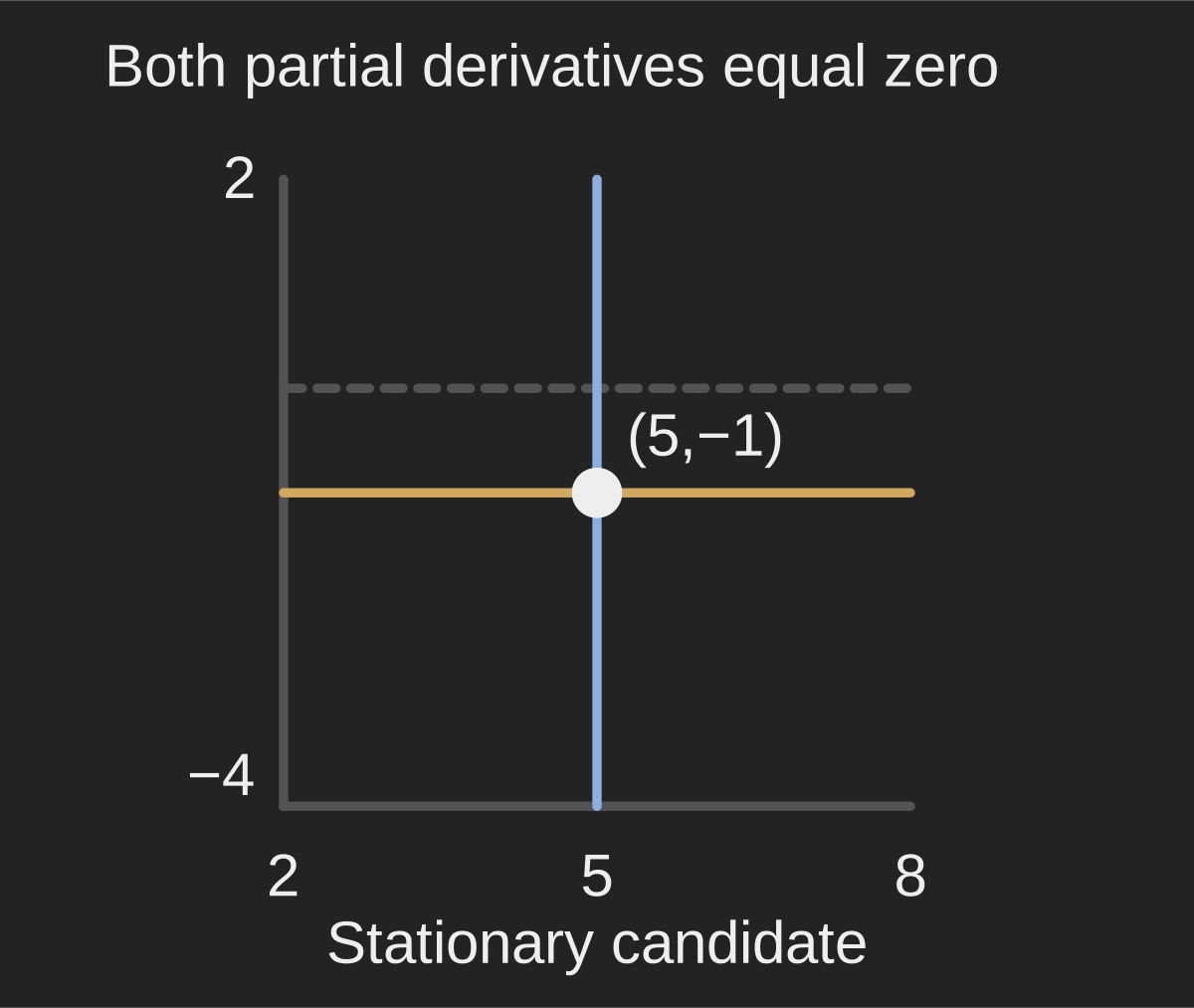
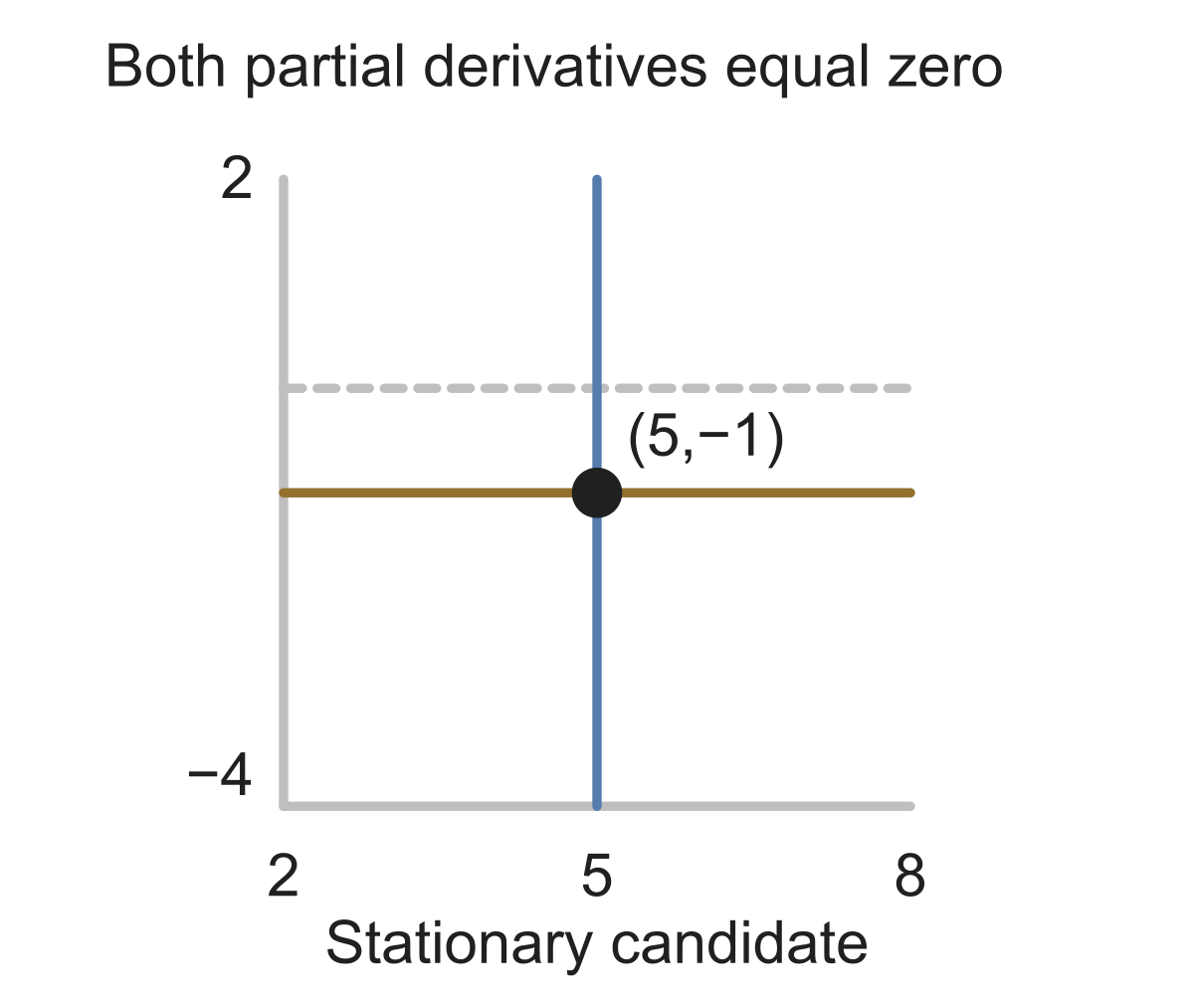
Set both components of (2x−10,4y+4) to zero. Solving gives the stationary candidate (5,−1).
For , the derivative vanishes at 2 and the square is minimized there. For , the derivative also vanishes at 0, but moving either way lowers the function. The same zero-gradient condition can describe a minimum or a maximum.
. Find the stationary candidate (x,y).
Show answer and explanation
Set both components to zero: (x,y)=(3, -2).
02A closer look#
If a minimum location is specified but a coefficient is unknown, substitute that location into the derivative and set it to zero.
Keep the differentiable-interior assumptions explicit when using this necessary condition.
on the real line. If is an interior minimum, what must b equal?
Show answer and explanation
The derivative is 10x+b. At x=-1, zero requires b=10.
03A zero gradient can occur at a minimum, maximum or saddle point#
A zero gradient can occur at a minimum, maximum or saddle point. At a saddle, nearby points have both higher and lower values.
Boundary minima and nondifferentiable minima can fail the zero-gradient test because its assumptions do not apply.
has zero gradient at (0,0). A report calls it a minimum. Repair it.
Show answer and explanation
Along y: lower; x: higher.
04An optimizer often stops near a zero gradient#
An optimizer often stops near a zero gradient. To interpret that point, consider the objective and constraints. A boundary minimum can have a nonzero ordinary derivative because some improvement directions lie outside the allowed domain.
Set every gradient component to zero, then check classification and the interior/differentiability assumptions.
- Apply the zero-gradient necessary condition to a differentiable interior local optimum.
Sources & further reading
- [1]OpenStax Calculus Volume3 §4.7 ↗OpenStax Calculus Volume3 §4.7 · Article