Local and global optima
A local minimum compares a neighborhood; a global minimum compares the entire feasible domain.
On this page 7 sections
01A local minimum wins within some neighborhood of a decision#
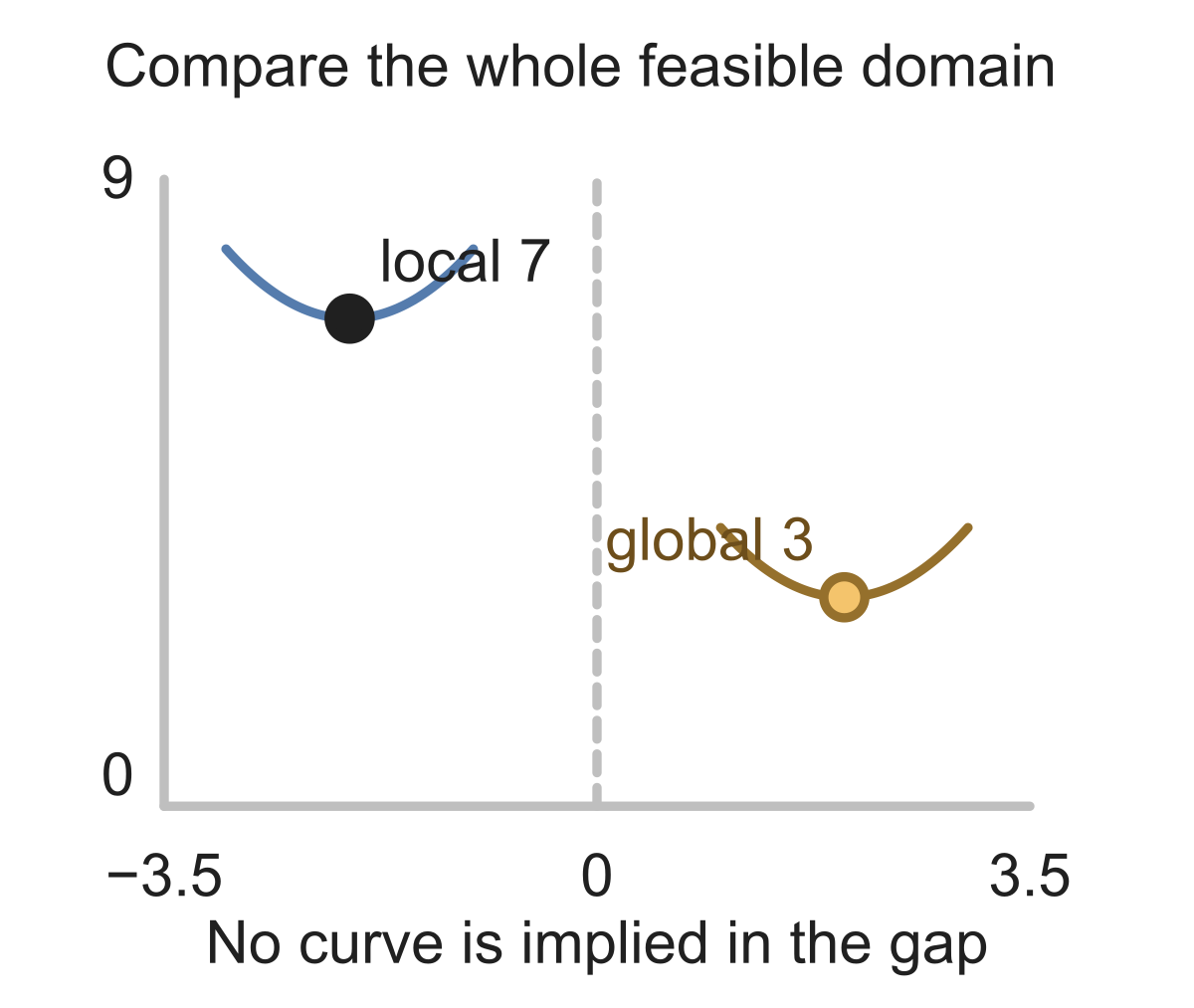
A local minimum wins within some neighborhood of a decision. A global minimum wins over the entire feasible domain.
Every global minimum is local. A local minimum can still have a better competitor farther away.
On , cost bottoms at 7. On , cost bottoms at 3.
![The feasible domain is [-3,−1] union [1,3]. On the left f=(x+2)²+7, with minimum 7 at −2. On the right f=(x−2)²+3, with minimum 3 at 2. The gap is not feasible and has no drawn function. The left minimum is local; the right is global.](/visuals/o-local-global/plane-1rsj7ry.svg)
![The feasible domain is [-3,−1] union [1,3]. On the left f=(x+2)²+7, with minimum 7 at −2. On the right f=(x−2)²+3, with minimum 3 at 2. The gap is not feasible and has no drawn function. The left minimum is local; the right is global.](/visuals/o-local-global/plane-1rsj7ry-dark.svg)
At feasible a, cost is 8. All feasible points cost at least 8; another ties. Classify a.
Show answer and explanation
Ties allow global minima.
02For separated quadratic branches, find the minimum within each interval#
For separated quadratic branches, find the minimum within each interval. Comparing the branch minima determines the best cost over their union.
Different branches may tie; global optimality does not require a unique decision.
Feasible x: . Left cost: ; right cost: . Classify .
Show answer and explanation
5 locally; 2 globally.
03A finite collection of trials is not an exhaustive continuous domain#
A finite collection of trials is not an exhaustive continuous domain. Winning those trials does not certify all untested points.
A whole-domain lower bound can certify global optimality. One lower-cost feasible counterexample can disprove it.
For on all real x, a report proves and calls x=0 global. Verdict?
Show answer and explanation
Every cost ≥ f(0)=0.
Identify the comparison domain and use actual bounds or counterexamples before claiming global optimality.
- Distinguish neighborhood optimality from optimality over the feasible set.
Sources & further reading
- [1]Boyd & Vandenberghe §4.1.1 ↗Boyd & Vandenberghe §4.1.1 · Article