Proximal gradient steps
For f(w)+λ||w||₁, proximal gradient takes u=w−η∇f(w) and applies soft thresholding at ηλ.
On this page 8 sections
01Understand the idea#
Proximal gradient separates two jobs in an objective: improve a smooth data loss, then handle a nonsmooth penalty. For an L1 penalty, that second job is soft thresholding. This avoids pretending that absolute value has an ordinary derivative at zero.
For an L1 proximal-gradient step, use η>0 and λ≥0. With smooth gradient g=∇f(w), take:
Then apply soft thresholding at ηλ to each coordinate: w′=S_(ηλ)(u).
For w=4, g=2, η=0.5 and λ=2, the smooth step gives u=3. Threshold 1 shrinks it to w′=2.
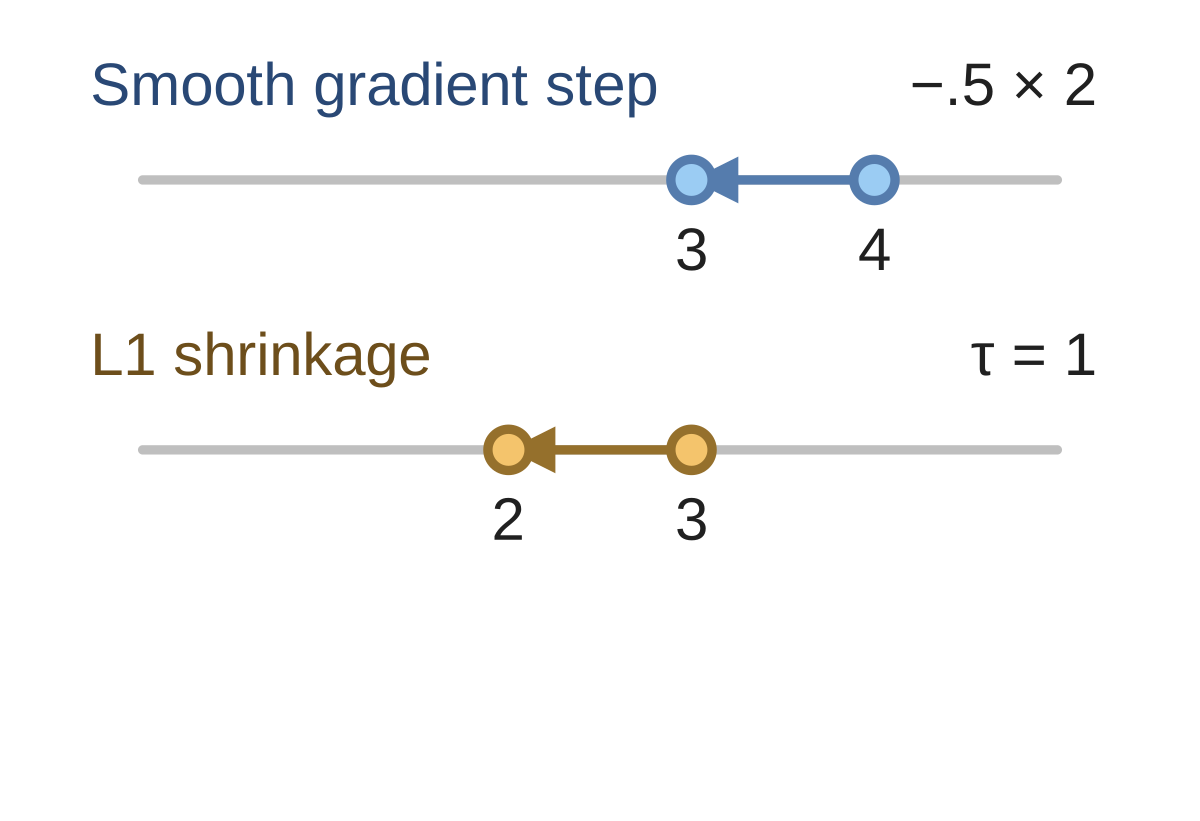
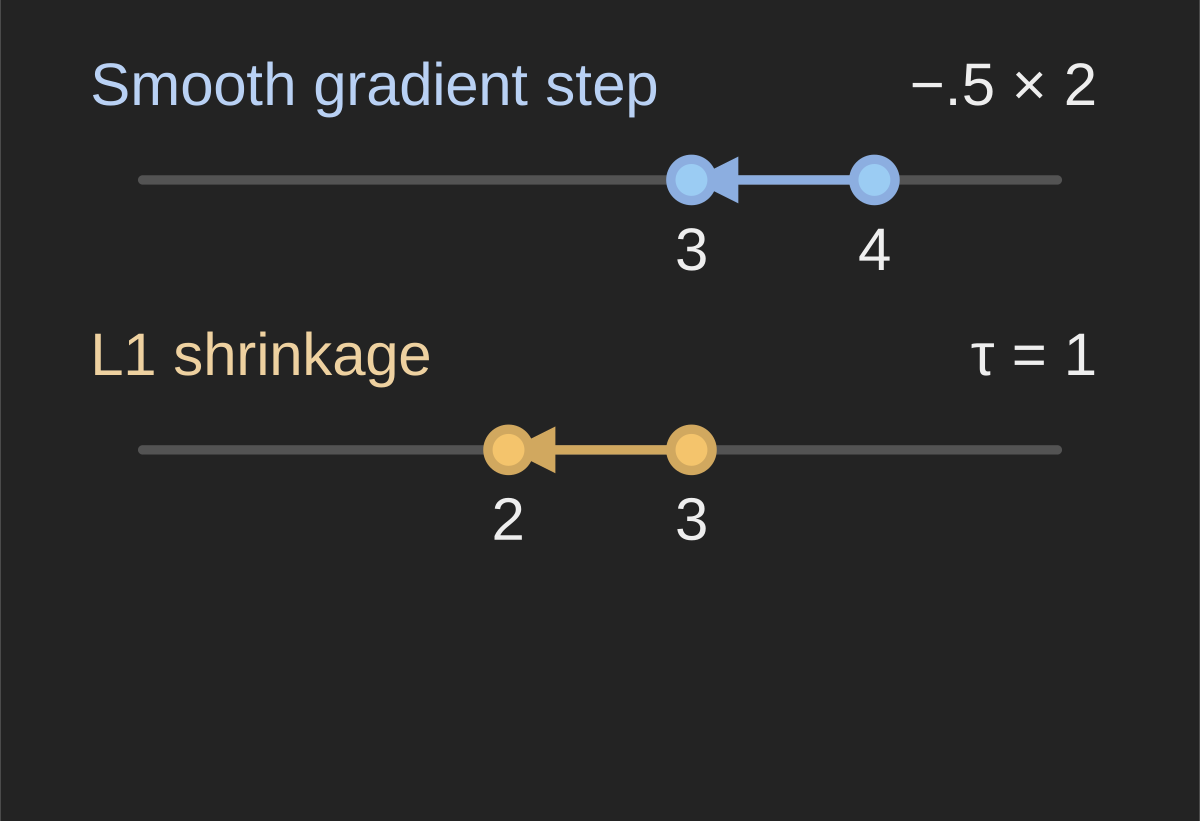
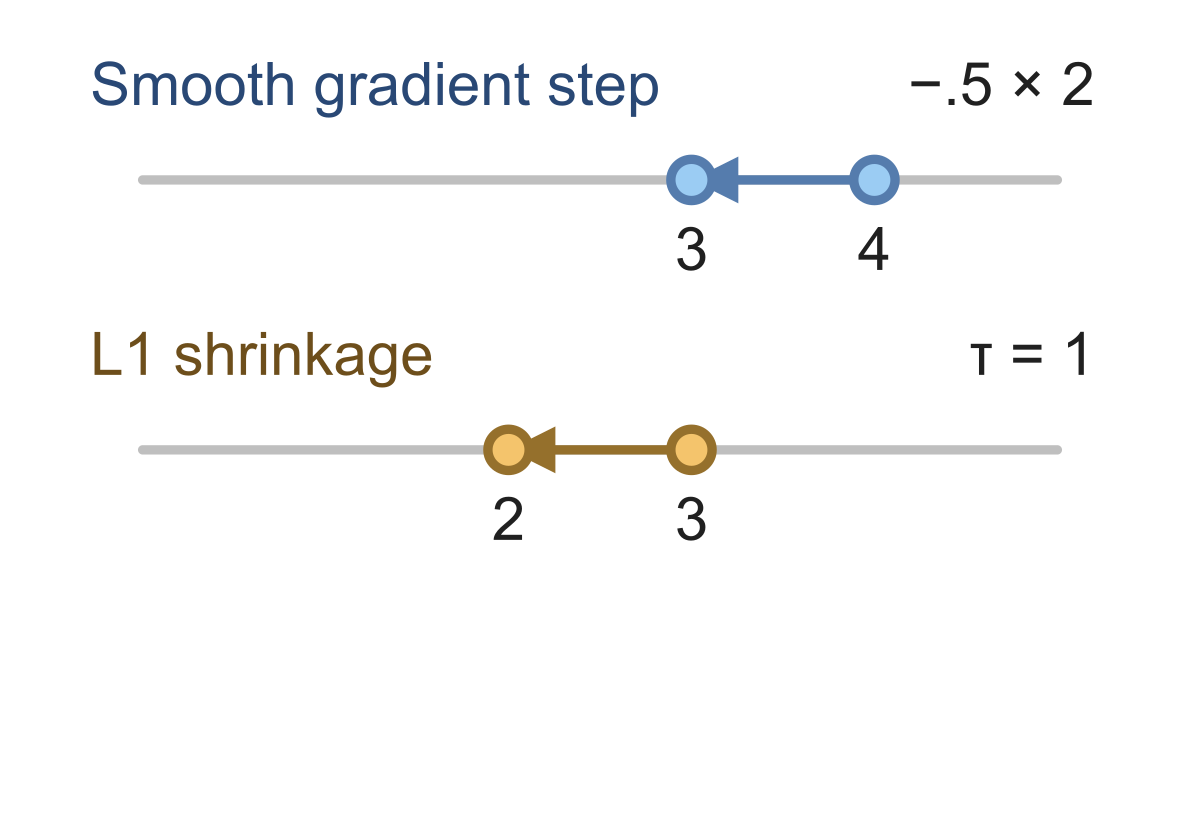
For , smooth gradient 2, rate 0.5, and penalty weight 2, first take the smooth step: . Compute threshold , then shrink 3 to 2. The intermediate 3 is not the final parameter, and using threshold would give the wrong final value.
For f(w)+λ||w||₁, use u=w−ηg then w′=S_(ηλ)(u), where g=∇f(w). (w,g,η,λ)=(4, 4, 0.5, 1). Find w′.
Show answer and explanation
u=2, threshold=0.5, output=1.5.
02For a vector, first compute every coordinate of u#
For a vector, first compute every coordinate of u. Then apply the same threshold ηλ to each scalar coordinate.
Some coordinates can become exactly zero while others survive. This is a proximal step for the stated L1 objective.
For f(w)+λ||w||₁, use u=w−ηg then w′=S_(ηλ)(u), where g=∇f(w). w=, g=, η=0.5, λ=2. Find w′.
Show answer and explanation
u=(3,−1.5); τ=1.
03The threshold is the product of step size and L1 penalty weight#
The threshold is the product of step size and L1 penalty weight. Using λ alone changes the update when η differs from one.
Keep the order: smooth-gradient step, then threshold. This avoids pretending the absolute-value penalty has an ordinary derivative at zero.
For f(w)+λ||w||₁, use u=w−ηg then w′=S_(ηλ)(u), where g=∇f(w). (w,g,η,λ)=(-4, -2, 0.5, 3). Draft uses threshold λ and gets 0. Correct w′.
Show answer and explanation
u=-3, threshold=1.5, output=-1.5.
04A closer look#
In a sparse regression update, apply the smooth step to all coefficients, then threshold each penalized coordinate. Some become exactly zero while others survive. The loss normalization, penalty weight, and learning rate all belong to the specified objective and update convention.
Take the smooth step first, compute the scaled threshold ηλ, then soft-threshold each coordinate.
- Compute a supplied proximal-gradient step for an L1-regularized objective.
Sources & further reading
- [1]Parikh & Boyd §4.2 equation4.6 and §6.5.2 equation 6.9 ↗Parikh & Boyd §4.2 equation4.6 and §6.5.2 equation 6.9 · Article