Soft thresholding
Soft thresholding subtracts τ from magnitude with a zero floor and preserves the sign of surviving values.
On this page 8 sections
01Understand the idea#
Soft thresholding moves a value toward zero by a chosen amount, stopping if it reaches zero. In sparse models, this operation can eliminate small coefficients entirely while reducing larger ones. It treats positive and negative values symmetrically by working with their magnitudes.
Soft thresholding shrinks a scalar’s magnitude by τ, stopping at zero. Let m be the remaining magnitude:
Use τ≥0 and sign(0)=0.
Input −5 with threshold 2 has magnitude 5. Shrink that magnitude to 3, then restore the negative sign to obtain −3.
![Soft threshold with tau=2 is S2(z)=sign(z)max(|z|−2,0). The graph is zero throughout [−2,2], then has slope 1 on both outer pieces. Input −5 returns −3.](/visuals/o-soft-threshold/plane-19uiq9j.svg)
![Soft threshold with tau=2 is S2(z)=sign(z)max(|z|−2,0). The graph is zero throughout [−2,2], then has slope 1 on both outer pieces. Input −5 returns −3.](/visuals/o-soft-threshold/plane-19uiq9j-dark.svg)
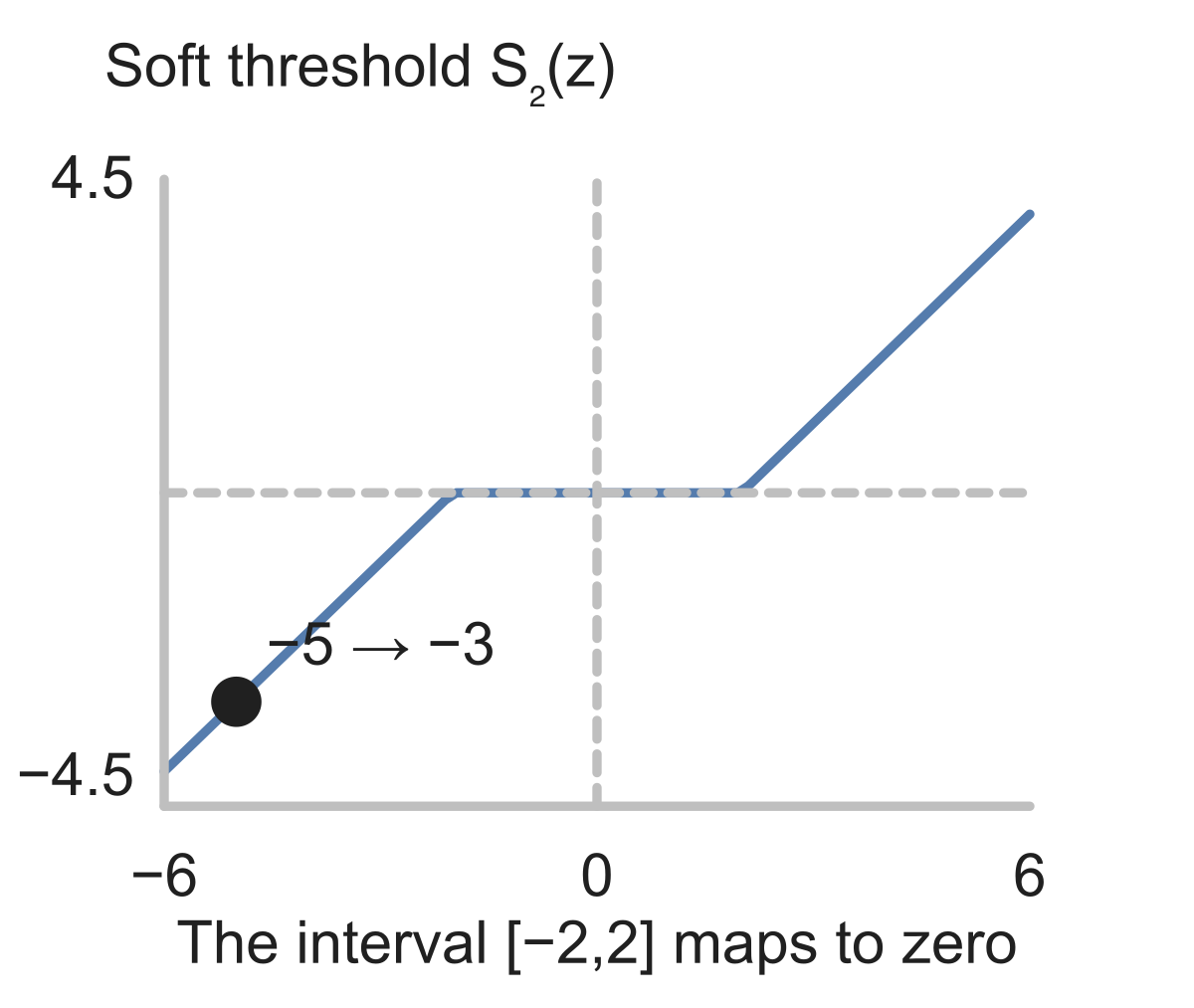
For input and threshold 2, start with magnitude 5. Subtract 2 to get 3, then restore the negative sign to obtain . For input with the same threshold, is negative, so clamp the remaining magnitude at zero. Do not let shrinkage cross zero and reverse the sign.
Sτ(z)=sign(z)max(|z|−τ,0). z=-7, τ=3. Find Sτ(z).
Show answer and explanation
Shrink magnitude to 4; output -4.
02A closer look#
If the output survives and keeps the input’s sign, the threshold equals the drop in magnitude. A nonzero output makes that threshold recoverable.
A zero output instead tells you only that the threshold was at least the input magnitude.
Sτ(z)=sign(z)max(|z|−τ,0). Input -8 gives nonzero output -5. Find τ.
Show answer and explanation
Threshold = |input|−|output| = 3.
03Soft thresholding is not clipping large values to ±τ#
Soft thresholding is not clipping large values to ±τ. It subtracts τ from their magnitudes and zeroes small values.
Never shrink past zero and flip the sign. The max with zero prevents that overshoot.
Sτ(z)=sign(z)max(|z|−τ,0). z=-2, τ=5. Draft output -2. Correct it.
Show answer and explanation
Shrink magnitude to 0; output 0.
04The flat zero region is why this operation can create sparse coefficient vectors#
The flat zero region is why this operation can create sparse coefficient vectors. It differs from clipping: clipping caps large magnitudes, whereas soft thresholding removes small ones and subtracts a fixed amount from larger ones. The next lesson uses it after a gradient step.
Compare magnitude with τ; zero it if small, otherwise shrink the magnitude without flipping sign.
- Apply a supplied soft-thresholding operator to one scalar coordinate.
Sources & further reading
- [1]Parikh & Boyd §6.5.2 equation 6.9 ↗Parikh & Boyd §6.5.2 equation 6.9 · Article