Exponential derivatives
An exponential changes at a rate proportional to its current value.
On this page 7 sections
01A rate proportional to the value#
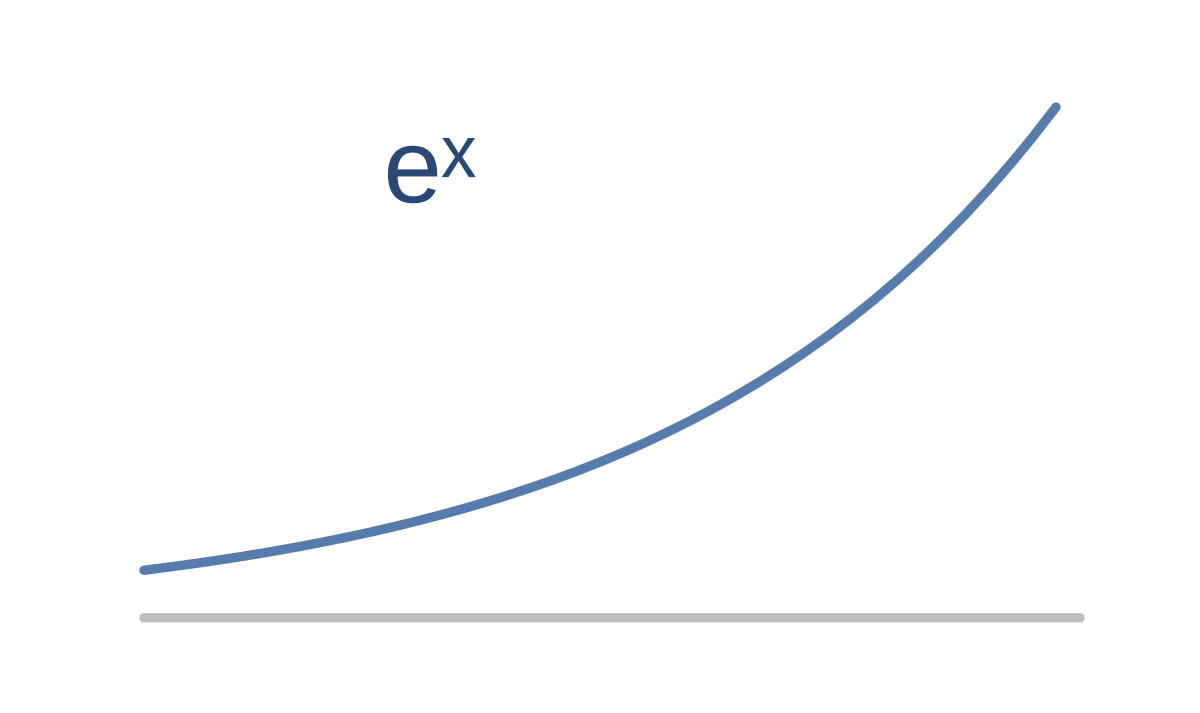
An exponential changes at a rate proportional to its current value. This is why exponentials appear in growth models and in the scores that become ML probabilities. The constant base determines the proportionality factor.
For the natural exponential , the derivative equals the function: . At , its value and slope are both . At a larger input, both are larger.
A different positive base has a different rate. Write and use the chain rule. The inner derivative contributes :
02Include the inner change#
For , the outer exponential contributes , and the inner function contributes .
At , the derivative is , not .
What is the derivative of ?
Show answer and explanation
The chain rule multiplies the exponential by the inner derivative 3.
Likewise, has derivative . Its values stay positive but decrease as increases. The minus sign describes the direction of change, not the sign of the function.
03Check the base#
For a constant base , the real exponential rule applies for all real inputs. When , the function is constant and the derivative is zero because . For , and the function decreases.
Which function needs an exponential derivative rule rather than the constant-power rule?
Show answer and explanation
In 4 to the x, the exponent varies and the base stays constant.
Do not use the power rule as if the exponent were a fixed number. In , the base varies. In , the exponent varies. That distinction determines which derivative rule you need.
Differentiate an exponential function with a constant base.
- Differentiate an exponential function with a constant base.
Sources & further reading
- [1]OpenStax Calculus Volume 1, §3.9 ↗openstax.org · Article