Corners and cusps
Differentiability fails when the one-sided difference quotients do not approach the same finite value.
On this page 7 sections
01For , both branches meet at #
For , both branches meet at . The graph is continuous there, but it has a corner.
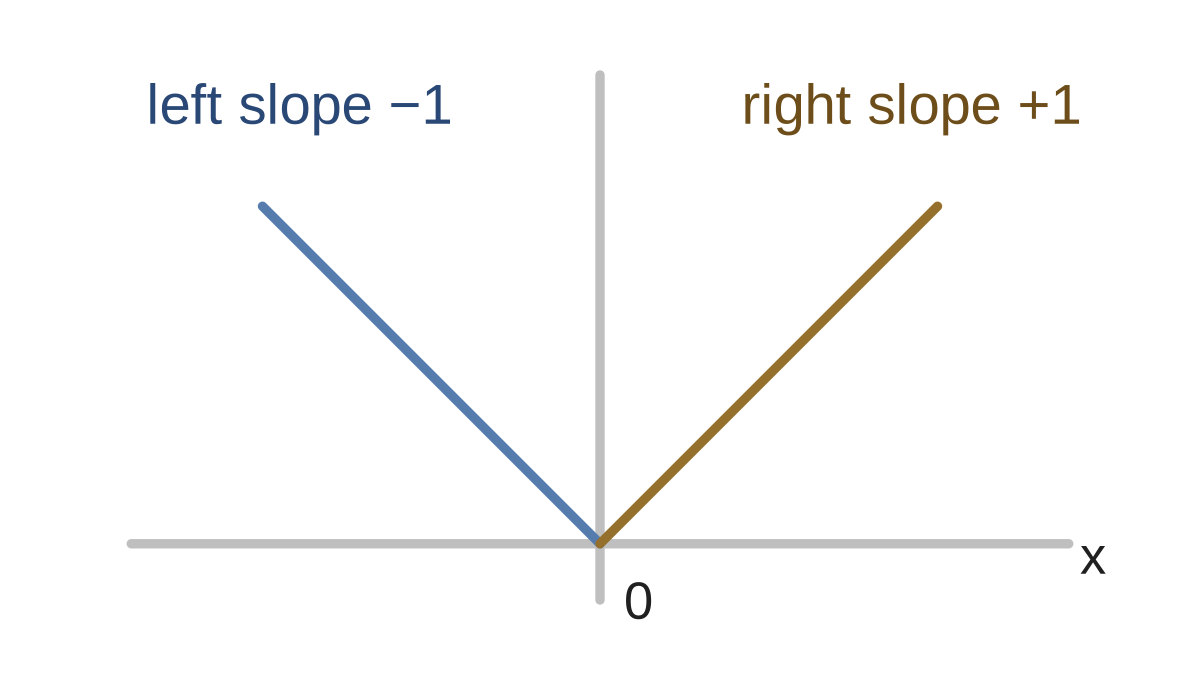
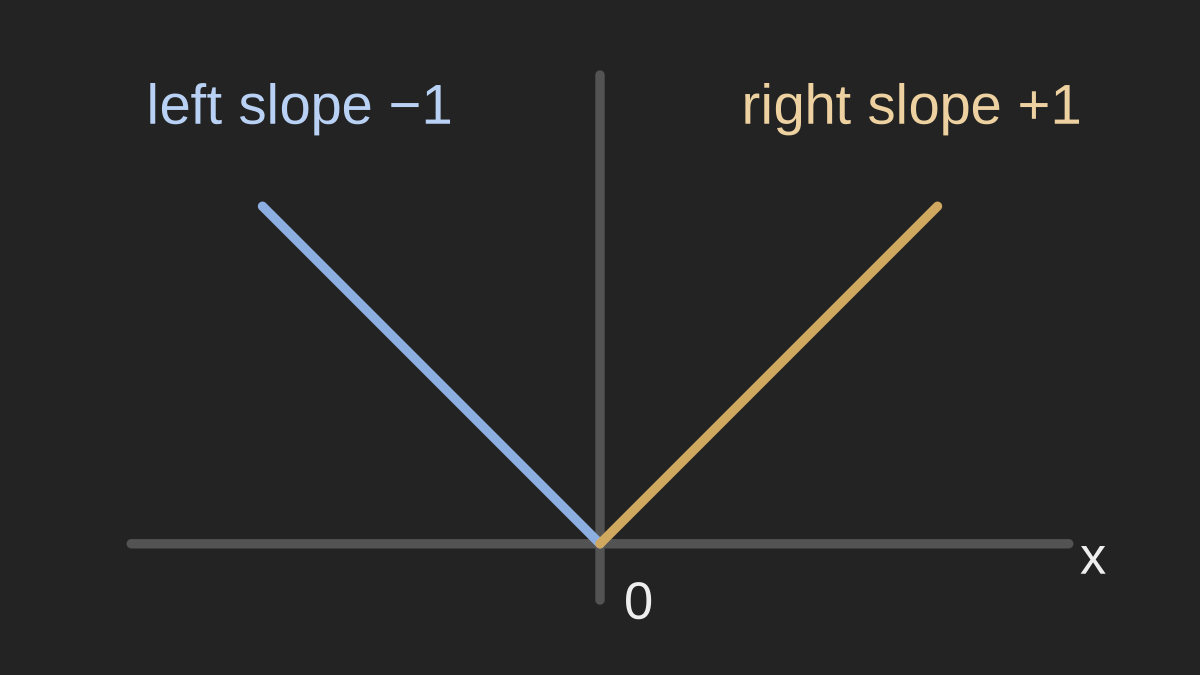
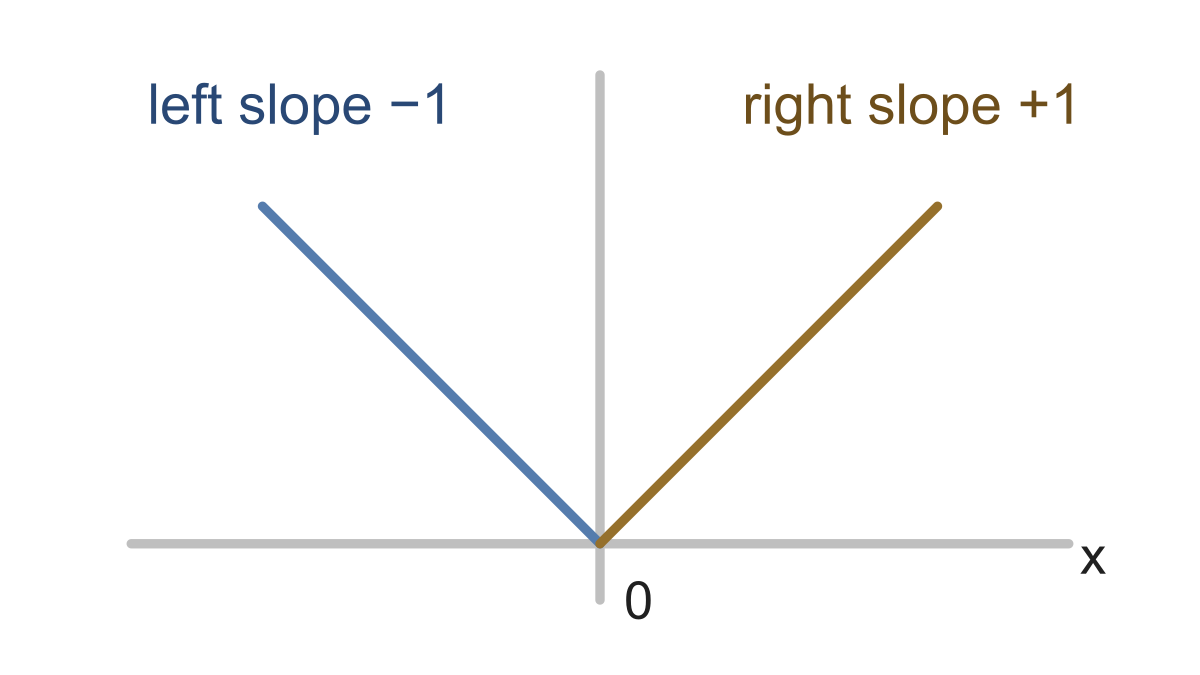
For at , the quotient is . Negative gives ; positive gives .
The limits disagree. Their average is not a derivative.
Difference quotient: for ; for . Derivative?
Show answer and explanation
The side limits differ.
02A cusp can have unbounded opposite slopes#
A cusp can have unbounded opposite slopes. For at , the quotient on the right is .
As , its positive denominator shrinks toward zero, so the quotient grows without bound.
For at , negative gives . Its positive denominator shrinks toward zero, so decreases without bound.
At a response join, limiting secant rates are left and right . One instantaneous rate?
Show answer and explanation
Both limits equal .
03A derivative requires the same finite limiting slope from both sides#
A derivative requires the same finite limiting slope from both sides. Unequal finite limits produce a corner. Opposite unbounded limits produce a cusp. Continuity alone does not decide differentiability.
Difference-quotient limits at : left , right . Claim: derivative . Repair.
Show answer and explanation
No finite slope exists.
Compare both limiting slopes; they must agree and be finite.
- Diagnose failure of differentiability from unequal one-sided slopes.
Sources & further reading
- [1]OpenStax Calculus Volume 1, 3.2 The Derivative as a Function ↗OpenStax Calculus Volume 1 · Book