Skip to content
Glacius
CalculusConcept reference

Derivative definition

The derivative at a point is the finite two-sided limit of its difference quotient.

On this page 7 sections
  1. Overview
  2. At input a, the difference quotient Q(h) compares nearby outputs
  3. The exact quotient Q(h)=4+h approaches 4 from either side
  4. Check your understanding
  5. Key takeaway
  6. Sources & further reading
  7. Concept connections

01At input a, the difference quotient Q(h) compares nearby outputs#

At input aa, the difference quotient Q(h)Q(h) compares nearby outputs. Keep h0h\ne0 while forming it:

f(a+h)f(a)h\frac{f(a+h)-f(a)}h

The derivative is the finite two-sided limit f(a)=limh0Q(h)f\prime(a)=\lim_{h\to0}Q(h).

For f(x)=x2f(x)=x^2 at a=2a=2, expand (2+h)2=4+4h+h2(2+h)^2=4+4h+h^2. Subtract f(2)=4f(2)=4 to get the output change:

4h+h24h+h^2

For f(x)=x2f(x)=x^2 at 22, divide its increment 4h+h24h+h^2 by h0h\ne0. Cancel the shared factor, then take the limit.

Q(h)=4+h  4Q(h)=4+h\ \longrightarrow\ 4

Thus f(2)=4f\prime(2)=4. Substituting zero before canceling would leave 0/00/0.

Check your reasoning

f(x)=x2+2x+1f(x)=x^{2}+2x+1, a=1a=1. Find the quotient Q(h)Q(h) and slope.

  1. AQ=4Q=4; slope 44.
  2. BQ=4+hQ=4+h; slope 44.
  3. CQ=2+hQ=2+h; slope 22.
Show answer and explanation
Q=4+hQ=4+h; slope 44.

For h0h\ne0, Q=4+h4Q=4+h\to 4.

02The exact quotient Q(h)=4+h approaches 4 from either side#

The exact quotient Q(h)=4+hQ(h)=4+h approaches 44 from either side. Samples illustrate this; the simplified formula establishes the limit.
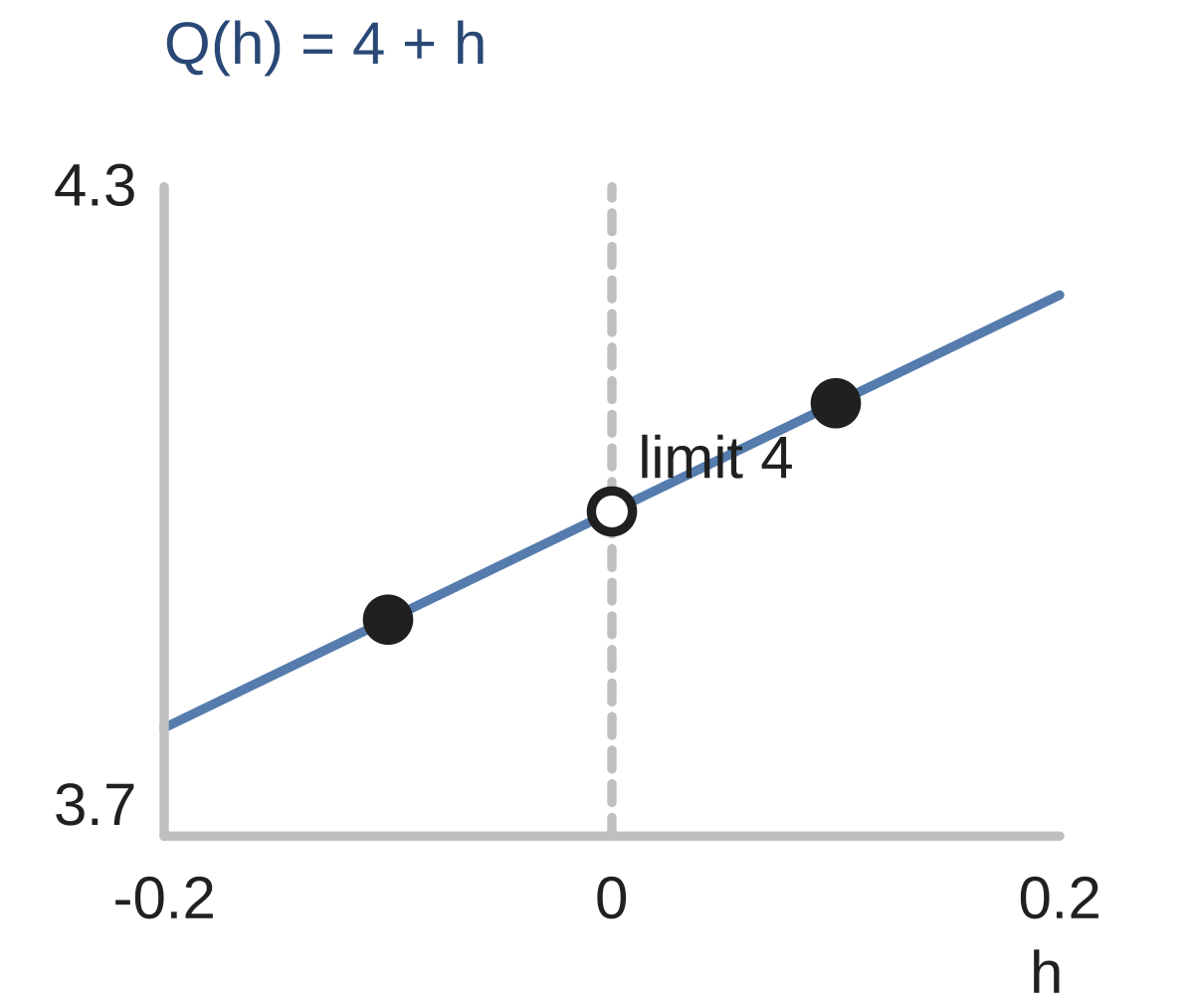
For nonzero h, Q(h)=4+h. Values at h=−.1 and .1 are 3.9 and 4.1. The open point at (0,4) marks the limiting quotient, with h=0 excluded from the original difference quotient.For nonzero h, Q(h)=4+h. Values at h=−.1 and .1 are 3.9 and 4.1. The open point at (0,4) marks the limiting quotient, with h=0 excluded from the original difference quotient.
Figure 1For nonzero h, Q(h)=4+h. Values at h=−.1 and .1 are 3.9 and 4.1. The open point at (0,4) marks the limiting quotient, with h=0 excluded from the original difference quotient.
Link to this figure ↗Download SVGDownload PNG
Check your reasoning

A response changes by Δy=5h2h2\Delta y=5h-2h^{2}. Find limh0Δy/h\lim_{h\to0}\Delta y/h.

Show answer and explanation
5

Divide by hh: 52h55-2h\to5.

03Check your understanding#

Check your reasoning

f(x)=x2x+4f(x)=x^{2}-x+4, a=3a=3. Claim: set h=0h=0 first. Repair the quotient and derivative.

  1. AQ=5Q=5; slope 55.
  2. BQ=6+hQ=6+h; slope 66.
  3. CQ=5+hQ=5+h; slope 55.
Show answer and explanation
Q=5+hQ=5+h; slope 55.

For h0h\ne0, Q=5+h5Q=5+h\to 5.

Key takeaway

Simplify with a nonzero increment, then take its limit.

  • Compute a simple derivative from a difference-quotient limit.

Sources & further reading

  1. [1]

Reference this concept

Link to this page, a section, or an individual figure.

Glacius. “Derivative definition.” Math behind ML. /learn/c-derivative-limit