Total differentials
A scalar function’s gradient has one partial derivative per input coordinate.
On this page 7 sections
01Add the local effects of several changes#
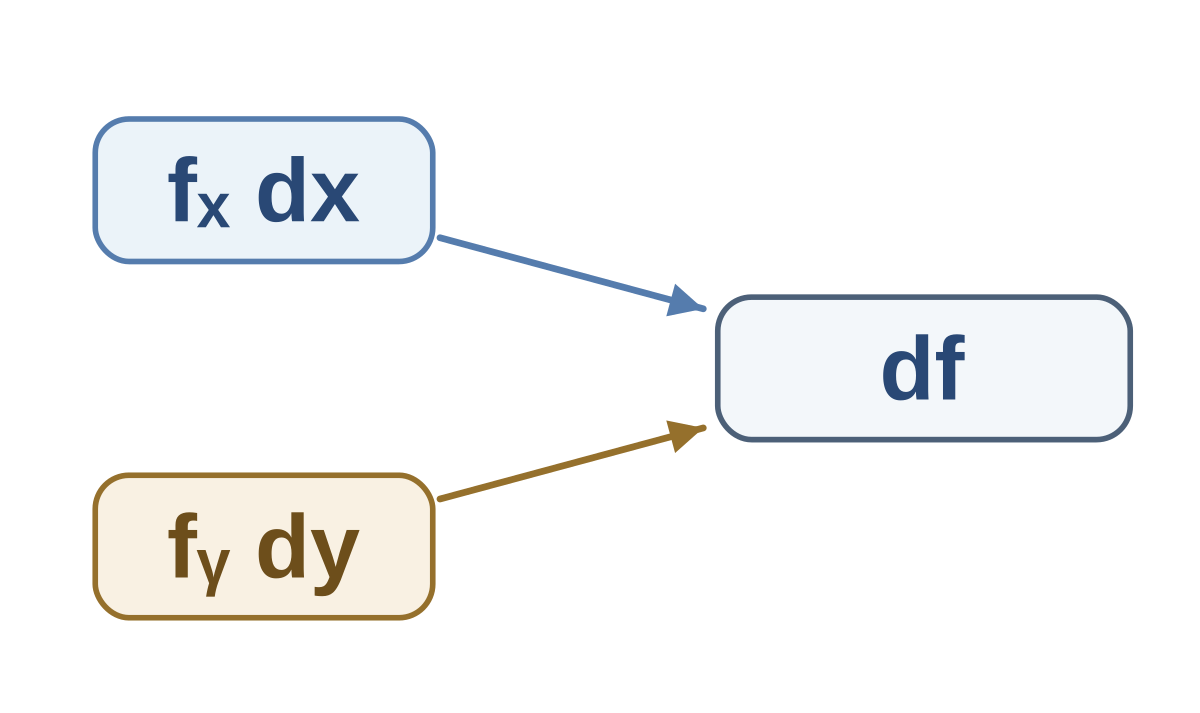
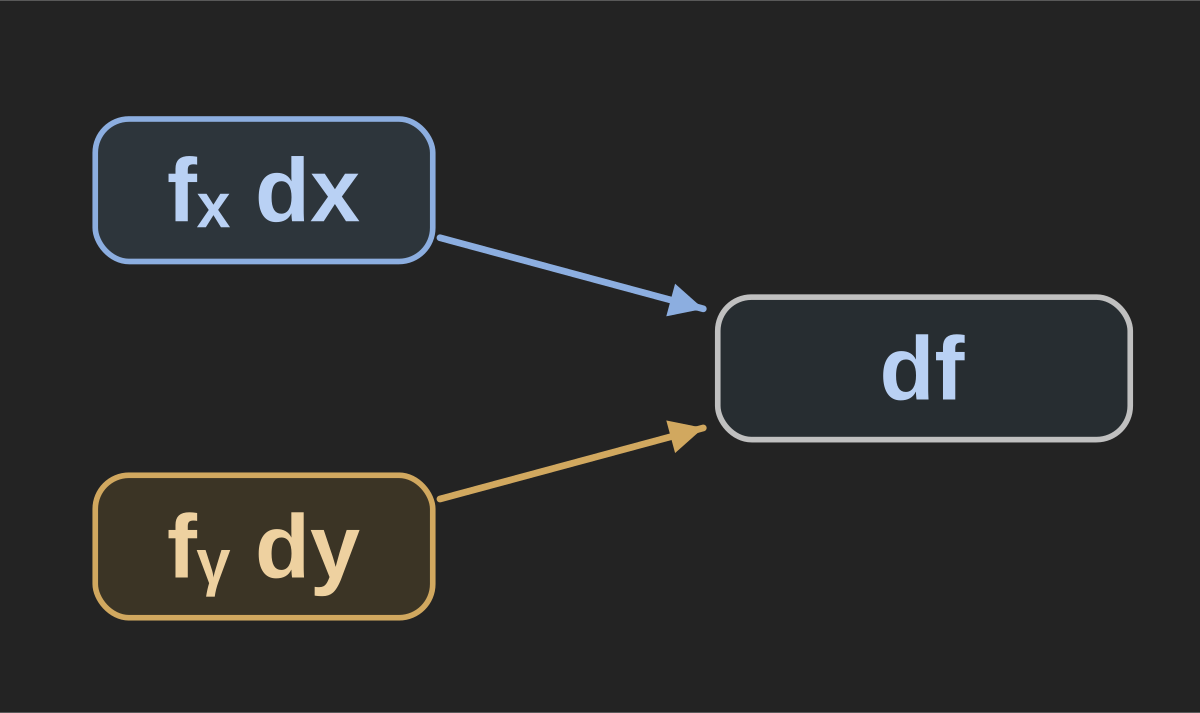
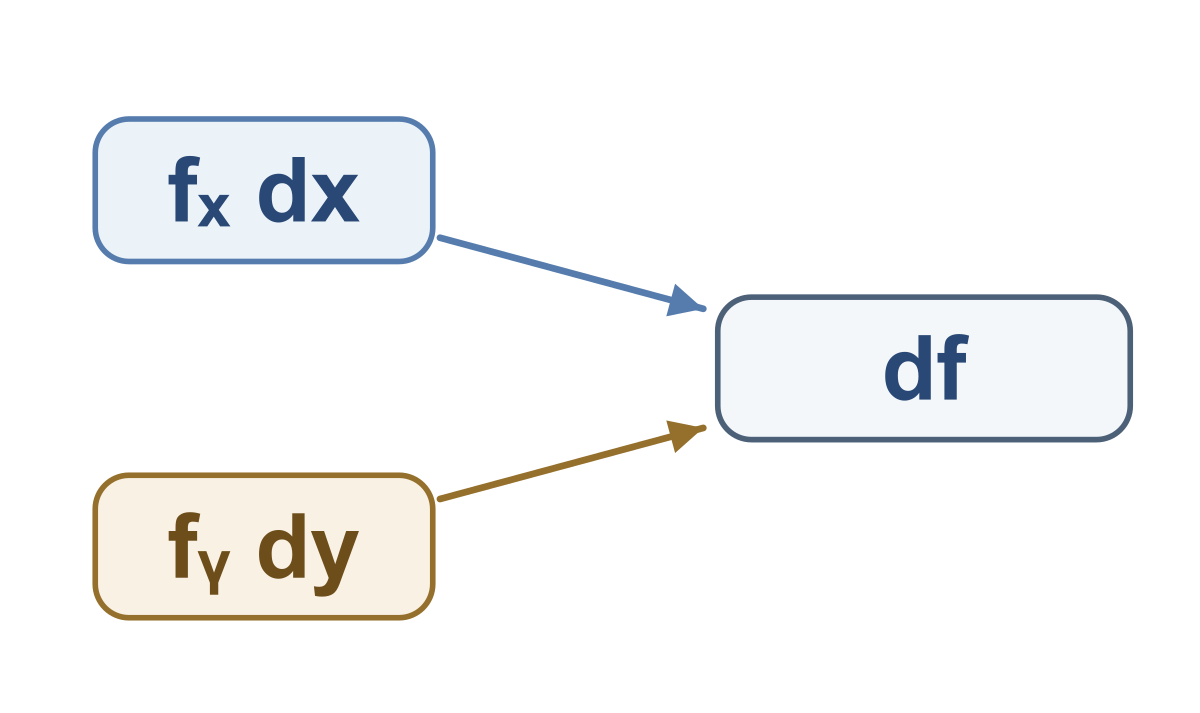
A scalar function’s gradient has one partial derivative per input coordinate. Each partial derivative predicts that coordinate’s contribution to a small output change. Add the contributions:
This extends scalar linearization: one slope times one displacement becomes a dot product of sensitivities and coordinate displacements. Both vectors must use the same coordinate order.
02Compute the change, then the new value#
Let . At , its value is and gradient is . For perturbation , the first contribution is and the second is .
The estimated new value is . The exact value at is . The difference of comes from the quadratic term in the first input change.
The gradient is (2,−3) and a small perturbation is (0.1,0.2). Estimate the scalar change.
Show answer and explanation
The dot product is 0.2−0.6=−0.4.
03Local cancellation#
If the dot product is zero, the first-order estimate is zero. The exact change can still be nonzero. At , has zero gradient, but moving to increases it by .
A draft multiplies the two partial effects 0.2 and −0.3. What is their total first-order change?
Show answer and explanation
First-order coordinate contributions are added.
Use the gradient at the original point and report whether the requested quantity is the change or the new value. The formula is exact for affine functions and generally approximate for finite steps through nonlinear functions.
Estimate a scalar change from a small vector perturbation.
- Estimate a scalar change from a small vector perturbation.
Sources & further reading
- [1]MIT 6.390, Appendix A: Matrix Calculus ↗introml.mit.edu · Article
- [2]Boyd and Vandenberghe, Introduction to Applied Linear Algebra ↗stanford.edu · Article