Quantifiers
A universal claim requires a property for every member of a domain, whereas an existence claim requires at least one qualifying member.
On this page 7 sections
01A quantifier tells you how broadly a claim applies#
A quantifier tells you how broadly a claim applies. Compare two claims about a nonempty set of three files: “Every file opens” and “At least one file opens.” They ask for different evidence.
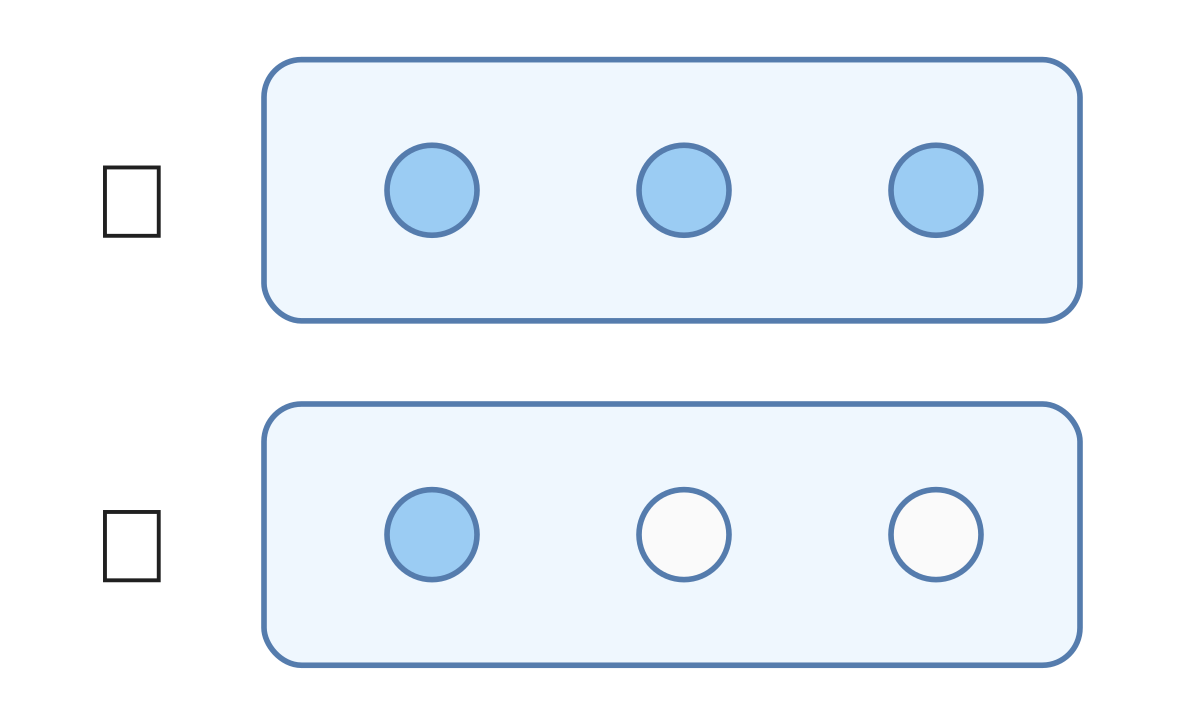
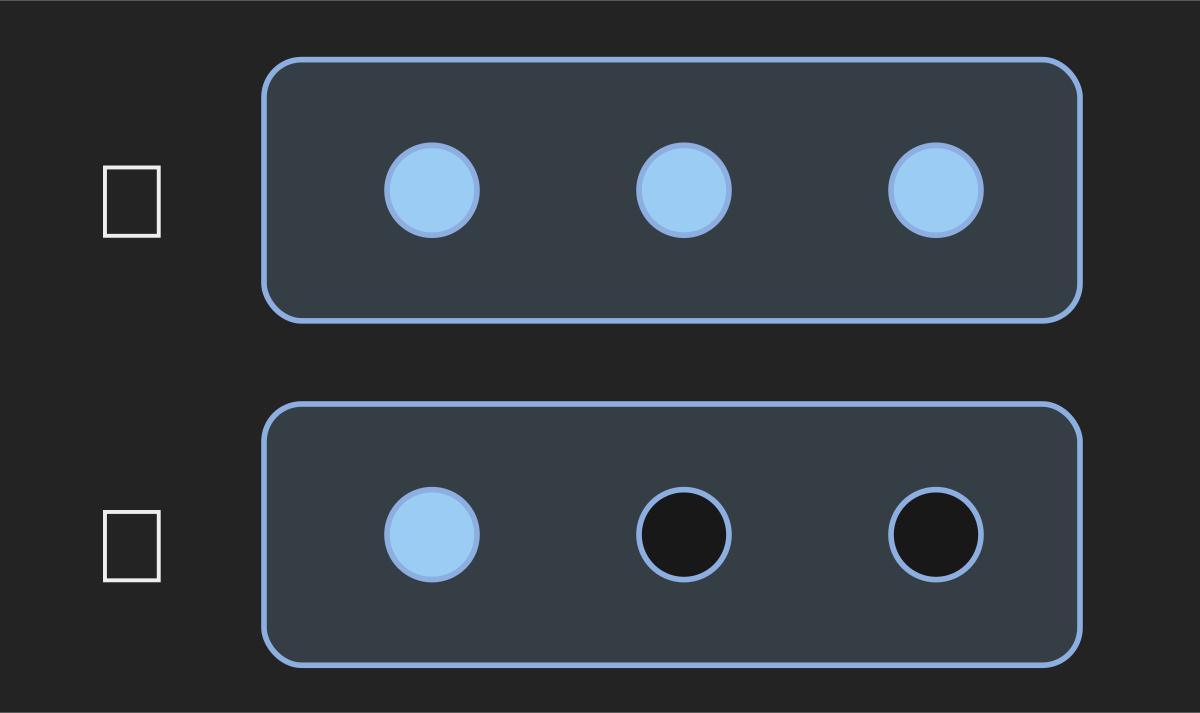
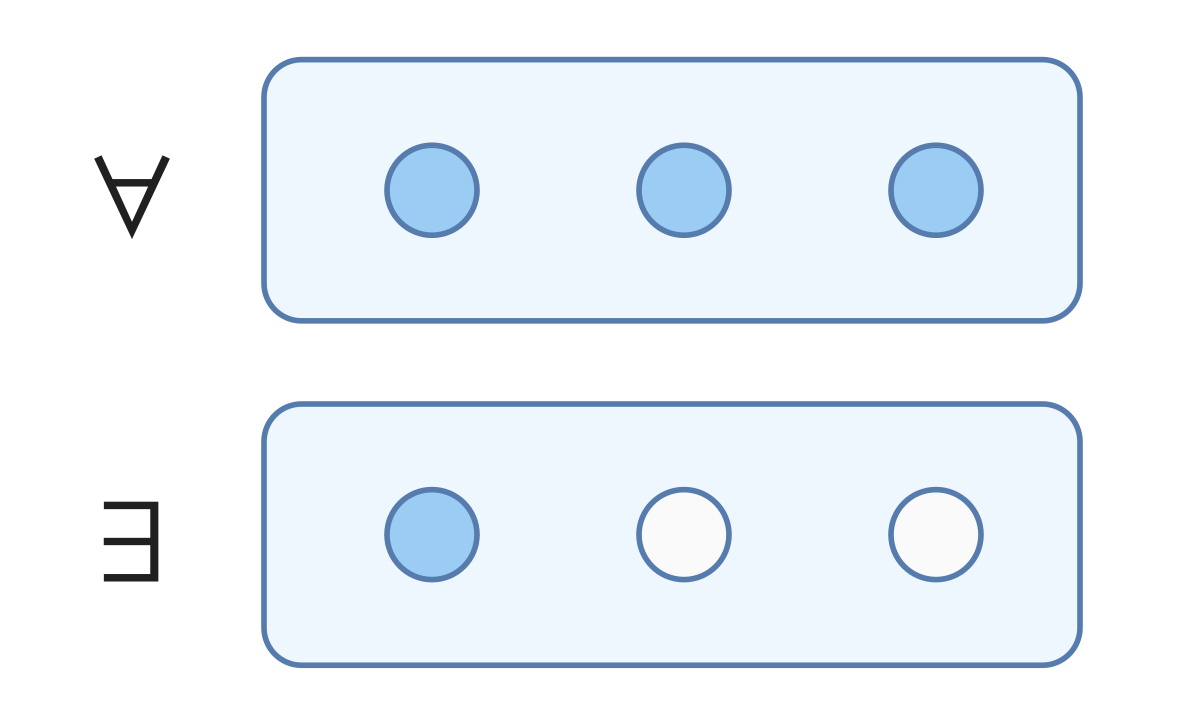
A universal claim requires the property for every member of its domain. If is a set of three files, “Every file in opens” covers those files, not every file anywhere.
The universal symbol reads “for every”.
For a set of three files, “At least one file in opens” is an existence claim. It needs a member with the property. “Some” means at least one, which may include all.
The existence symbol reads “there exists”.
Which claim concerns every card?
Show answer and explanation
Every covers the whole set.
02Suppose file A opens and B and C have not been checked#
Suppose file A opens and B and C have not been checked. This establishes that a file opens. It leaves “Every file opens” unresolved. Distinguishing the claim’s scope comes before judging it true or false.
Six sensors: one responds, five untested. Which claim follows?
Show answer and explanation
One responds. Others are untested.
03Check your understanding#
All three cards are blue. “At least one is blue” requires:
Show answer and explanation
One or more allows all three cards.
Name the domain and read the quantifier. Every requires the whole domain; exists or some requires at least one and allows more.
- Distinguish a universal claim from an existence claim
Sources & further reading
- [1]OpenStax Contemporary Mathematics, 2.1 ↗OpenStax · Book