Condition numbers
For a full-rank square system, the 2-norm condition number is the ratio of its largest to smallest singular value.
On this page 9 sections
01Understand the idea#
A condition number describes sensitivity: how much an output or solution can change relative to a small relative change in the data. A system can have a unique solution and still be difficult to solve accurately when its input measurements are uncertain.
For an invertible square matrix, a large singular value stretches one direction strongly while a small one barely changes another. Solving the system reverses those stretches. The weak direction then requires a large amplification, making uncertainty in that direction especially consequential.
A unique solution can still react strongly to small data changes. For a full-rank square system, the 2-norm condition number compares its largest and smallest singular values.
Singular scales 8 and 0.5 give a ratio of 16. The system responds unevenly across directions: one is scaled sixteen times as much as the other.
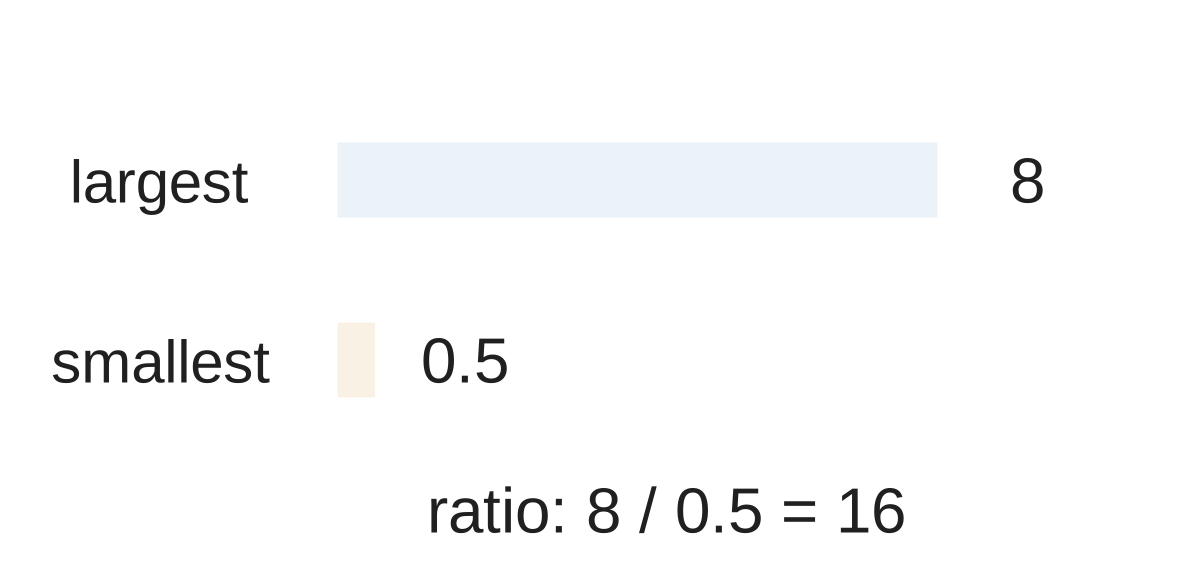
For singular values , identify the largest and smallest positive scales first. Their ratio is . The middle value does not enter this ratio. Multiplying the whole matrix by 3 makes the extremes 24 and 1.5, whose ratio is still 16. Overall size and relative sensitivity are different quantities.
Full-rank square system. Singular values . Give .
Show answer and explanation
.
02A closer look#
A larger condition number means greater possible relative sensitivity in the inverse problem. It is a worst-case measure: a condition number of 16 does not mean every data change produces sixteen times the relative solution change.
Full-rank square system, scales . Claim: unique solution means . Repair.
Show answer and explanation
Extreme ratio: .
03Uniform scaling does not change the ratio#
Uniform scaling does not change the ratio. Scaling singular values to leaves the condition number at 3. Compare ratios, not the biggest or smallest value by itself.
Full-rank square inverse systems. Singular values: A ; B . Compare worst-case relative sensitivity.
Show answer and explanation
; .
04A closer look#
In regression, nearly redundant features can make fitted coefficients very sensitive even when predictions change little. Conditioning helps explain that instability. The condition number is a worst-case amplification bound under the stated norm; it does not say every dataset actually suffers that much error.
Largest divided by smallest measures possible relative sensitivity. Uniform scaling preserves this ratio.
- Interpret the ratio of largest to smallest nonzero singular values for a full-rank square system.
Further questions
How can predictors make fitted coefficients unstable?
Sources & further reading
- [1]
- [2]