Singular values
Exact rank is the number of nonzero singular values.
On this page 9 sections
01Understand the idea#
A singular value tells you how strongly a matrix stretches one of its special input directions. In , both direction vectors have length 1. The output therefore has length . These scales are nonnegative; a negative coordinate elsewhere in the factorization is not a negative singular value.
Picture measurements that respond strongly to one input pattern and not at all to another. A zero singular value means changing the input along that second direction changes none of the outputs. Counting directions that survive tells us how many independent directions the matrix can produce: its rank.
A positive singular scale preserves its direction; a zero scale removes it. Complete scales preserve two independent directions, so the rank is 2.
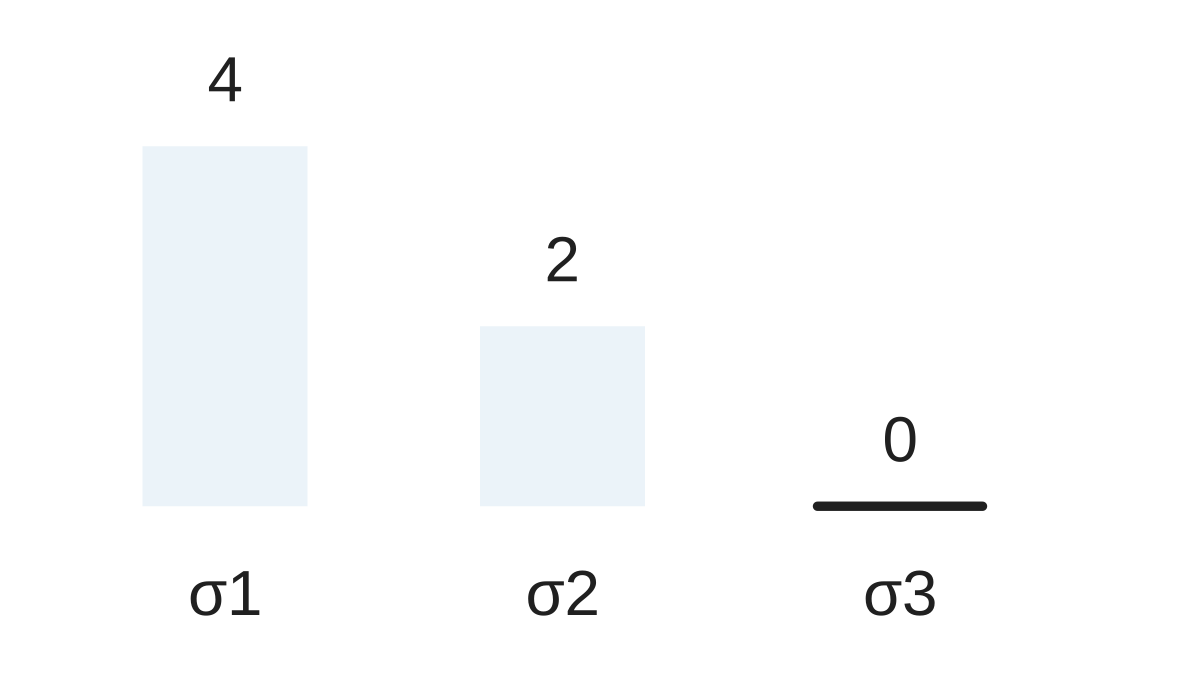
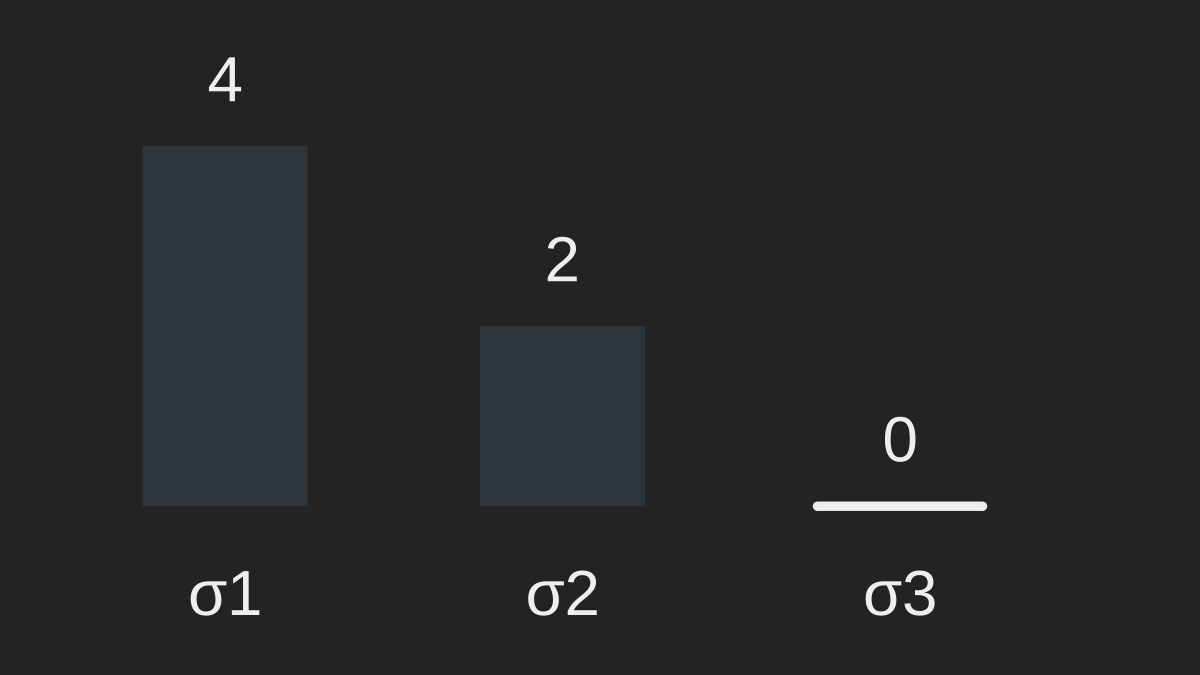
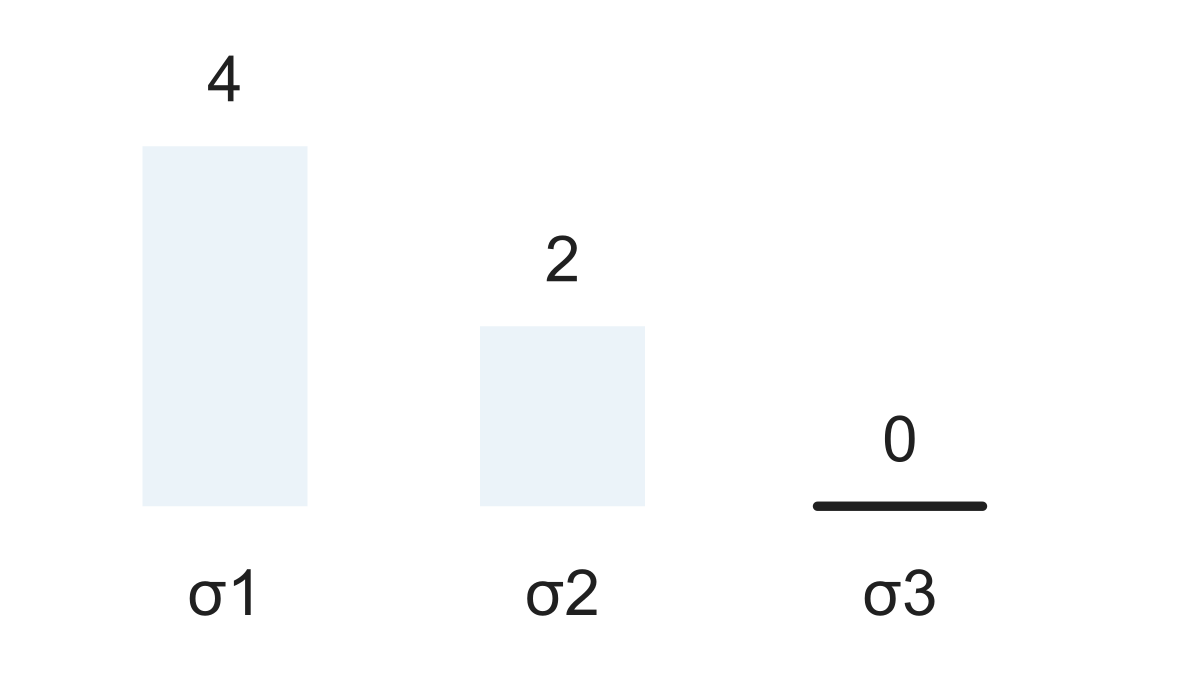
Count nonzero values, not their magnitudes. For a matrix with complete exact scales , both copies of 5 count.
For complete exact singular values , ask about each scale separately: 4 preserves a direction, 2 preserves another, and 0 removes one. The rank is 2. Neither the sum 6 nor the largest value 4 counts directions. Check that the list has entries for an matrix.
Matrix shape . Complete exact singular values . Give rank.
Show answer and explanation
3 positive scales give rank .
02Every exact positive scale counts, however small#
Every exact positive scale counts, however small. Scales give rank 2. Numerical software may choose a tolerance, but that is a separate decision; these tasks use exact values.
Shape ; complete exact scales . Claimed rank . Repair.
Show answer and explanation
2 positive scales give rank .
03Suppose a channel edit changes complete singular scales to #
Suppose a channel edit changes complete singular scales to . One active direction is removed, so rank falls from 2 to 1. Changing 6 to another positive value would preserve the count.
Complete exact scales . Replace the second singular scale with . New rank?
Show answer and explanation
: rank .
04With measured data, a tiny positive scale may be mostly noise#
With measured data, a tiny positive scale may be mostly noise. A numerical-rank calculation therefore needs a stated tolerance and a scale convention. These exercises supply exact values and ask exact rank; every positive value counts. This distinction matters before declaring that a dataset contains a redundant feature.
Count positive singular scales once each. Zero scales do not contribute; size and repetition do not change that rule.
- Infer rank from the nonzero singular values of a matrix.
Further questions
Does a very small positive scale matter beyond rank?
Sources & further reading
- [1]