Dimension
The dimension of a finite-dimensional subspace is the number of vectors in any basis of that subspace.
On this page 7 sections
01Dimension counts the vectors in a basis#
Dimension counts the vectors in a basis. It tells you how many independent directions are needed to describe the subspace.
The two vectors shown form a basis of S. Each has three entries, but this subspace has dimension 2.
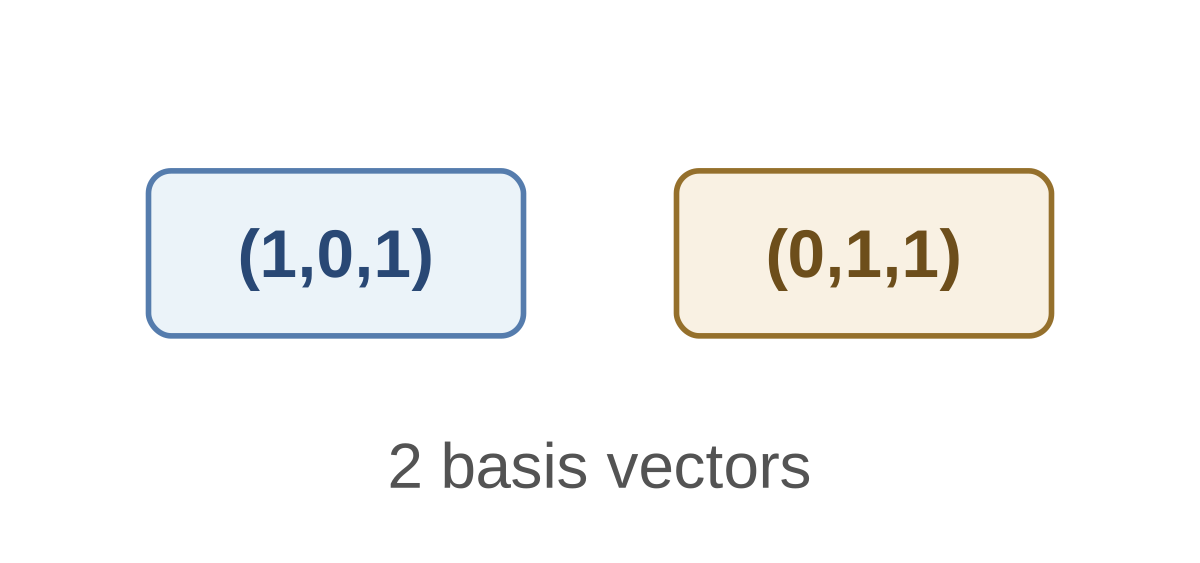

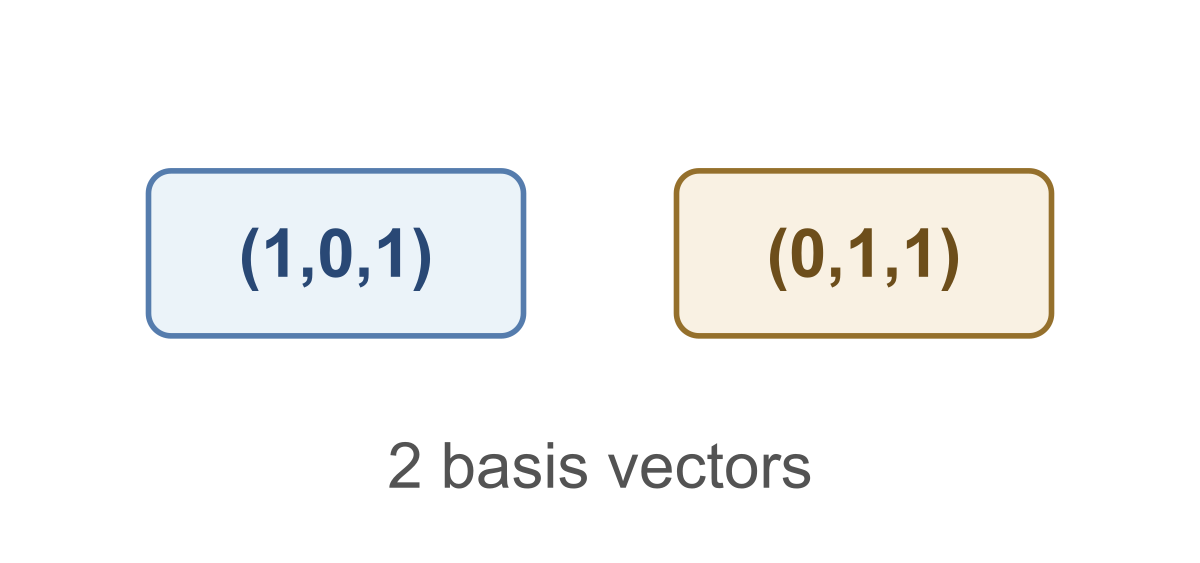
is a basis of S. What is ?
Show answer and explanation
Count the 3 whole basis vectors.
02One basis for an allowed-output subspace has two patterns#
One basis for an allowed-output subspace has two patterns. Choosing a different basis for the same subspace changes the patterns, but still needs two. All bases of a fixed subspace have the same size.
A basis for an allowed-output subspace S has 2 vectors, each with 4 entries. A different basis describes the same S. How many vectors does it have?
Show answer and explanation
Both bases describe S, so both contain 2 vectors.
03The zero subspace contains only the zero vector#
The zero subspace contains only the zero vector. Its basis is the empty list: there are no directions to supply. Its dimension is 0. A list containing the zero vector would be dependent.
is a basis of S. Correct the claim (entries per vector).
Show answer and explanation
Count the two basis vectors.
Count basis vectors, not entries per vector. Every basis of the same subspace has the same number of vectors.
- Determine subspace dimension from a basis.
Sources & further reading
- [1]TU Delft Linear Algebra, section 4.2: Basis and Dimension ↗TU Delft · Article