Gaussian elimination
Elimination replaces an equation with a row combination that makes a selected variable coefficient zero.
On this page 7 sections
01Elimination makes one variable’s coefficient zero#
Elimination makes one variable’s coefficient zero. For and , subtract three copies of the first equation from the second.
Use . The new coefficients are and . The right side is .
![Before rows are [1, 2, 7] and [3, 1, 8]; the last entry of each row is the right-hand constant. Operation R₂ ← R₂ − 3R₁ leaves row 1 unchanged and replaces row 2 with [0, -5, -13]. Every entry, including the constant, is updated.](/visuals/la-elimination/matrix-8xz1wl.svg)
![Before rows are [1, 2, 7] and [3, 1, 8]; the last entry of each row is the right-hand constant. Operation R₂ ← R₂ − 3R₁ leaves row 1 unchanged and replaces row 2 with [0, -5, -13]. Every entry, including the constant, is updated.](/visuals/la-elimination/matrix-8xz1wl-dark.svg)
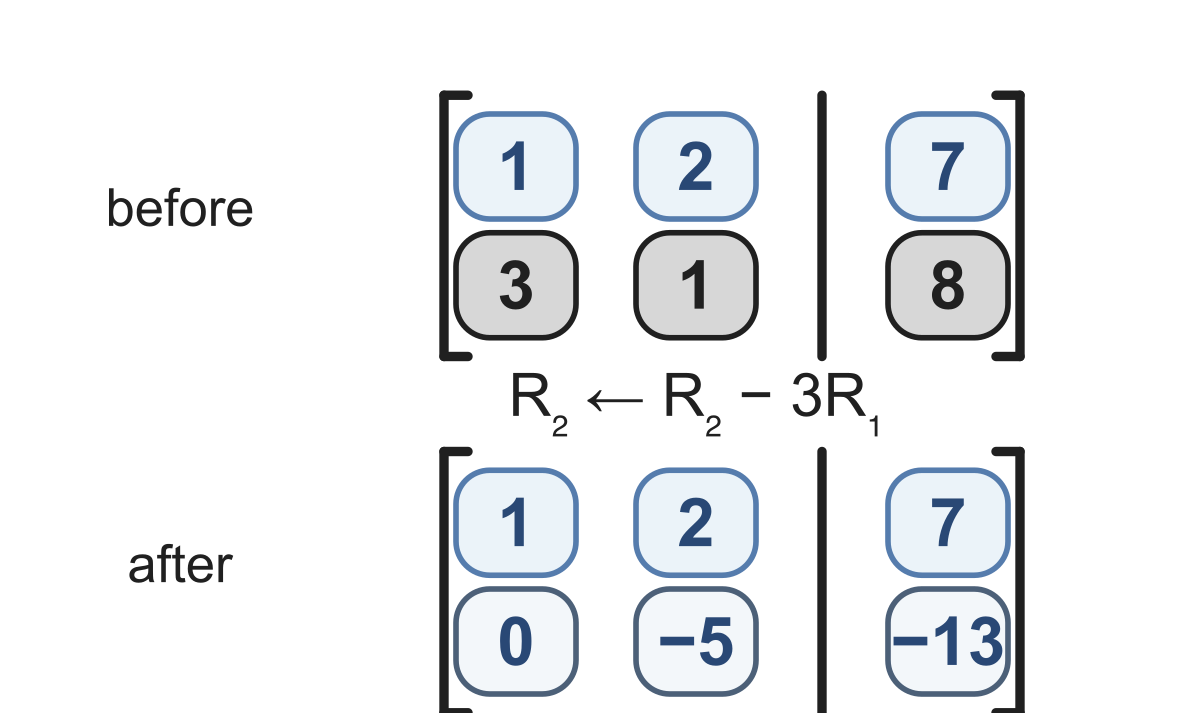
Order . Eliminate x from using . New ?
Show answer and explanation
Use .
02Choose a multiple that cancels the target coefficient#
Choose a multiple that cancels the target coefficient. If the source coefficient is 2 and the target is 6, subtract 3 source rows. If they are 1 and −2, add 2 source rows. A zero source coefficient cannot cancel a nonzero target.
Order . Eliminate x from using . New right side?
Show answer and explanation
Apply the same subtraction: .
03Apply the chosen multiple to every entry in the target row; keep the source row#
Apply the chosen multiple to every entry in the target row; keep the source row. Once the selected coefficient is zero, that elimination step is done. Larger systems repeat this move on other rows and variables.
Unit prices . Orders: (1,1) costs 4; (2,3) costs 10. Pairs give quantities. Eliminate u from the second.
Show answer and explanation
Use .
Cancel the coefficient and update every other entry, including the constant.
- Eliminate a variable using elementary row operations.
Sources & further reading
- [1]Margalit and Rabinoff: Interactive Linear Algebra, 1.2 Row Reduction ↗Margalit and Rabinoff · Book