Row operations
An elementary row operation swaps rows, scales a row by a nonzero number or adds a multiple of a different row.
On this page 7 sections
01Write coefficients and the right side together in an augmented row#
Write coefficients and the right side together in an augmented row. For , the row is . A row operation changes whole equations while keeping the same solutions.
You may swap two rows or multiply a row by a nonzero number. Swapping can be undone by swapping again; scaling can be undone by dividing by that number.
New after .
Show answer and explanation
Row 1 receives the entire old row 2.
02You may add a multiple of a different row to a target, leaving the source row unchanged#
You may add a multiple of a different row to a target, leaving the source row unchanged. Here gives .
![Before rows are [1, 2, 5] and [3, 1, 4]; the last entry of each row is the right-hand constant. Operation R₂ ← R₂ + R₁ leaves row 1 unchanged and replaces row 2 with [4, 3, 9]. Every entry, including the constant, is updated.](/visuals/la-row-operation/matrix-kbwpf6.svg)
![Before rows are [1, 2, 5] and [3, 1, 4]; the last entry of each row is the right-hand constant. Operation R₂ ← R₂ + R₁ leaves row 1 unchanged and replaces row 2 with [4, 3, 9]. Every entry, including the constant, is updated.](/visuals/la-row-operation/matrix-kbwpf6-dark.svg)
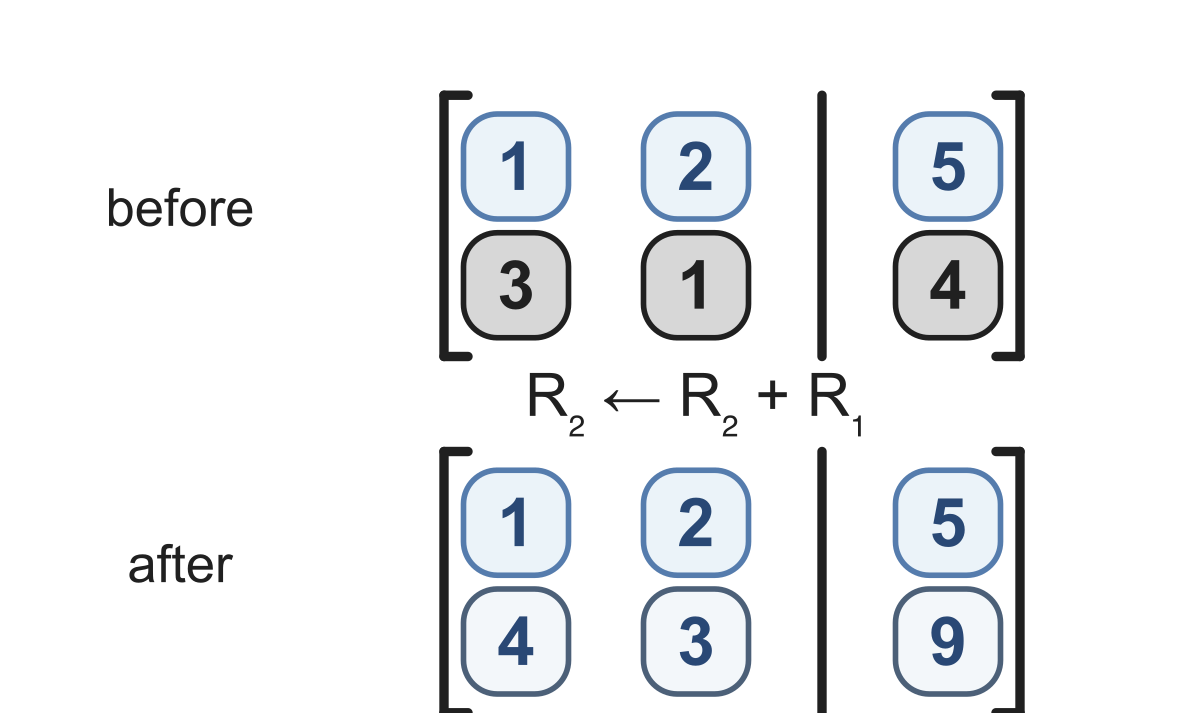
Row is . Apply . New right side?
Show answer and explanation
The constant also gets multiplied by −2.
03Subtracting the same multiple reverses a row replacement#
Subtracting the same multiple reverses a row replacement. Scaling by zero loses the original equation: becomes . That move cannot preserve its constraint.
Rows are ; . Apply . New ?
Show answer and explanation
Operate on both sides of the target equation.
Operate on the whole row, including its right side. Keep the move reversible.
- Apply one solution-preserving elementary row operation.
Sources & further reading
- [1]Margalit and Rabinoff: Interactive Linear Algebra, 1.2 Row Reduction ↗Margalit and Rabinoff · Book
- [2]OpenStax Algebra and Trigonometry 2e: 11.6 Solving Systems with Gaussian Elimination ↗OpenStax Algebra and Trigonometry 2e · Book