Skip to content
Glacius
Linear algebraConcept reference

Pivots

A pivot in row-echelon form is the first nonzero entry of a nonzero row.

On this page 7 sections
  1. Overview
  2. In row-echelon form, zero rows come last
  3. A pivot need not be 1
  4. A closer look
  5. Key takeaway
  6. Sources & further reading
  7. Concept connections

01In row-echelon form, zero rows come last#

In row-echelon form, zero rows come last. Each nonzero row starts farther right than the row above, and entries below each leading entry are zero.

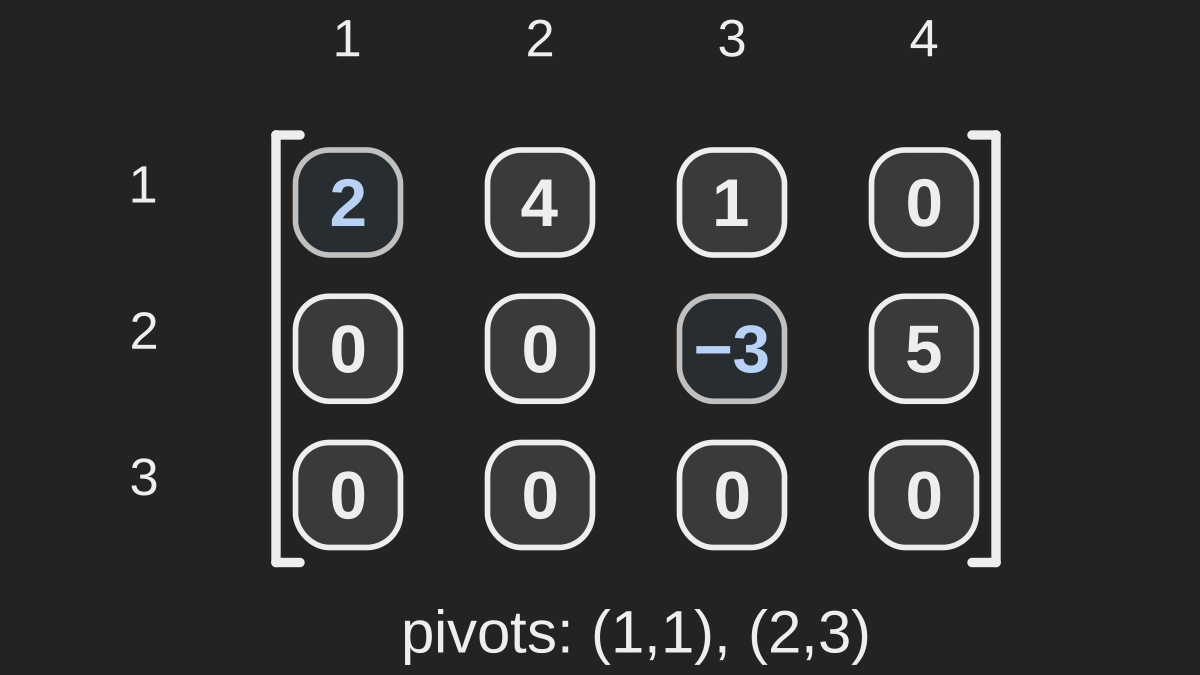
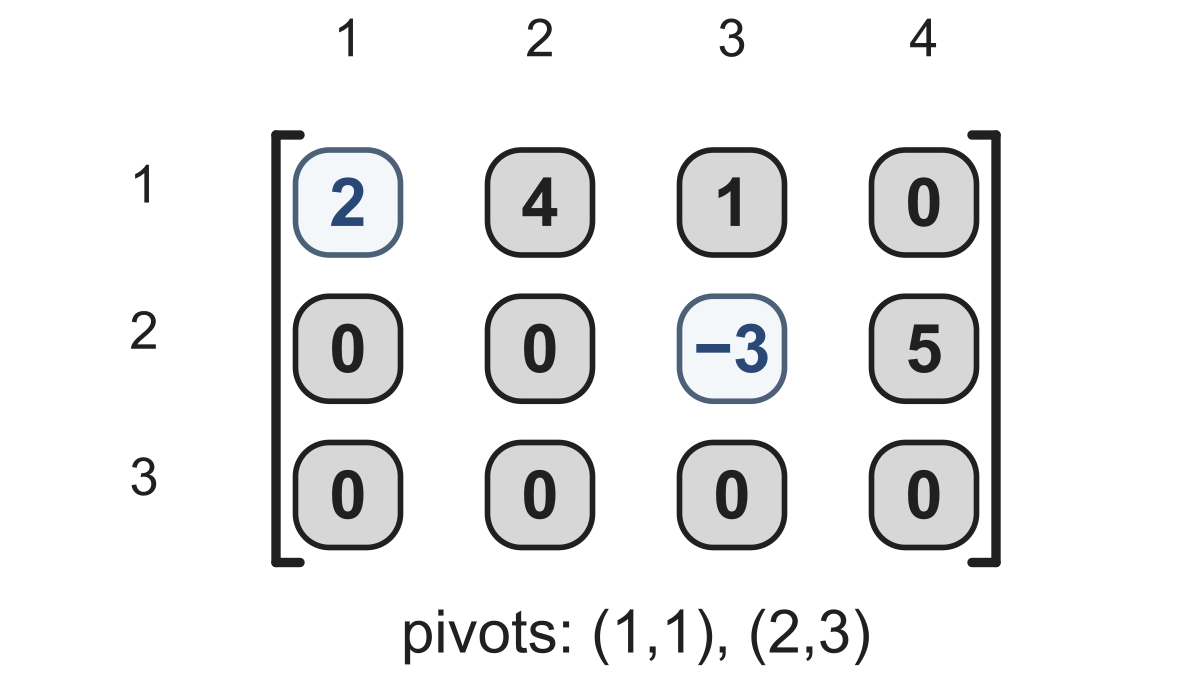
A pivot is the first nonzero entry of a nonzero echelon row. Here they are 2 at (1,1)(1,1) and −3 at (2,3)(2,3). The last row is all zero, so it has no pivot.
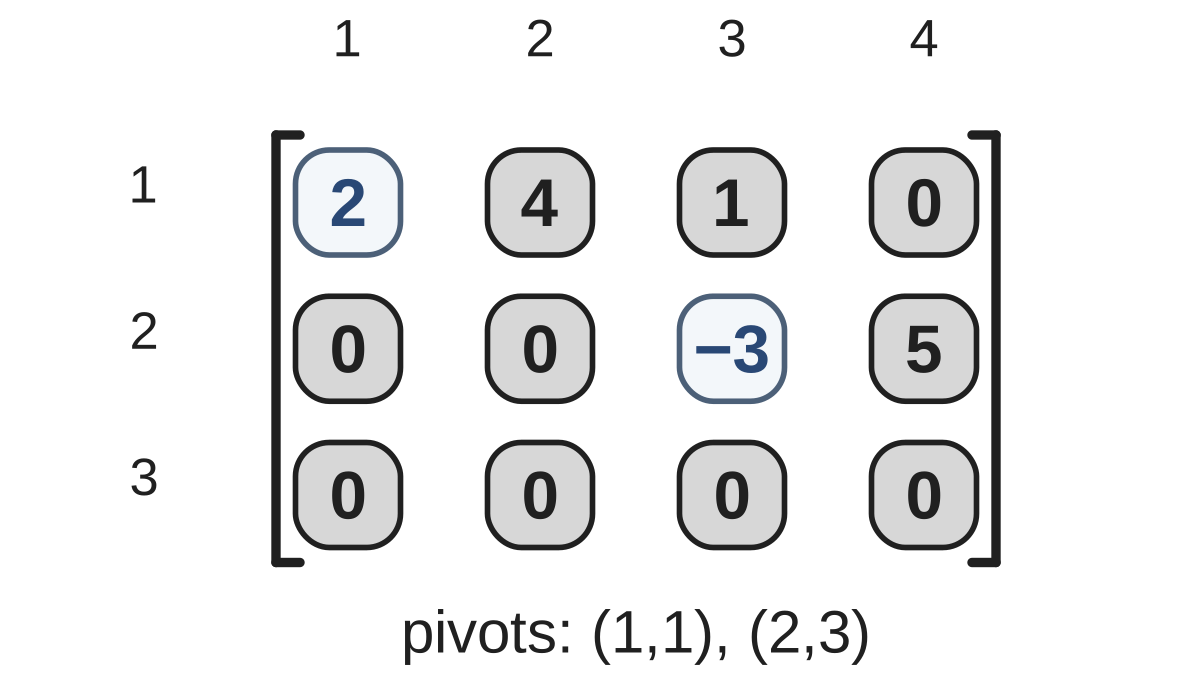
A row-echelon matrix has rows (2,4,1,0), (0,0,−3,5), and (0,0,0,0). Its pivots are 2 at (1,1) and −3 at (2,3). The zero row has no pivot. Row and column labels show positions; highlighted entries are the first nonzero in their rows.A row-echelon matrix has rows (2,4,1,0), (0,0,−3,5), and (0,0,0,0). Its pivots are 2 at (1,1) and −3 at (2,3). The zero row has no pivot. Row and column labels show positions; highlighted entries are the first nonzero in their rows.
Figure 1A row-echelon matrix has rows (2,4,1,0), (0,0,−3,5), and (0,0,0,0). Its pivots are 2 at (1,1) and −3 at (2,3). The zero row has no pivot. Row and column labels show positions; highlighted entries are the first nonzero in their rows.
Link to this figure ↗Download SVGDownload PNG
Check your reasoning

Echelon matrix. All pivots (row, column)? [231004]\begin{bmatrix}2&3&1\\0&0&4\end{bmatrix}

  1. A(1,1), (1,2), (1,3), (2,3)
  2. B(1,1), (2,3)
  3. C(1,1), (2,2)
Show answer and explanation
(1,1), (2,3)

First nonzero per nonzero row.

02A pivot need not be 1#

A pivot need not be 1. A nonzero entry later in the same row is not another pivot. Report the position as row, then column; the pivot’s value is a separate number.

Check your reasoning

Row-echelon form? [1223]\begin{bmatrix}1&2\\2&3\end{bmatrix}

  1. ANo: no step right.
  2. BYes.
  3. CNo: pivots must be 1.
Show answer and explanation
No: no step right.

Leading columns must step right.

03A closer look#

For a table with named columns, locate the leading entry first, then read its column label. Zero rows contribute no positions. Check echelon form before using this rule; a raw matrix may still need elimination.

Check your reasoning

Echelon columns: (u, v, w). What is the column number of the pivot in row 2? [123005]\begin{bmatrix}1&2&3\\0&0&5\end{bmatrix}

Show answer and explanation
3

Row 2 first becomes nonzero in column 3.

Key takeaway

In each nonzero echelon row, find the first nonzero entry.

  • Identify pivot positions in row-echelon form.

Sources & further reading

  1. [1]

Reference this concept

Link to this page, a section, or an individual figure.

Glacius. “Pivots.” Math behind ML. /learn/la-pivot