Euclidean length
Euclidean length is the nonnegative square root of the sum of squared coordinates.
On this page 7 sections
01Euclidean length measures a vector’s straight arrow#
Euclidean length measures a vector’s straight arrow. For , perpendicular coordinate changes form a right triangle.
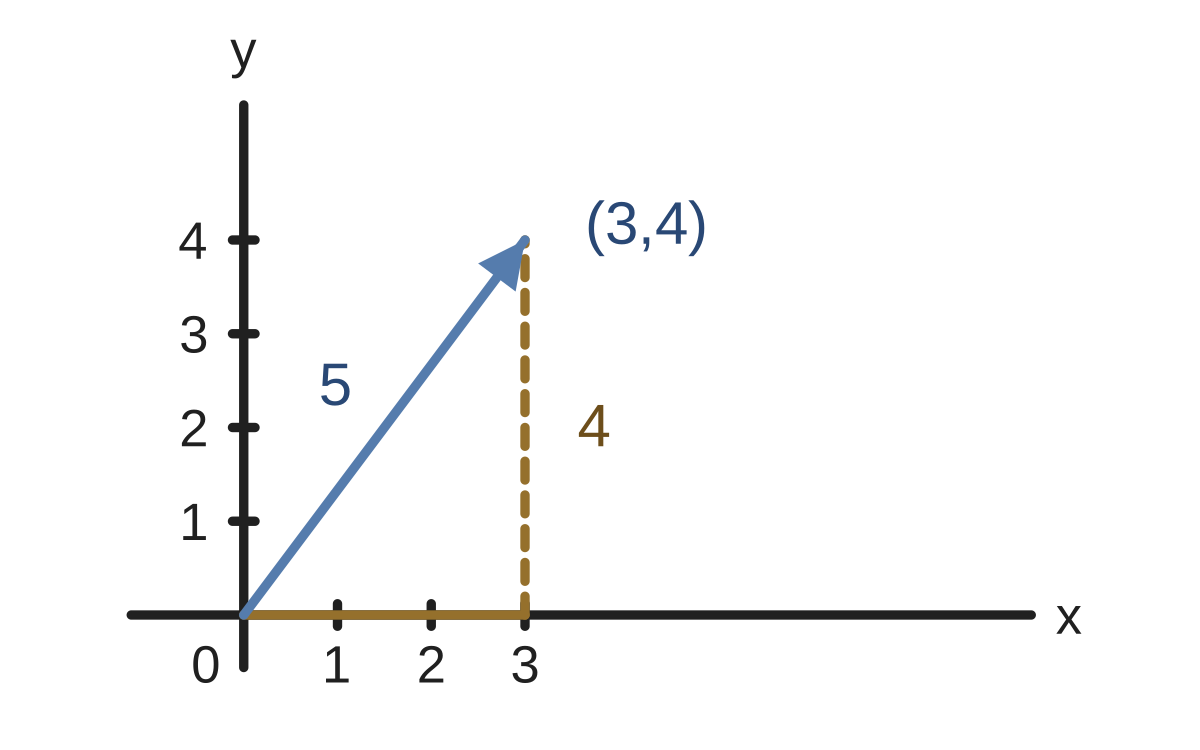
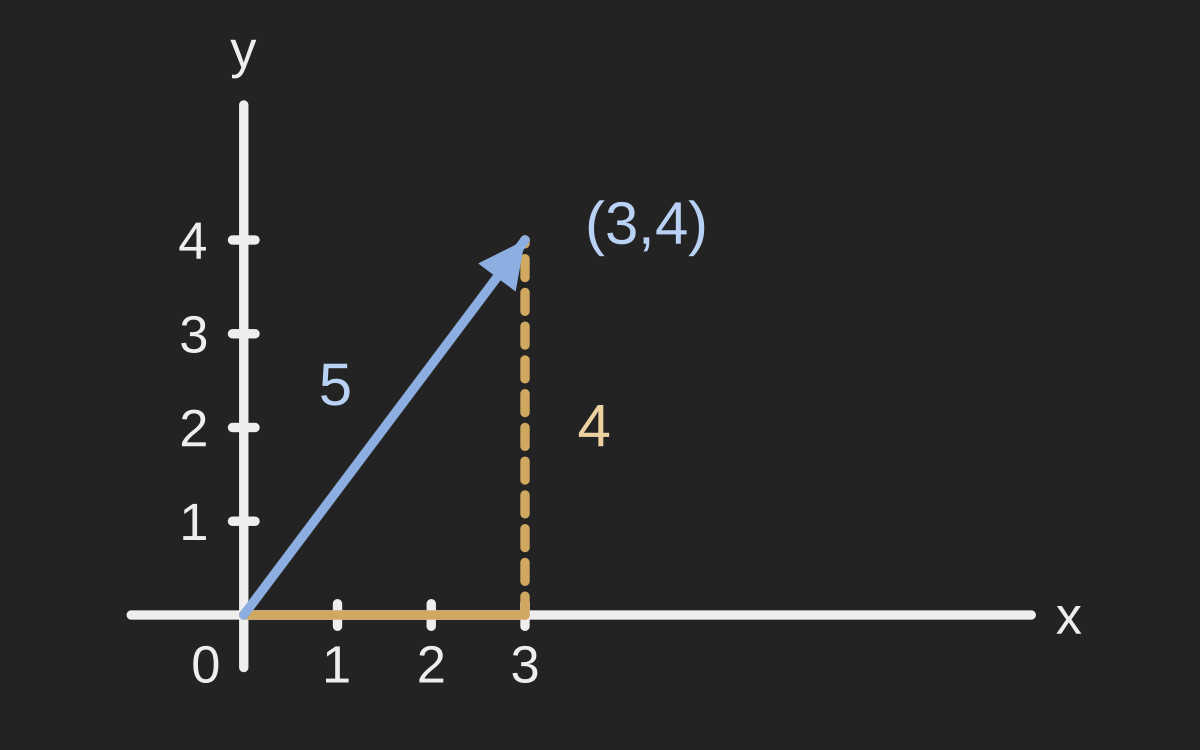
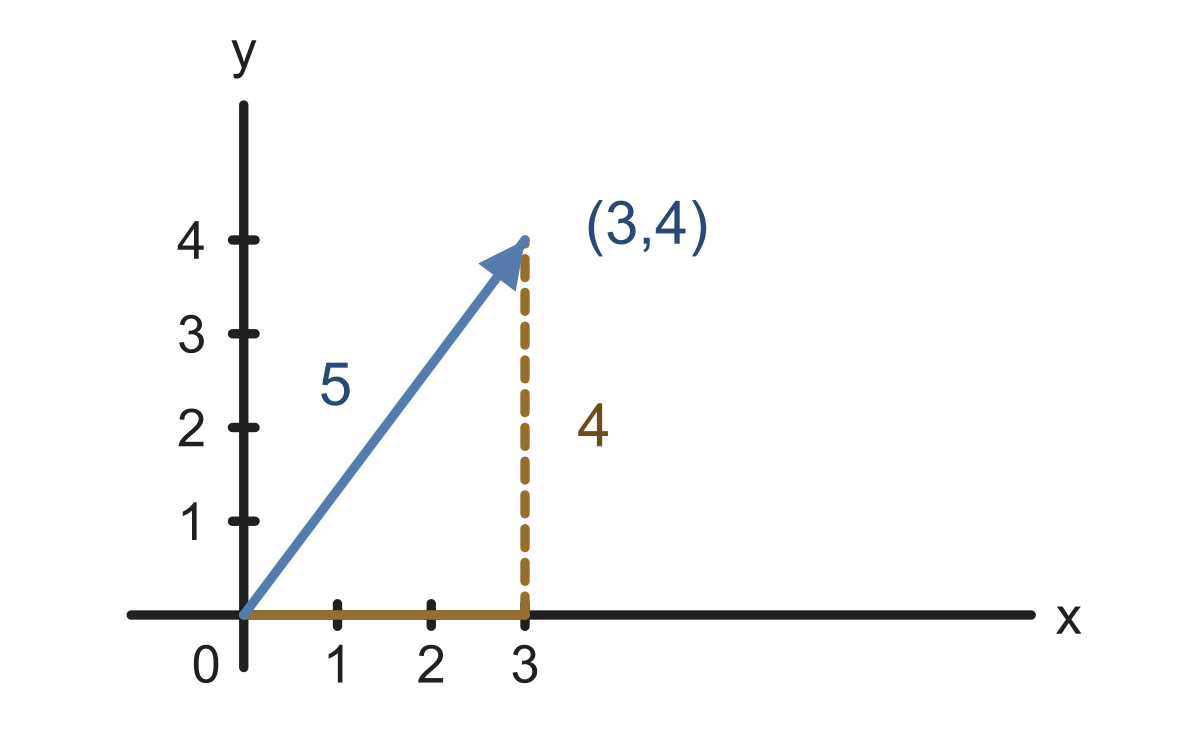
For , square the two perpendicular contributions: and . Their sum gives the squared length.
Take the nonnegative square root.
The subscript names Euclidean length. For any coordinate vector, square every entry, add, then take the square root. The dot product with itself gives that sum.
Using the dot product you already know.
What is the Euclidean length of ?
Show answer and explanation
. The nonnegative square root is .
02Signs disappear when coordinates are squared#
Signs disappear when coordinates are squared. For , the length is still . The zero vector has length ; every nonzero vector has positive length.
The zero vector has zero length.
A grid move changes x by 5 and y by −12. What is its straight-line length?
Show answer and explanation
The squared changes contribute , so the length is .
03Check your understanding#
For , length omits which step?
Show answer and explanation
The squared sum is ; the length is .
Square each coordinate, add, then take the nonnegative square root.
- Compute the Euclidean length of a vector
Sources & further reading
- [1]OpenStax Calculus Volume 3, 2.1 Vectors in the Plane ↗OpenStax · Book
- [2]Goodfellow, Bengio and Courville, Deep Learning (2016), 2.5 Norms ↗Deep Learning textbook · Book