Skip to content
Glacius
Linear algebraConcept reference

Orthonormal bases

A basis is orthonormal when every vector has unit Euclidean length and every distinct pair has zero dot product.

On this page 7 sections
  1. Overview
  2. An orthonormal basis is a set of perpendicular directions, each of length 1
  3. Unit length alone is also insufficient
  4. A supplied basis already spans its space
  5. Key takeaway
  6. Further questions
  7. Concept connections

01An orthonormal basis is a set of perpendicular directions, each of length 1#

An orthonormal basis is a set of perpendicular directions, each of length 1. These two properties let dot products report coordinates directly. They are what make the coordinate changes in QR, SVD, and PCA especially convenient.

Check both properties separately: dot each vector with itself to check length, and dot different vectors to check perpendicularity. Perpendicular vectors of length 2 are orthogonal, but they are not orthonormal.

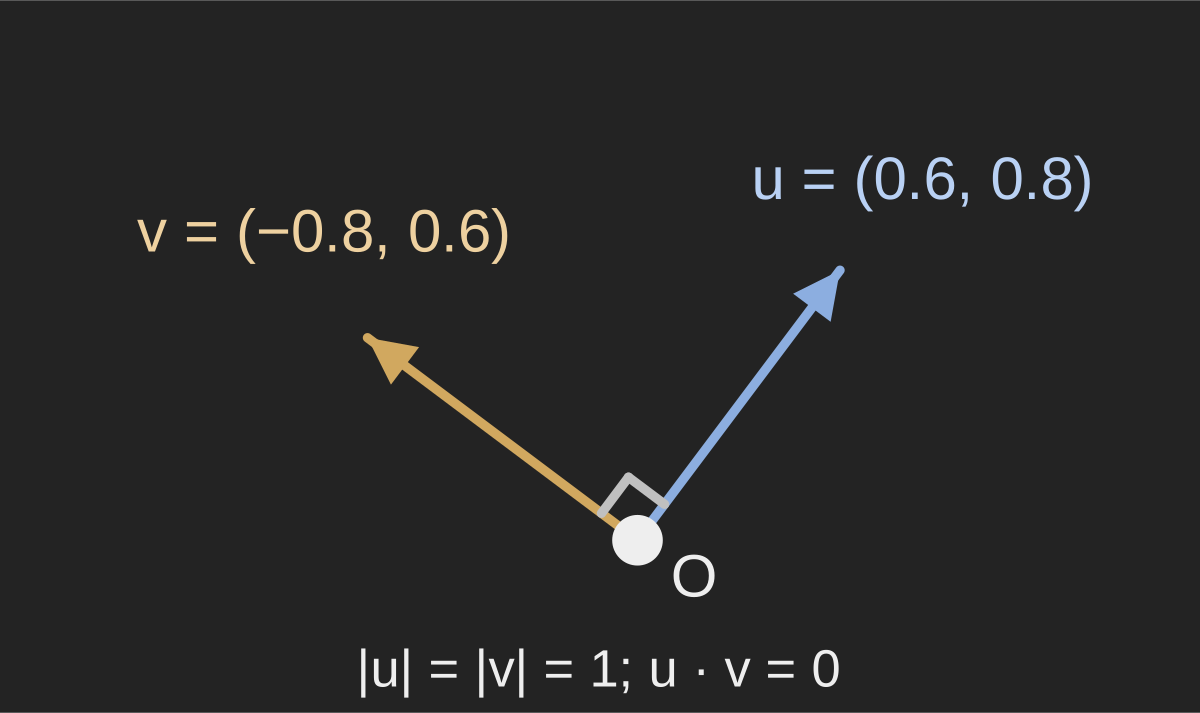
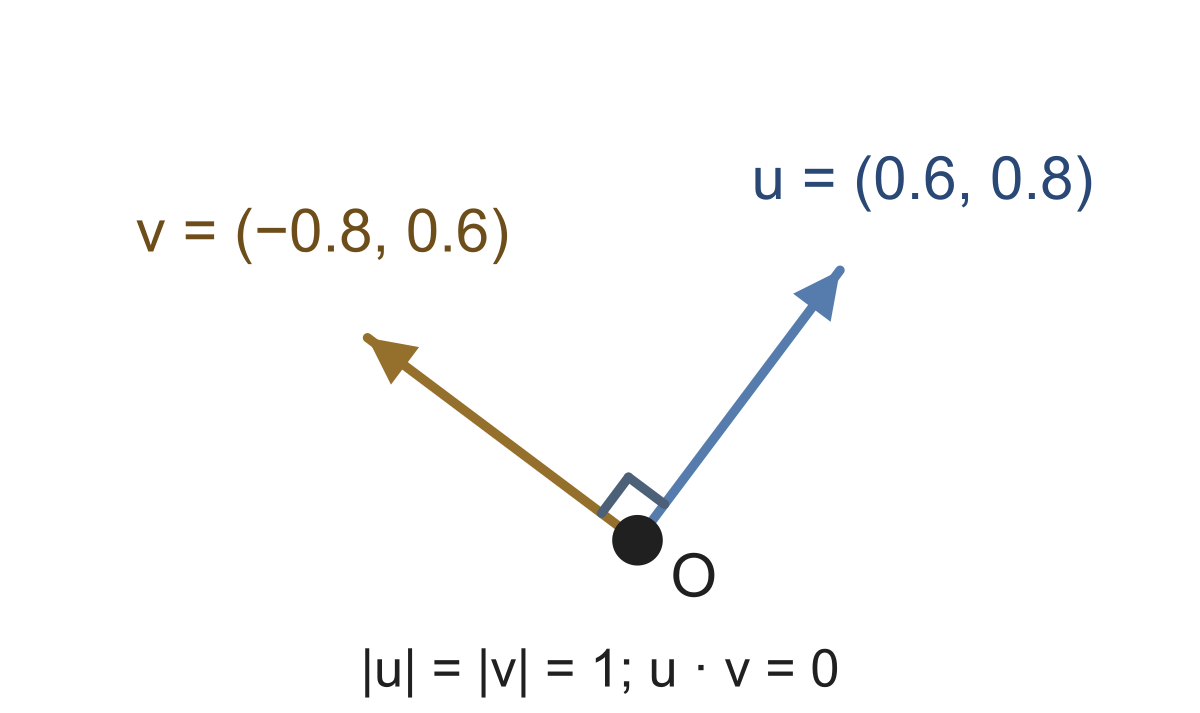
An orthonormal basis uses perpendicular unit vectors. For the supplied basis u=(0.6,0.8)u=(0.6,0.8) and v=(0.8,0.6)v=(-0.8,0.6), check both lengths and their dot product.
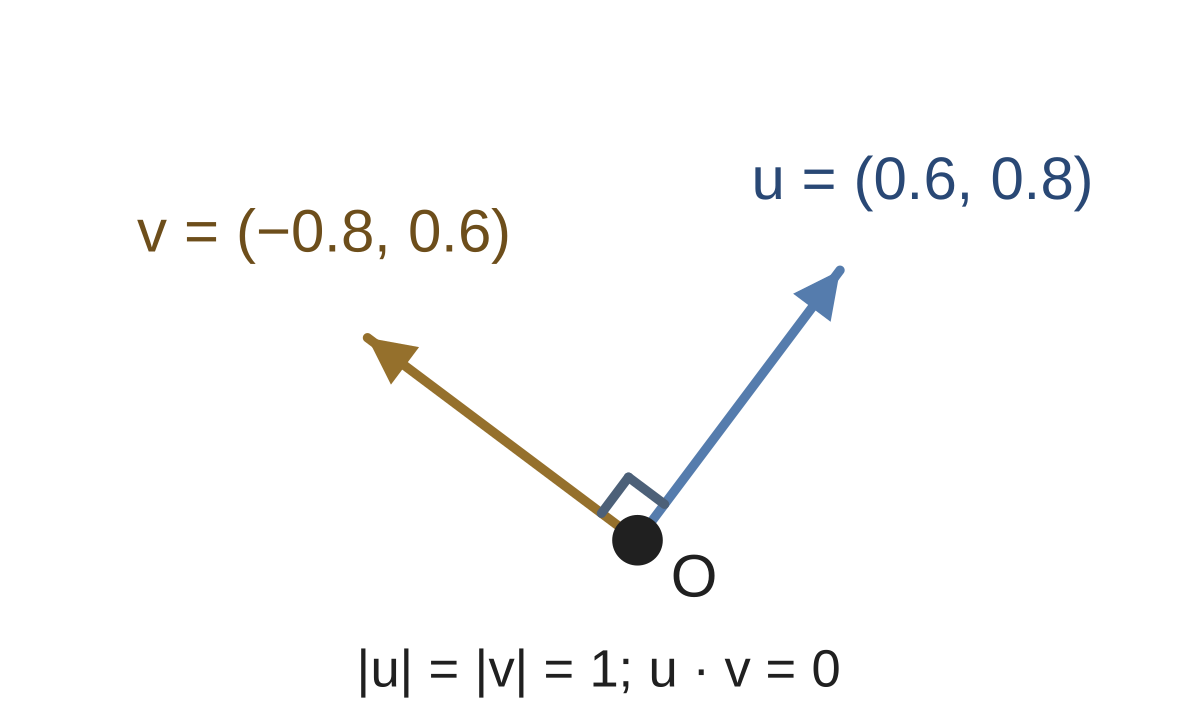
Vectors u=(0.6,0.8) and v=(-0.8,0.6) share origin O. Both have Euclidean length 1 and their dot product is 0. Arrows are drawn at 90 pixels per coordinate unit, so both have 90 pixel lengths and meet at a right angle.Vectors u=(0.6,0.8) and v=(-0.8,0.6) share origin O. Both have Euclidean length 1 and their dot product is 0. Arrows are drawn at 90 pixels per coordinate unit, so both have 90 pixel lengths and meet at a right angle.
Figure 1Vectors u=(0.6,0.8) and v=(-0.8,0.6) share origin O. Both have Euclidean length 1 and their dot product is 0. Arrows are drawn at 90 pixels per coordinate unit, so both have 90 pixel lengths and meet at a right angle.
Link to this figure ↗Download SVGDownload PNG

For u=(0.6,0.8)u=(0.6,0.8) and v=(0.8,0.6)v=(-0.8,0.6), each squared length is 0.36+0.64=10.36+0.64=1. Their dot is 0.48+0.48=0-0.48+0.48=0. These values meet both orthonormal conditions.

For u=(0.6,0.8)u=(0.6,0.8) and v=(0.8,0.6)v=(-0.8,0.6), squared lengths are 0.36+0.64=10.36+0.64=1 for each. Their dot product is 0.48+0.48=0-0.48+0.48=0. These directions can therefore be used as unit perpendicular axes. A coordinate along uu is obtained by xux\cdot u.

Check your reasoning

Basis u=(1,0)u=(1,0), v=(0,2)v=(0,2). Orthonormal?

  1. AYes.
  2. BNo: v has length 2.
  3. CNo: the dot is nonzero.
Show answer and explanation
No: v has length 2.

Check lengths as well as the dot.

02Unit length alone is also insufficient#

Unit length alone is also insufficient. The basis (1,0)(1,0), (0.6,0.8)(0.6,0.8) has two unit vectors, but their dot is 0.6. With three vectors, check all three distinct pairs.

Check your reasoning

Basis u=(1,0,0)u=(1,0,0), v=(0,1,0)v=(0,1,0), w=(0,0.6,0.8)w=(0,0.6,0.8). Find vwv\cdot w.

Show answer and explanation
0.6

The nonzero dot rules out orthonormality.

03A supplied basis already spans its space#

A supplied basis already spans its space. To verify orthonormality, check each length and each distinct pair. Negative coordinates and rotated directions are allowed. A zero vector cannot have unit length.

Check your reasoning

Basis audit: lengths (1,1), pair dot −0.2. Orthonormal?

  1. AYes.
  2. BNo: the lengths fail.
  3. CNo: the dot is nonzero.
Show answer and explanation
No: the dot is nonzero.

Both tests must pass.

Key takeaway

Every length 1. Every distinct-pair dot 0.

  • Verify every unit-length and pairwise-orthogonality condition

Further questions

Does perpendicular automatically mean unit length?
No. For example, (2,0) and (0,1) have dot 0 but lengths 2 and 1. An orthonormal basis must pass both checks.

Reference this concept

Link to this page, a section, or an individual figure.

Glacius. “Orthonormal bases.” Math behind ML. /learn/la-orthonormal