Linearity
A map between real vectors is linear when it preserves addition and multiplication by every real scalar for all inputs.
On this page 7 sections
01The two rules of linearity#
For , linearity needs two rules. Additivity preserves sums for all input vectors .
Combine inputs or combine outputs:
Homogeneity preserves scaling. For every input vector and every real scalar :
Scale the input or the output:
Both rules must hold for T to be linear.
02A linear map: doubling a vector#
Take on real vectors. For arbitrary , distribute the doubling over each coordinate sum.
Apply T to the sum:
This also equals . Additivity holds for every pair.
For and any real , scaling the input gives .
Real scalar multiplication lets us write
So homogeneity holds too. With both rules valid for all inputs, is linear.
For on , find .
Show answer and explanation
The sides are and . Their difference is , so additivity fails.
03What a counterexample proves#
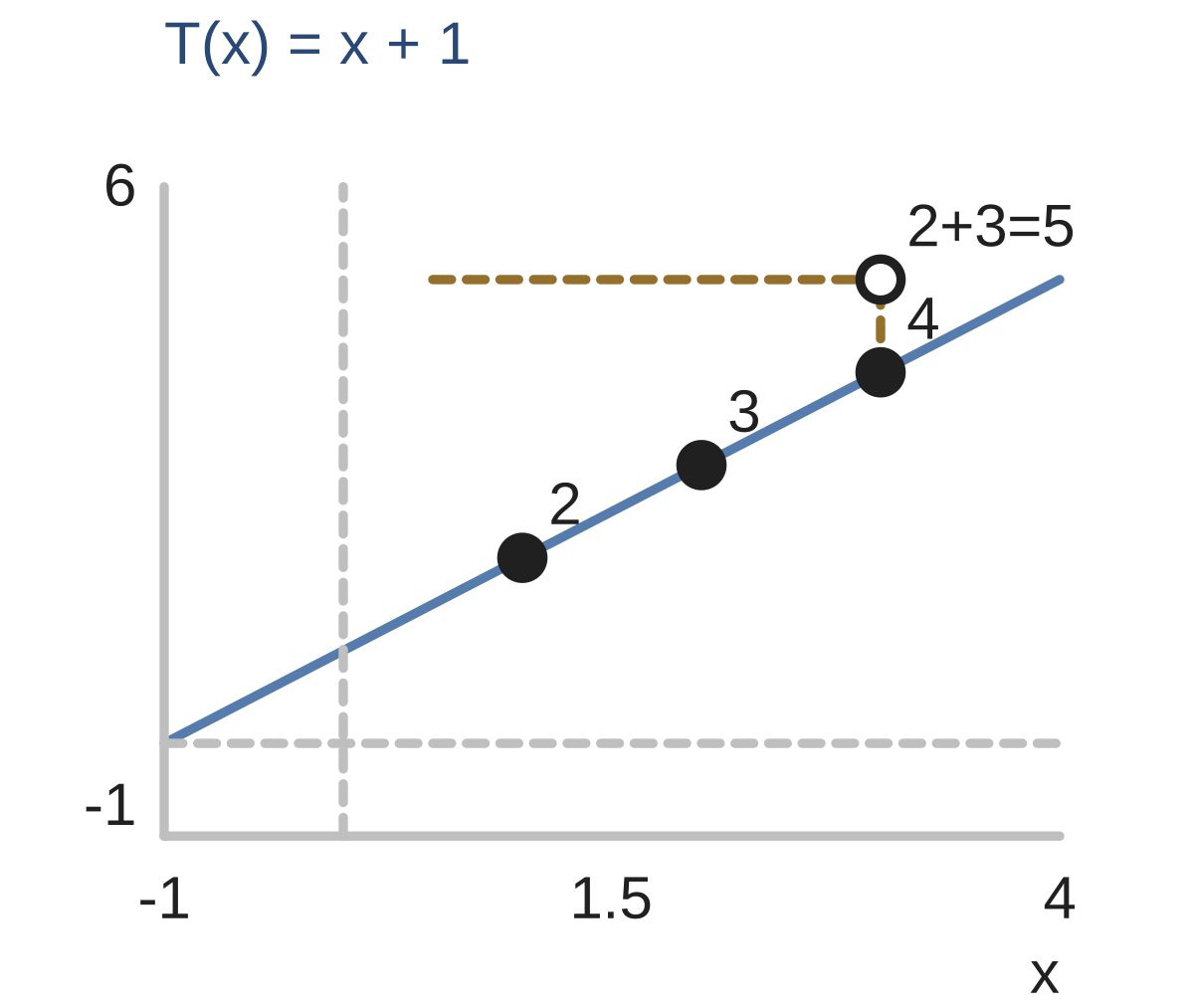
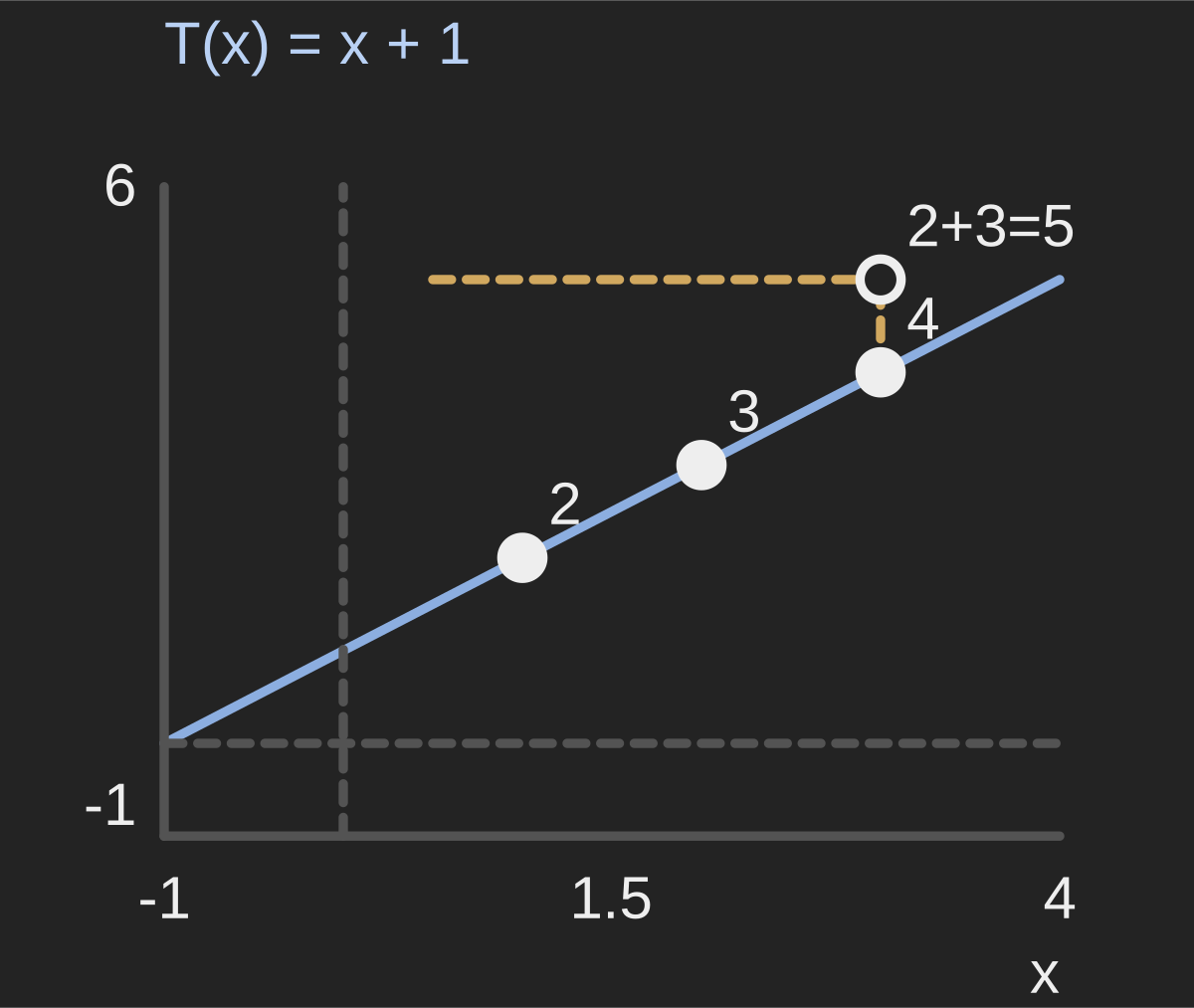
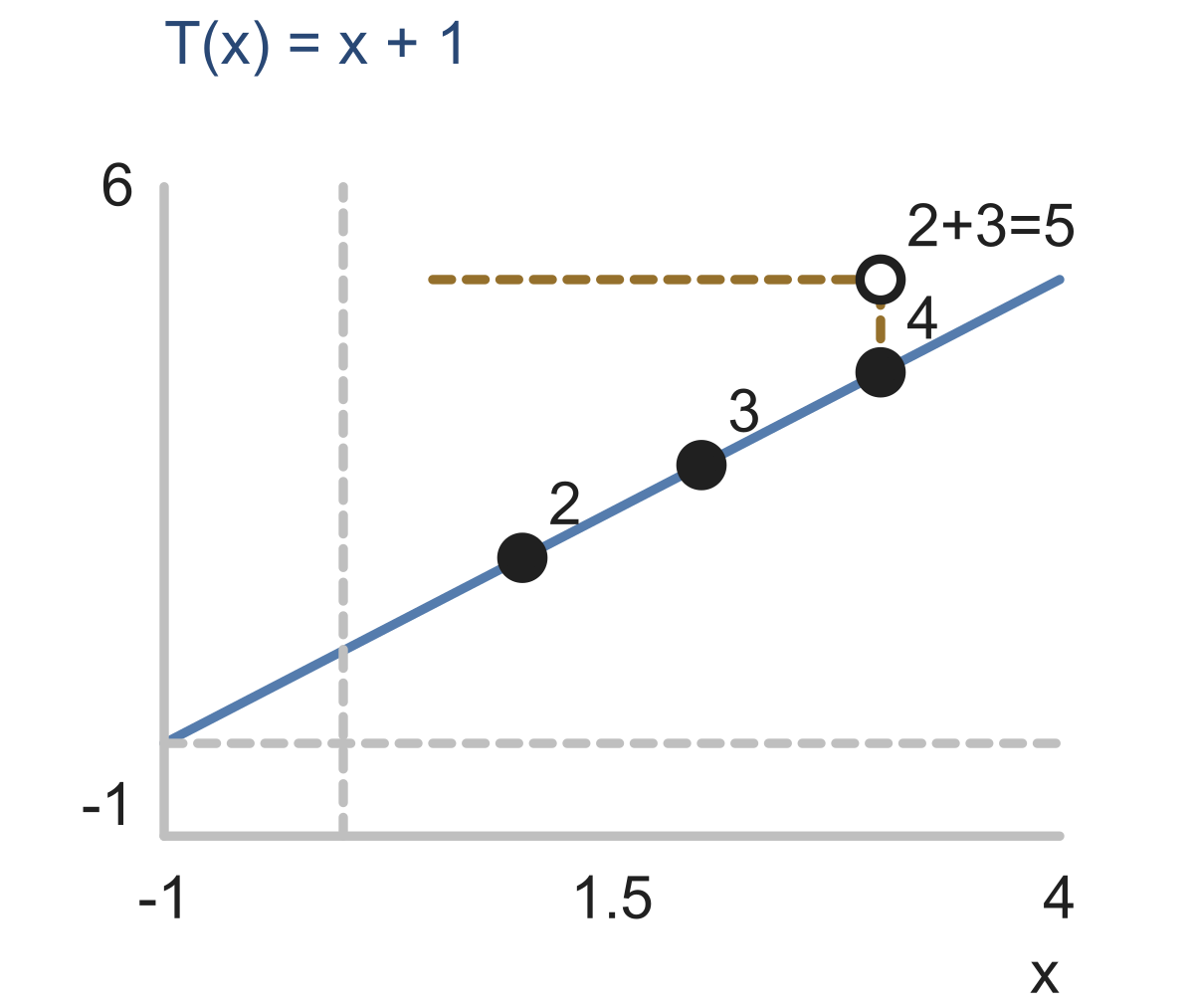
A linear map must send 0 to 0: set in homogeneity. Passing that test alone proves too little.
For on real numbers, . Yet while . This failure disproves linearity.
A sensor uses for real . What are and , in order?
Show answer and explanation
The outputs are and , so homogeneity fails.
One failed check disproves linearity. A finite set of passing numerical checks cannot prove that both rules hold for every input.
Do 20 passed addition tests prove a real-vector map linear?
Show answer and explanation
Both rules must hold for all inputs.
Prove both rules for all inputs; one failure disproves linearity.
- Check both addition and real-scalar preservation.
Sources & further reading
- [1]Boyd and Vandenberghe, Introduction to Applied Linear Algebra (2018), 2.1 pp.30–33 and 8.1 pp.147–149 ↗Boyd and Vandenberghe · Book