Skip to content
Glacius
Linear algebraConcept reference

Orthogonal vectors

Two real vectors of the same dimension are orthogonal when their dot product is zero.

On this page 7 sections
  1. Overview
  2. Two vectors are orthogonal when their dot product is zero
  3. Different lengths do not establish orthogonality
  4. Check your understanding
  5. Key takeaway
  6. Sources & further reading
  7. Concept connections

01Two vectors are orthogonal when their dot product is zero#

Two vectors are orthogonal when their dot product is zero. For two nonzero vectors, this means their directions meet at a right angle. The calculation checks every coordinate, even when a drawing is unavailable.

For u=(2,1)u=(2,1) and v=(1,2)v=(-1,2), the products −2 and 2 cancel. Their dot product is zero, so they are orthogonal.
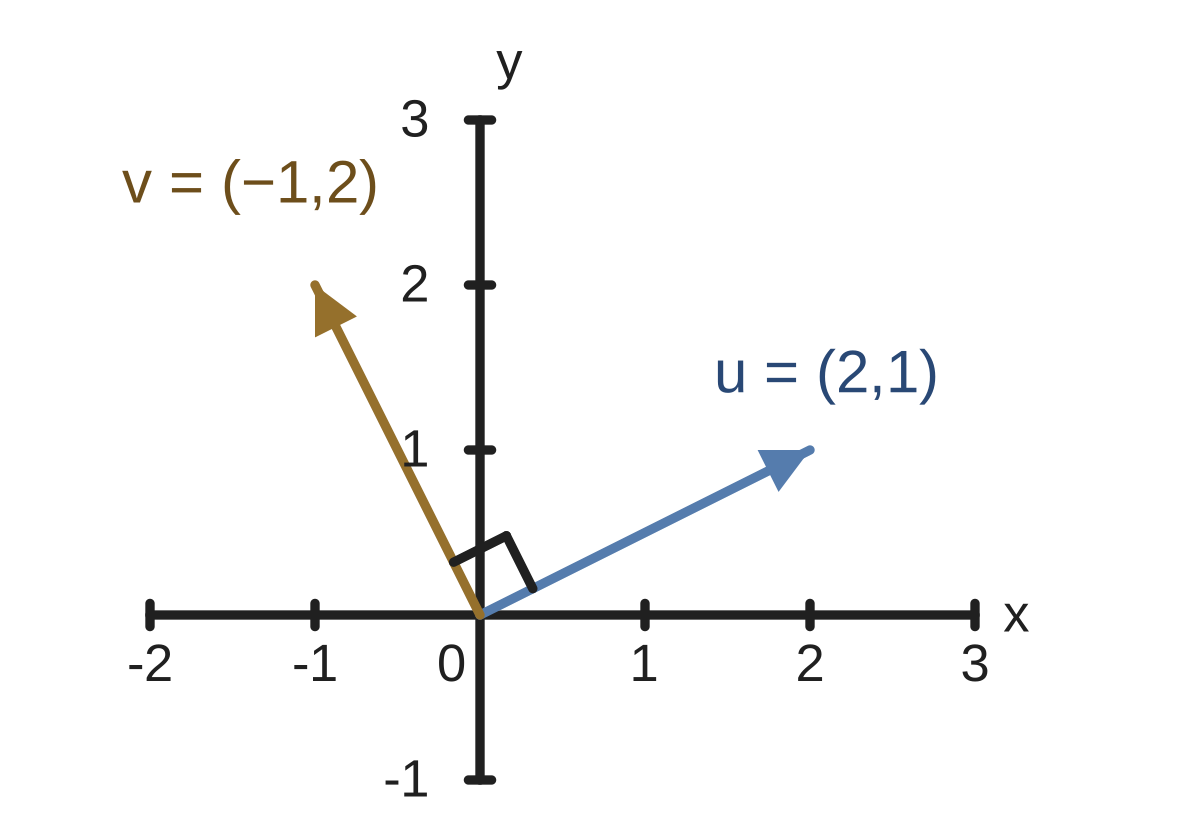
The axes use 44 pixels per unit in both directions. Arrows u=(2,1) and v=(-1,2) share the origin. Their dot product is 2(-1)+1(2)=0. The small square at the origin marks the right angle between these two nonzero vectors.The axes use 44 pixels per unit in both directions. Arrows u=(2,1) and v=(-1,2) share the origin. Their dot product is 2(-1)+1(2)=0. The small square at the origin marks the right angle between these two nonzero vectors.
Figure 1The axes use 44 pixels per unit in both directions. Arrows u=(2,1) and v=(-1,2) share the origin. Their dot product is 2(-1)+1(2)=0. The small square at the origin marks the right angle between these two nonzero vectors.
Link to this figure ↗Download SVGDownload PNG
Check your reasoning

Are (1,2)(1,2) and (4,2)(4,-2) orthogonal?

  1. AOrthogonal
  2. BNot orthogonal
  3. CDot product undefined
Show answer and explanation
Orthogonal

Their dot product is 44=04-4=0.

02Different lengths do not establish orthogonality#

Different lengths do not establish orthogonality. The vectors (1,0)(1,0) and (2,0)(2,0) point in the same direction; their dot product is 2. Orthogonality requires a zero total, even when the individual products are nonzero.

The zero vector has dot product zero with every vector of the same dimension, so it is orthogonal to each by the algebraic definition. It has no direction: an angle involving the zero vector is undefined.

Check your reasoning

For (0,0)(0,0) and (3,4)(3,4), which is correct?

  1. AOrthogonal; angle undefined.
  2. BOrthogonal; angle 90°.
  3. CNot orthogonal.
Show answer and explanation
Orthogonal; angle undefined.

Zero dot product; zero has no direction.

03Check your understanding#

Check your reasoning

A reference signal is r=(2,1)r=(2,1). Which signal is orthogonal to rr?

  1. A(2,1)(2,1)
  2. B(1,2)(1,2)
  3. C(1,2)(1,-2)
Show answer and explanation
(1,2)(1,-2)

Only (1,2)(1,-2) gives 2(1)+1(2)=02(1)+1(-2)=0.

Key takeaway

Test whether the dot product is zero; an angle requires two nonzero vectors.

  • Decide whether two vectors are orthogonal using their dot product.

Sources & further reading

  1. [1]
    MIT 18.022: Lecture 2, Dot productMIT OpenCourseWare · Book
  2. [2]

Reference this concept

Link to this page, a section, or an individual figure.

Glacius. “Orthogonal vectors.” Math behind ML. /learn/la-orthogonal