Skip to content
Glacius
Linear algebraConcept reference

Reduced echelon form

Reduced row-echelon form has unit pivots that are the only nonzero entries in their columns, in addition to the echelon conditions.

On this page 7 sections
  1. Overview
  2. Echelon form clears below pivots
  3. The augmented entry follows every row operation
  4. Nonpivot columns may stay nonzero
  5. Key takeaway
  6. Sources & further reading
  7. Concept connections

01Echelon form clears below pivots#

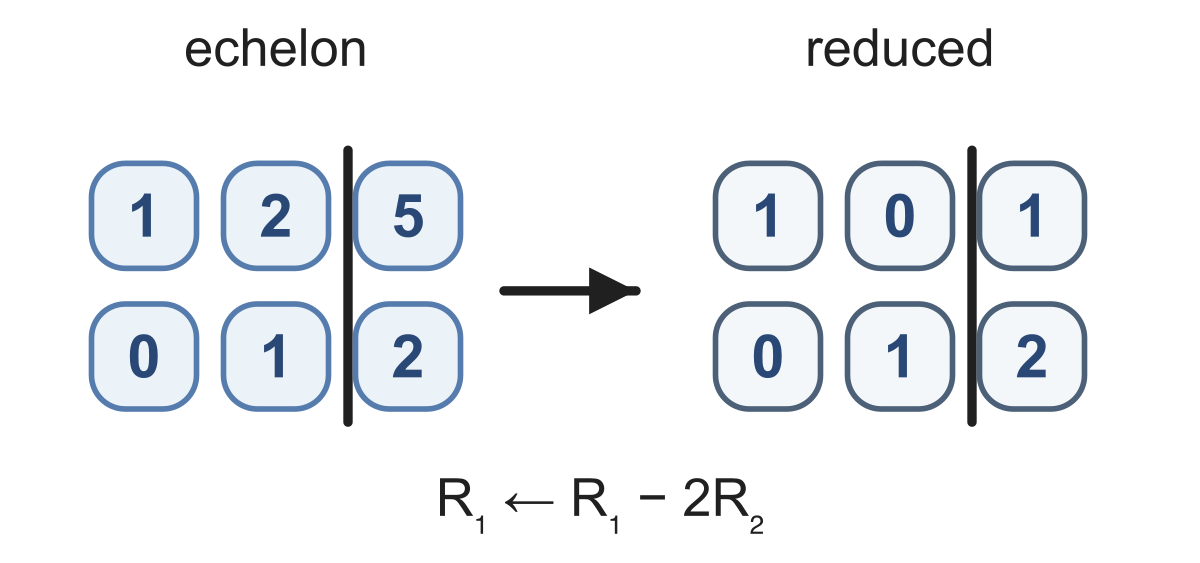
Echelon form clears below pivots. Reduced echelon form also makes every pivot 1 and clears above it. Here the 2 above the second pivot must go.
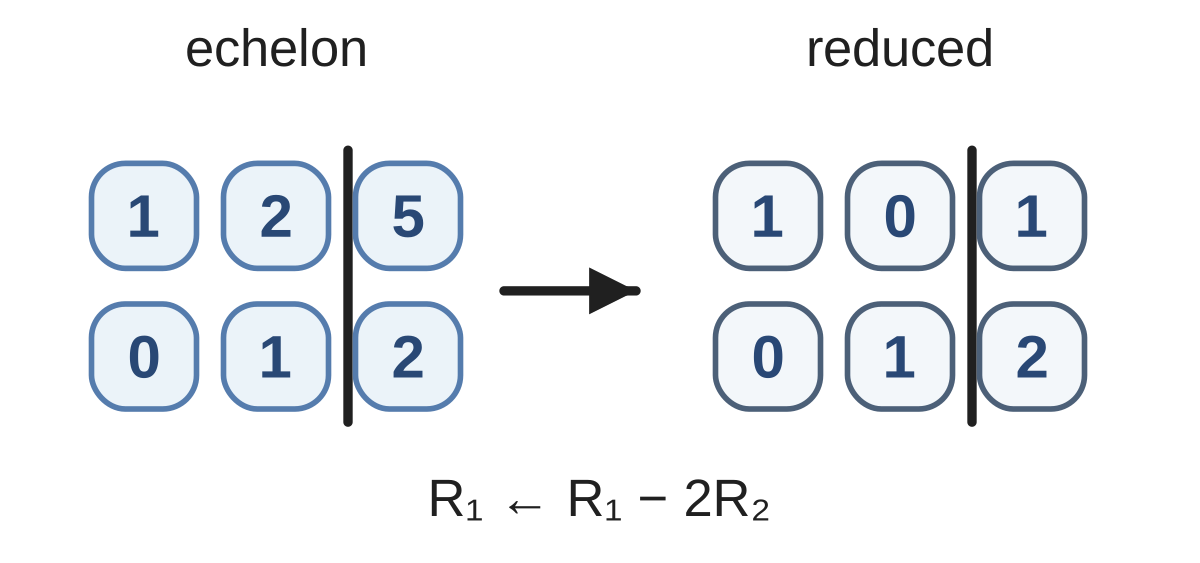
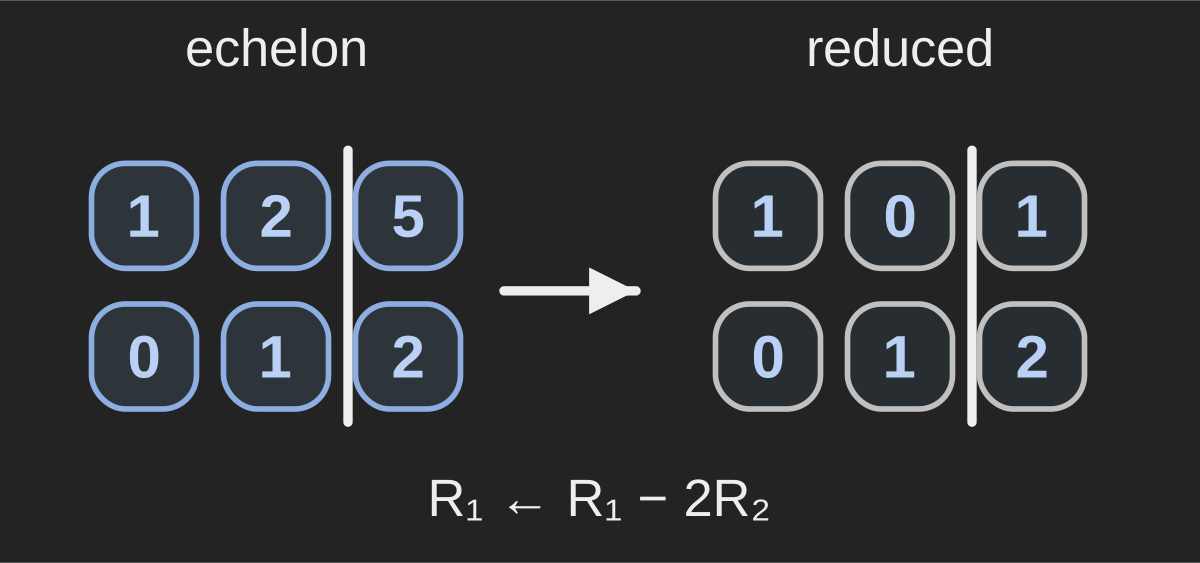
An echelon augmented matrix has rows (1,2|5) and (0,1|2). Replacing row 1 by row 1 minus twice row 2 gives reduced rows (1,0|1) and (0,1|2). This clears the 2 above the second pivot and updates 5 to 1 in the augmented column.An echelon augmented matrix has rows (1,2|5) and (0,1|2). Replacing row 1 by row 1 minus twice row 2 gives reduced rows (1,0|1) and (0,1|2). This clears the 2 above the second pivot and updates 5 to 1 in the augmented column.
Figure 1An echelon augmented matrix has rows (1,2|5) and (0,1|2). Replacing row 1 by row 1 minus twice row 2 gives reduced rows (1,0|1) and (0,1|2). This clears the 2 above the second pivot and updates 5 to 1 in the augmented column.
Link to this figure ↗Download SVGDownload PNG

Start with rows (1,15)(1,1\mid5) and (0,24)(0,2\mid4). Divide all of row 2 by 2 to get (0,12)(0,1\mid2). Then subtract it from row 1:

R1=(1,03)R_1=(1,0\mid3)
Check your reasoning

Reduce the rows. [115024]\left[\begin{array}{rr|r}1&1&5\\0&2&4\end{array}\right]

  1. ARows: (1,0) | 5; (0,1) | 2
  2. BRows: (1,0) | 3; (0,1) | 2
  3. CRows: (1,1) | 5; (0,1) | 2
Show answer and explanation
Rows: (1,0) | 3; (0,1) | 2

Halve row 2, then subtract it from row 1.

02The augmented entry follows every row operation#

The augmented entry follows every row operation. For rows (1,27)(1,2\mid7) and (0,13)(0,1\mid3), clearing the 2 changes the first right-hand side to 72(3)=17-2(3)=1. Leaving 7 would change the system.

Check your reasoning

Claim: already reduced. Repair: [127013]\left[\begin{array}{rr|r}1&2&7\\0&1&3\end{array}\right]

  1. ARows: (1,0) | 1; (0,1) | 3
  2. BRows: (1,0) | 7; (0,1) | 3
  3. CRows: (1,2) | 7; (0,1) | 3
Show answer and explanation
Rows: (1,0) | 1; (0,1) | 3

Apply R1R12R2R_1\leftarrow R_1-2R_2.

03Nonpivot columns may stay nonzero#

Nonpivot columns may stay nonzero. Subtract twice row (0,1,12)(0,1,-1\mid2) from (1,2,39)(1,2,3\mid9). Both the third entry and right-hand side change:

(1,0,55)(1,0,5\mid5)

The third column has no pivot, so its 5 is allowed.

Check your reasoning

A solver exports RREF from 2x+2y=102x+2y=10; y=2y=2. Find row 1’s final right-hand side.

Show answer and explanation
3

Clear yy: 2x=62x=6. Then divide by 2.

Key takeaway

Normalize pivots to 1. Clear above them, updating every entry in each affected row.

  • Reduce an echelon matrix to reduced row-echelon form.

Sources & further reading

  1. [1]

Reference this concept

Link to this page, a section, or an individual figure.

Glacius. “Reduced echelon form.” Math behind ML. /learn/la-rref