Inequalities
A solution of a scalar inequality is any value that makes its ordered comparison true.
On this page 7 sections
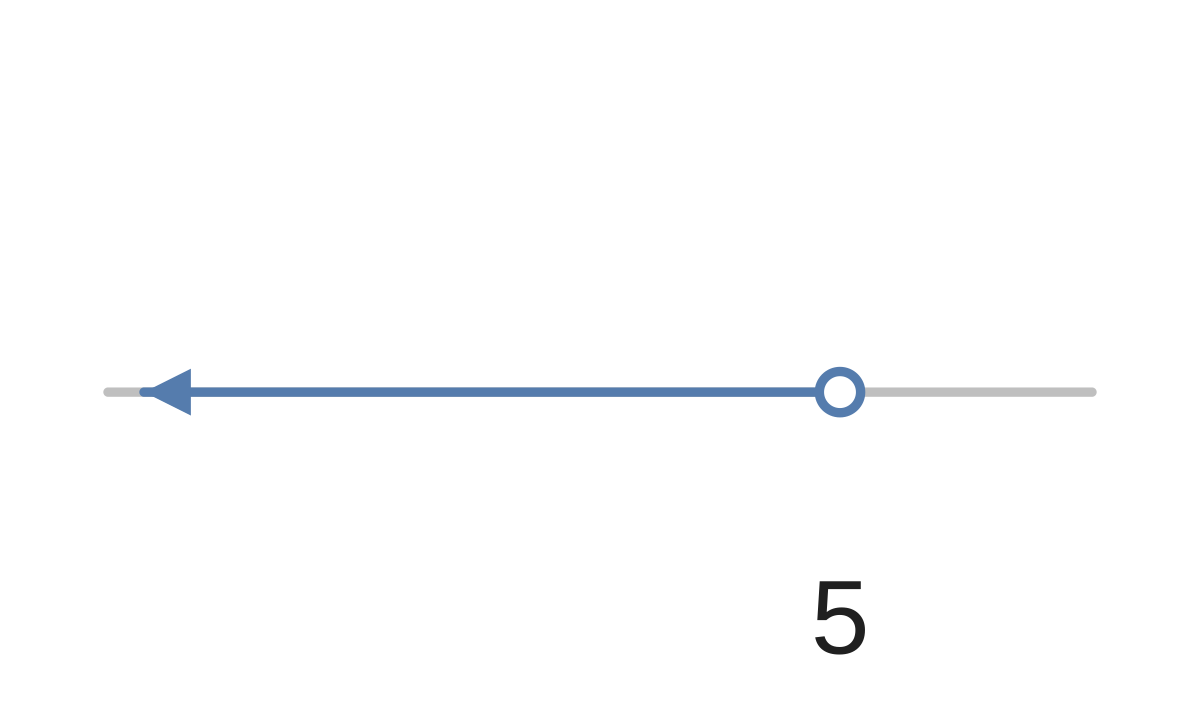
01An inequality describes a range of allowed values#
An inequality describes a range of allowed values. The sign means less than, greater than. Adding a bar, as in or , allows equality too.
The expression on the left must be below 7.
Starting from , subtract from both sides. Moving both values by the same amount keeps their order.
Solve the one-step inequality.
Multiplying or dividing by a positive number also keeps the order. A negative multiplier reverses it: , but .
Divide both sides of by −2 and reverse the sign.
Solve .
Show answer and explanation
Divide by , reversing to . The endpoint is .
02The bar still matters after solving#
The bar still matters after solving. For , the value is allowed; for , it is not. Dividing by a negative reverses direction but does not remove equality.
For the condition , test .
A display allows . What is the largest allowed value of ?
Show answer and explanation
Subtract : . Equality is allowed, so is included.
03Check your understanding#
A sensor rule is . Which range satisfies it?
Show answer and explanation
Dividing by reverses the inequality and gives .
Undo the operation on both sides. Reverse the inequality only when multiplying or dividing by a negative number; preserve whether equality is allowed.
- Solve a one-step scalar inequality
Sources & further reading
- [1]OpenStax Elementary Algebra 2e, 2.7 ↗OpenStax · Book