Learning rates
A quadratic update scales position by 1−ηa; its sign controls crossing and its magnitude controls distance.
On this page 8 sections
01The learning rate turns a direction into a distance#
The learning rate turns a direction into a distance. Too small a rate can make progress slow; too large a rate can jump past a minimum and grow the error. A simple quadratic lets us calculate these outcomes exactly instead of relying on a sketch.
For a positive quadratic, the learning rate determines how each update scales the current position.
For f(x)=x², a rate of 0.75 takes x from 4 to −2. It crosses the minimum but cuts the loss from 16 to 4.
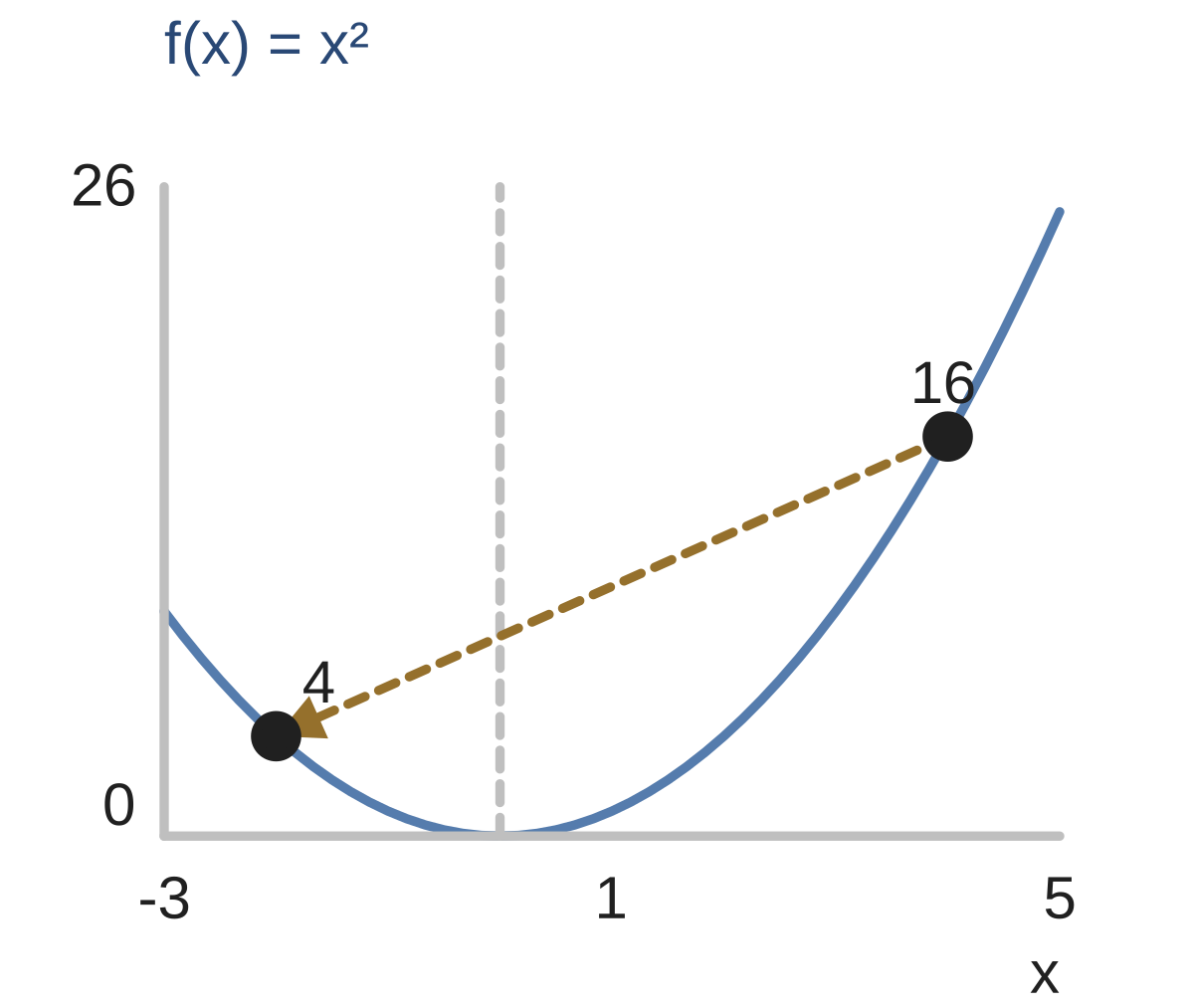
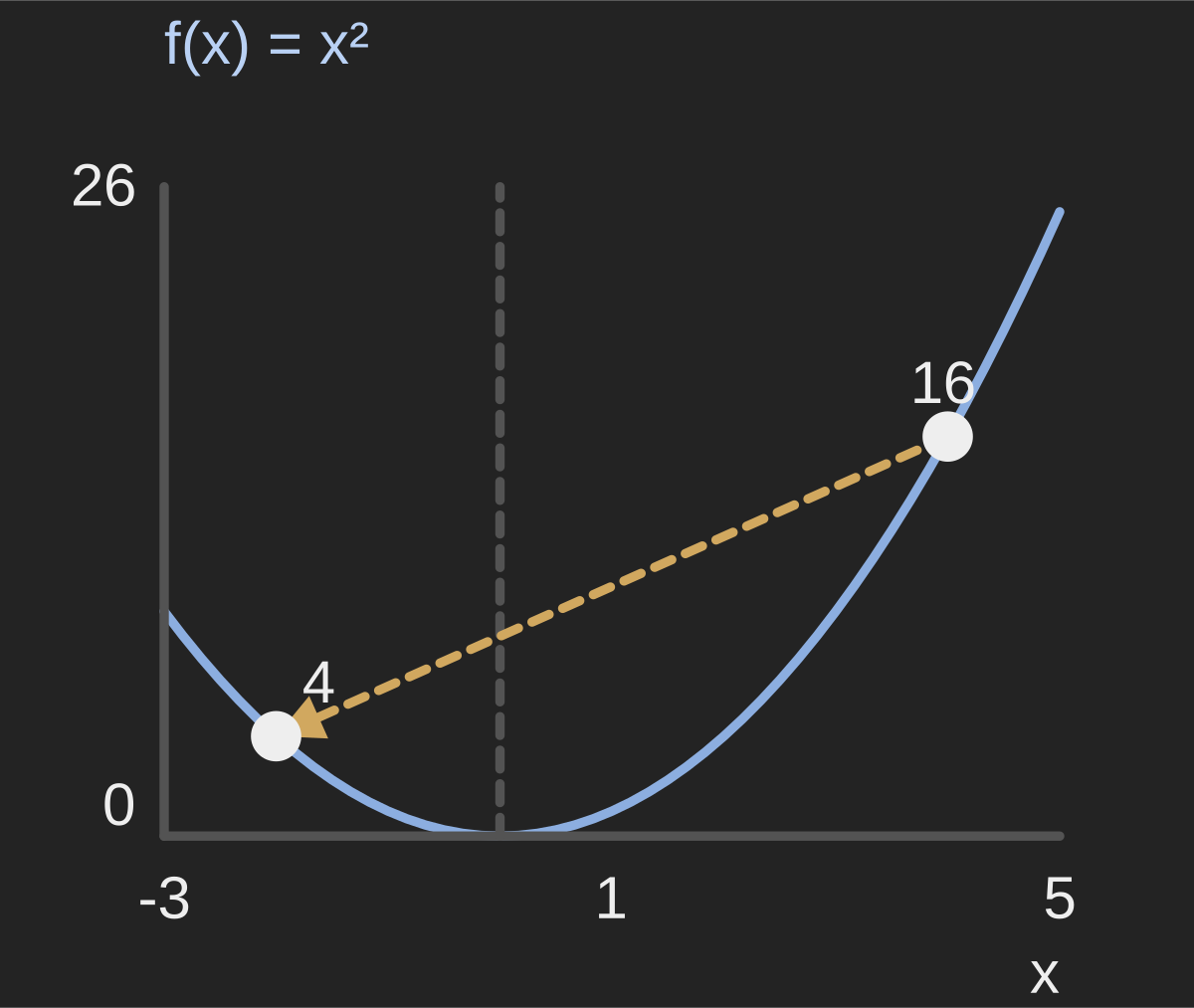
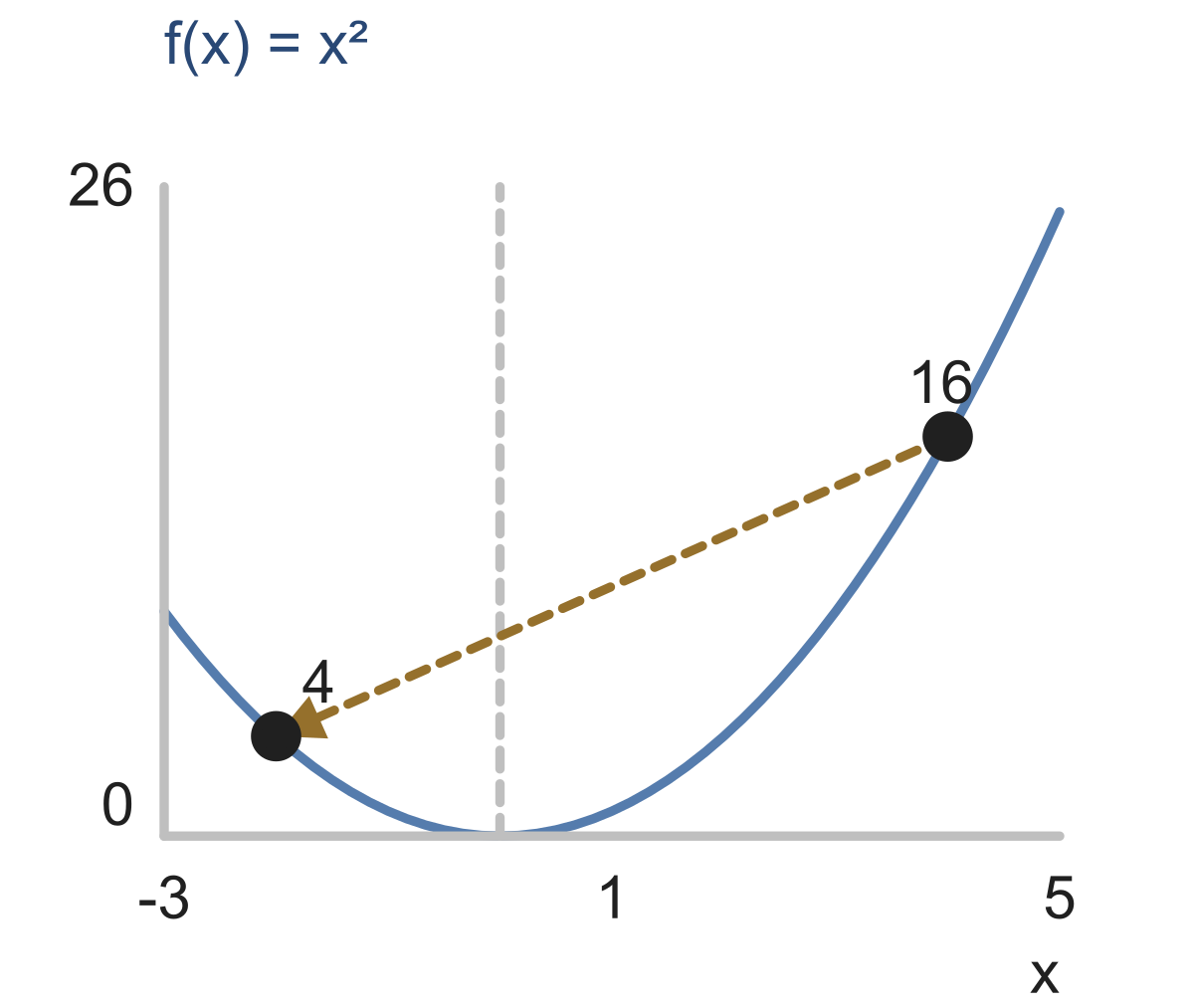
For , the gradient is , so one step gives . With and , the new value is 1. With , it is : the sign flips but the distance to zero shrinks. With , it is and the distance grows.
, start , . Give (next x; loss change).
Show answer and explanation
Factor 0 gives x=0. Loss goes from 18 to 0.
02A negative factor flips the sign#
A negative factor flips the sign. Its absolute value determines whether distance from zero shrinks, stays fixed or grows.
For a nonzero start, repeated fixed-rate steps converge to zero when the factor’s absolute value is below 1.
, fixed ; start nonzero. Repeated steps?
Show answer and explanation
Factor 0.5: same sign, closer.
03Crossing the minimum is not the same as diverging#
Crossing the minimum is not the same as diverging. A factor between −1 and 0 alternates signs while shrinking the distance.
At factor −1 the loss stays fixed; a factor below −1 makes distance and loss grow.
, , . Draft: crossing zero raises loss. Give (next x; loss change).
Show answer and explanation
x=−2; loss: 32→8.
04A closer look#
For this quadratic, improvement depends on the magnitude of the multiplier , not just whether it is positive. More complicated losses have different curvature in different regions and directions. A step-size rule must be interpreted for the stated objective.
Compute the update factor and compare its absolute value with 1 before interpreting an overshoot.
- Diagnose overshooting from a step size on a one-dimensional quadratic.
Sources & further reading
- [1]Dive into Deep Learning §12.3.1.1 ↗Dive into Deep Learning §12.3.1.1 · Article