Second derivatives
The second derivative is the derivative of the first derivative.
On this page 7 sections
01The first derivative is itself a function#
The first derivative is itself a function. Its derivative is the second derivative: it measures how the first rate changes with the input.
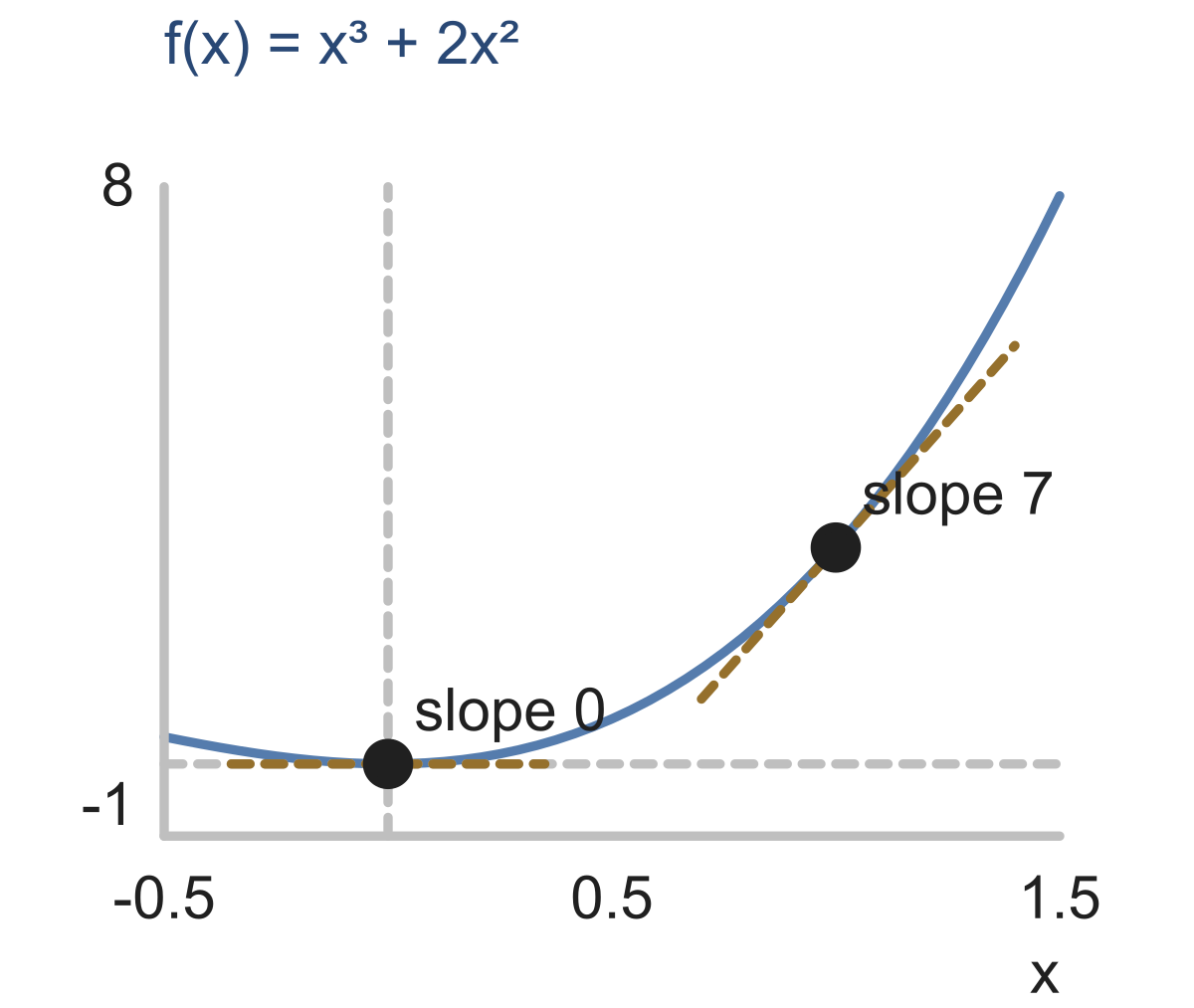
For , differentiate every term once, then differentiate the resulting function.
![For f=x³+2x², f′=3x²+4x and f″=6x+4. At x=0 the tangent slope is 0; at x=1 it is 7. On [0,1], f″ is positive, so the slope increases.](/visuals/c-second/plane-cspjyu.svg)
![For f=x³+2x², f′=3x²+4x and f″=6x+4. At x=0 the tangent slope is 0; at x=1 it is 7. On [0,1], f″ is positive, so the slope increases.](/visuals/c-second/plane-cspjyu-dark.svg)
. Find .
Show answer and explanation
Differentiate once to get , then again to get .
02For , the first derivative is #
For , the first derivative is . Keep those coefficients in the second step.
At , the second derivative is . Differentiate first, then evaluate.
If is position and is time, is velocity and is acceleration. With meters and seconds, their units are meters per second and meters per second squared.
Position in meters is , where is time in seconds. Acceleration is . Find acceleration at , in .
Show answer and explanation
Differentiate position twice: . At , this is .
03A nonzero first derivative can have zero derivative#
A nonzero first derivative can have zero derivative. For , the first derivative is the constant , so the second derivative is .
Two primes mean differentiate twice. They do not mean .
. A learner squares the first derivative. Repair .
Show answer and explanation
Differentiate once to get , then again to get .
Find the first derivative, then differentiate that function again.
- Compute the second derivative of a scalar function.
Sources & further reading
- [1]OpenStax Calculus Volume 1, 3.2: Higher-order derivatives ↗OpenStax Calculus Volume 1 · Book