Chebyshev's inequality
Chebyshev bounds P(|X−μ|≥d) by Var(X)/d² for positive d and finite variance.
On this page 7 sections
01Chebyshev bounds how often a variable lies at least a distance from its mean #
Chebyshev bounds how often a variable lies at least a distance from its mean . It needs finite variance, without requiring a normal distribution.
With mean 10 and variance 4, distance 4 gives a bound of 0.25. This includes both tails: values at most 6 or at least 14.
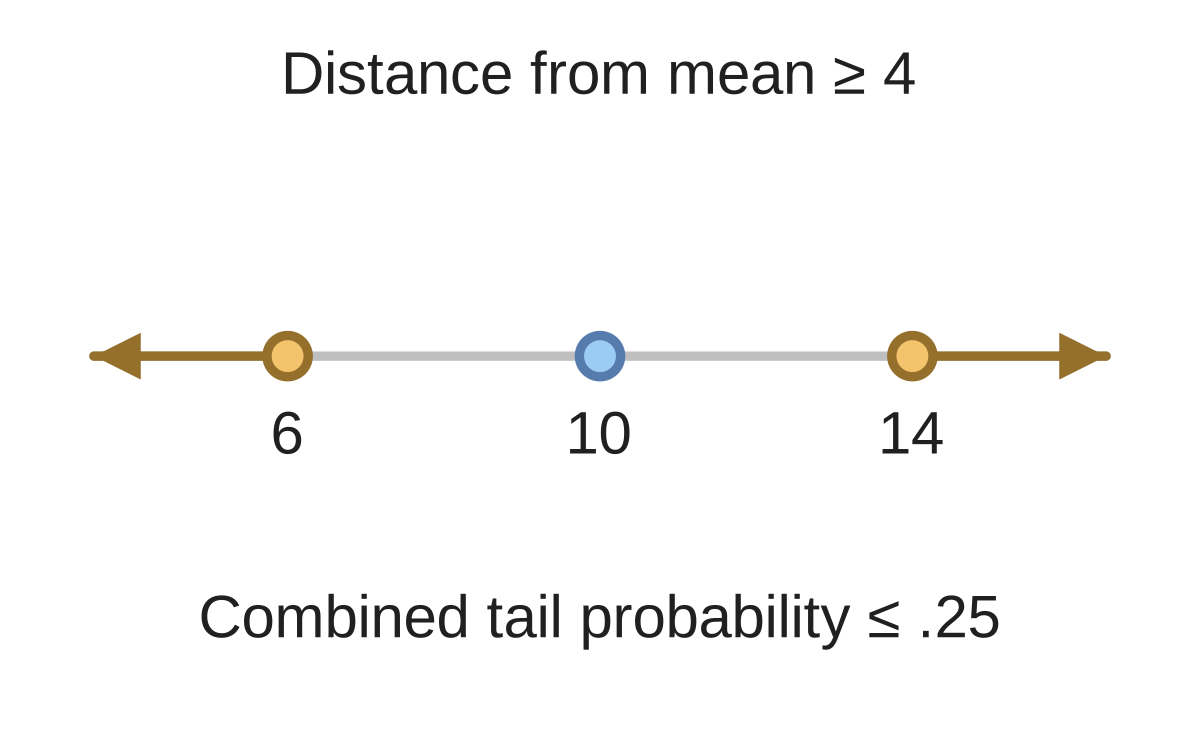
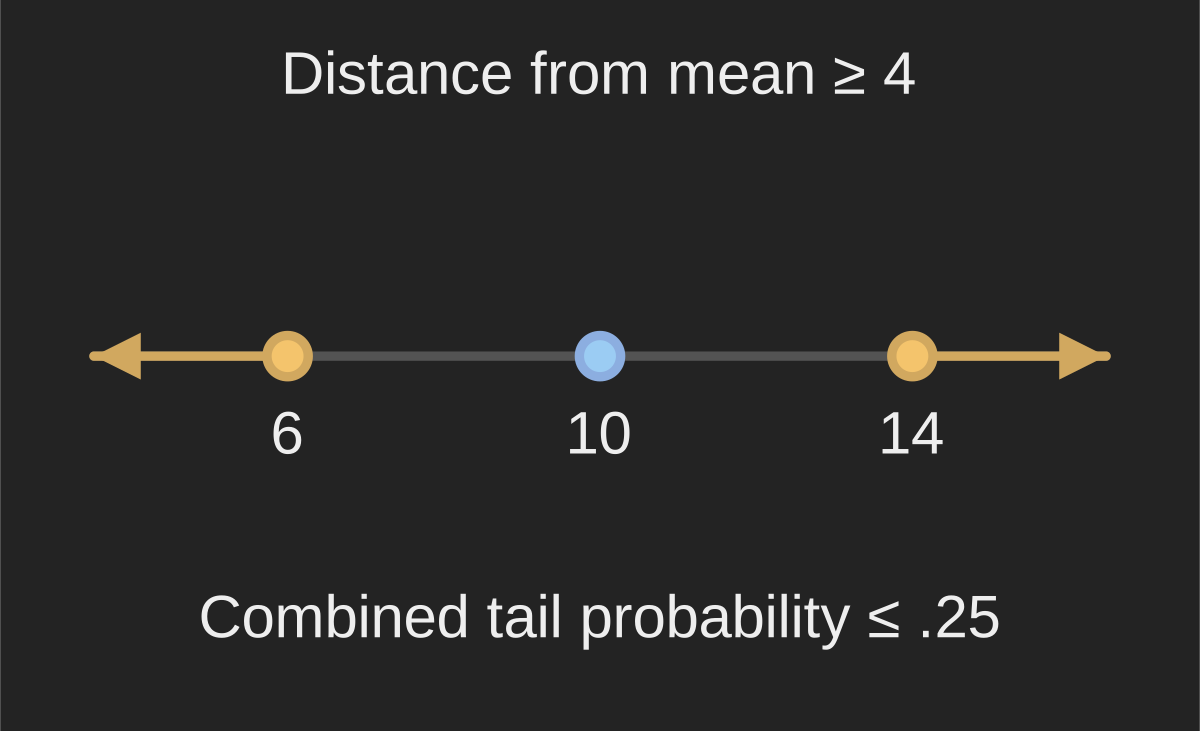
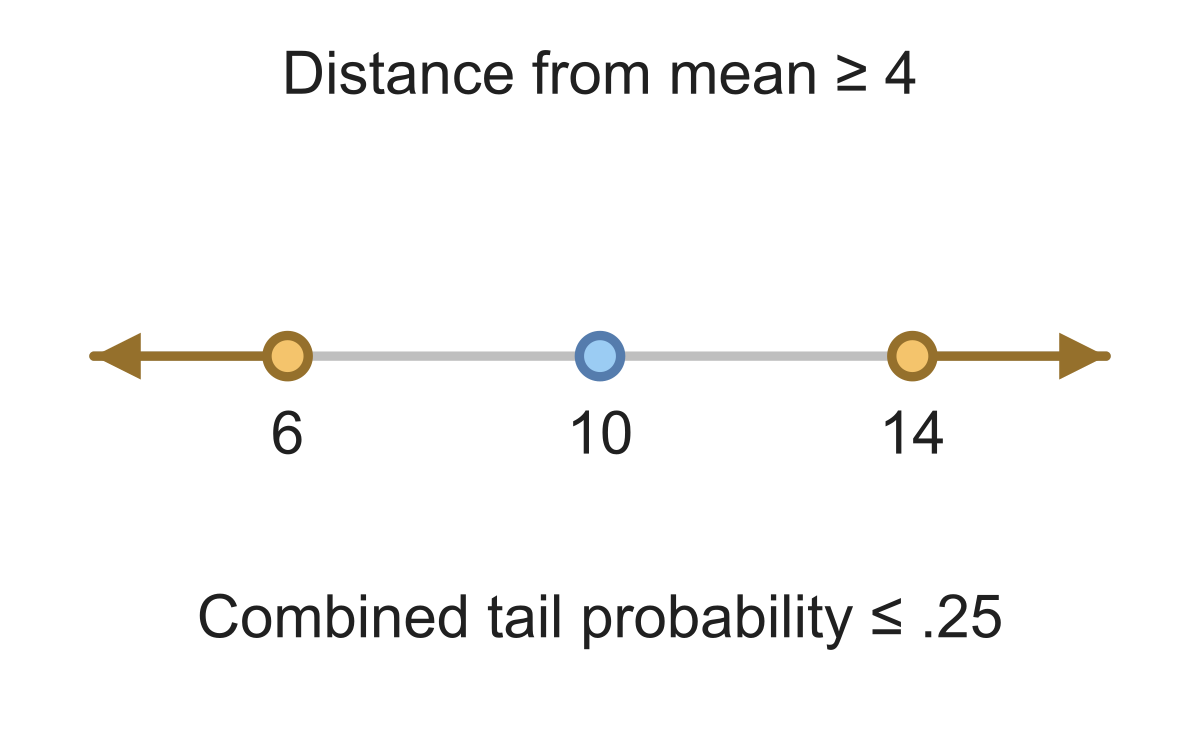
Mean , variance . Bound by Chebyshev, capped at .
Show answer and explanation
Distance is ; variance divided by its square is . Use upper bound .
02For a symmetric open band, measure from the center to either endpoint#
For a symmetric open band, measure from the center to either endpoint. The whole band width would double the distance incorrectly.
The same bound follows by applying Markov to the nonnegative squared deviation. If the ratio exceeds 1, retain the trivial bound 1.
Mean , variance . Bound the probability outside the open band by Chebyshev, capped at .
Show answer and explanation
Distance is ; variance divided by its square is . Use upper bound .
03Chebyshev provides a ceiling on the tail probability#
Chebyshev provides a ceiling on the tail probability. It cannot turn a mean and variance into an exact tail probability for every distribution.
The endpoints count in the deviation event because it uses . The inside event is the open band .
Mean , variance . Report: . Capped Chebyshev correction?
Show answer and explanation
.
Divide variance by squared distance; cap at 1 and keep the upper-bound interpretation.
- Bound a deviation probability using finite variance.
Sources & further reading
- [1]Pishro-Nik: Markov and Chebyshev Inequalities ↗Pishro-Nik · Article