Markov's inequality
For nonnegative X and positive a, Markov bounds P(X≥a) by E[X]/a.
On this page 7 sections
01How much probability can sit far above the mean?#
How much probability can sit far above the mean? If a variable is nonnegative, the mean limits how often it can reach a high threshold.
Markov requires and .
If the mean is , outcomes at least each contribute at least times their probability to that mean. Their probability cannot exceed .
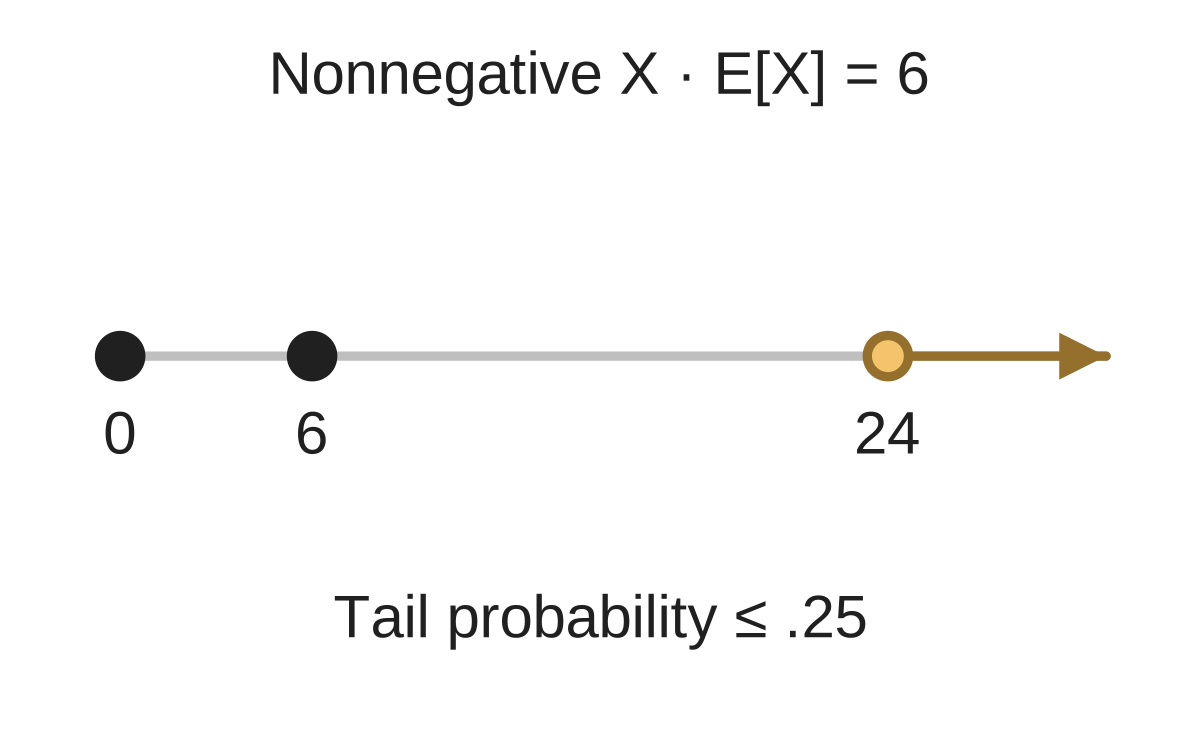
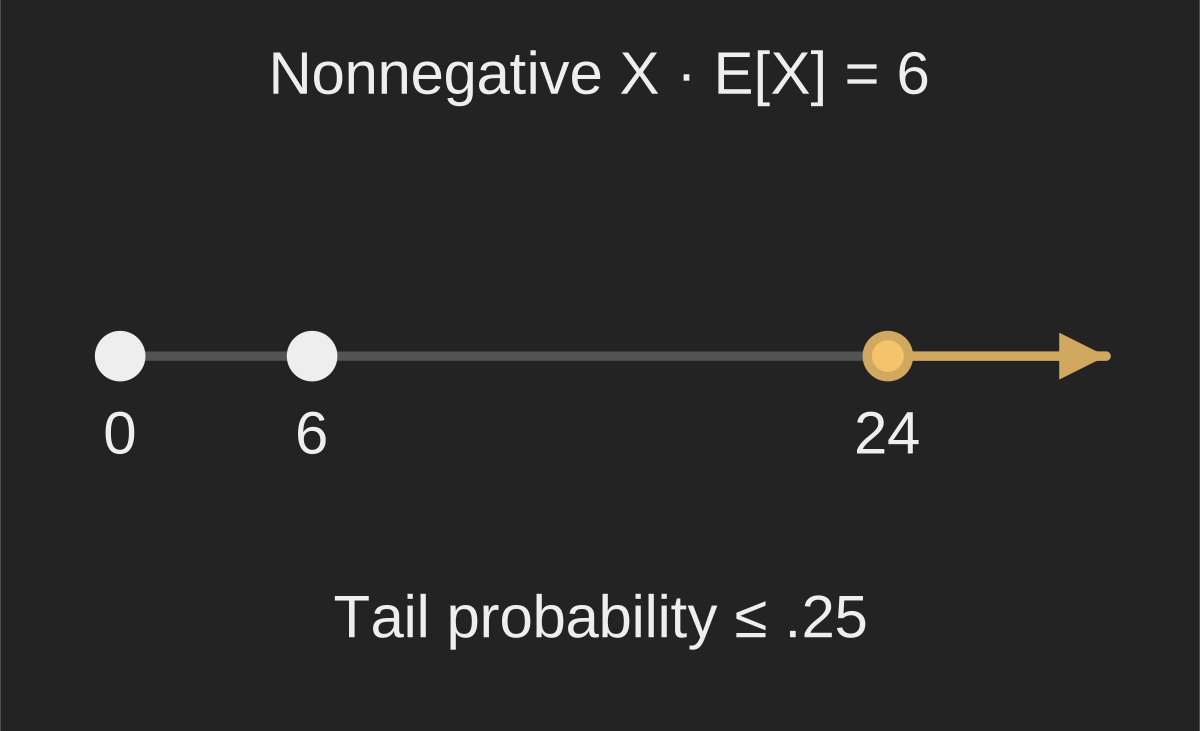
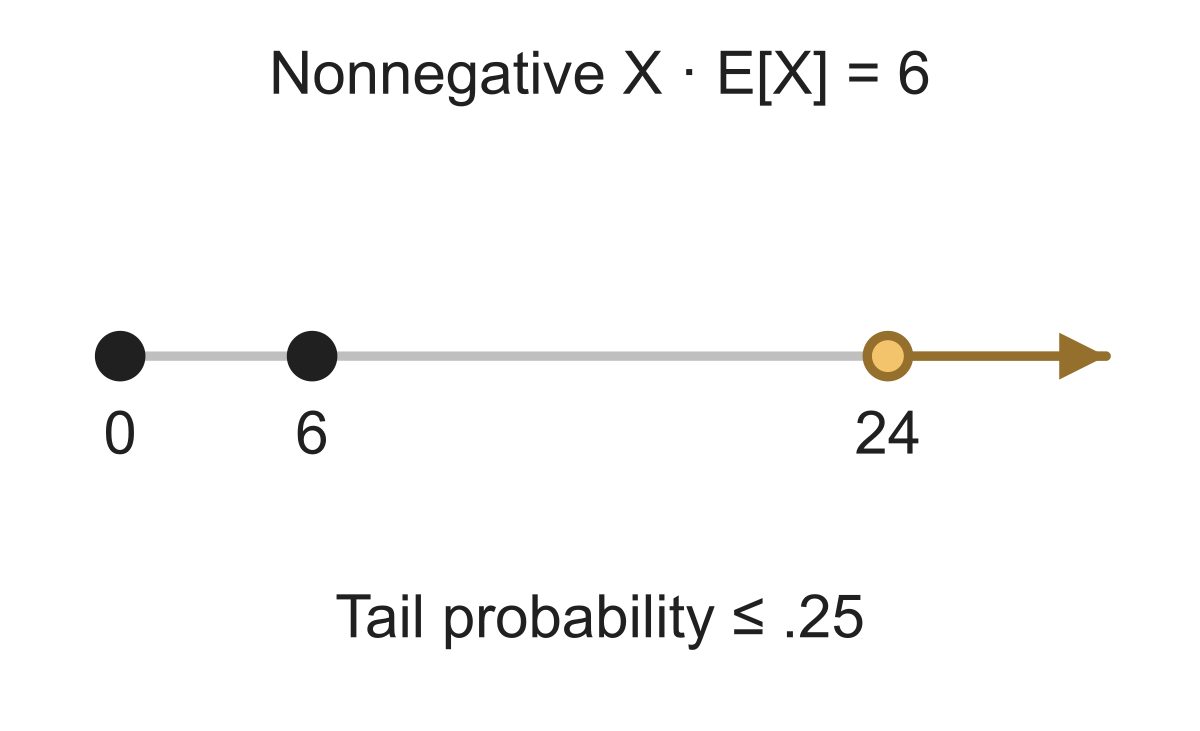
, . Bound using Markov and the cap .
Show answer and explanation
Mean divided by threshold is . The upper bound is .
02The variable can be a nonnegative count, duration or size#
The variable can be a nonnegative count, duration or size. Translate the requested event into a positive threshold, then divide its mean by that threshold.
If the ratio exceeds 1, use 1 as the tighter probability bound. This says nothing more than every probability being at most 1.
A nonnegative duration has mean seconds. Bound using Markov and the cap .
Show answer and explanation
Mean divided by threshold is . The upper bound is .
03A bound limits possible probabilities; it does not usually give the exact probability#
A bound limits possible probabilities; it does not usually give the exact probability. Two distributions can share a mean and have different tails.
The sign assumption matters. Negative values could offset a large positive tail, invalidating this direct calculation.
Report: for , . Repair it.
Show answer and explanation
is an upper bound.
Check nonnegativity, divide mean by positive threshold, and report an upper bound capped at 1.
- Bound a nonnegative variable's upper tail from its mean.
Sources & further reading
- [1]Pishro-Nik: Markov and Chebyshev Inequalities ↗Pishro-Nik · Article