ProbabilityConcept reference
Discrete marginals
A marginal mass function sums the joint probabilities over every value of the variable being removed.
On this page 8 sections
01A marginal distribution keeps one variable#
A marginal distribution keeps one variable. To keep , add the joint masses across all values.
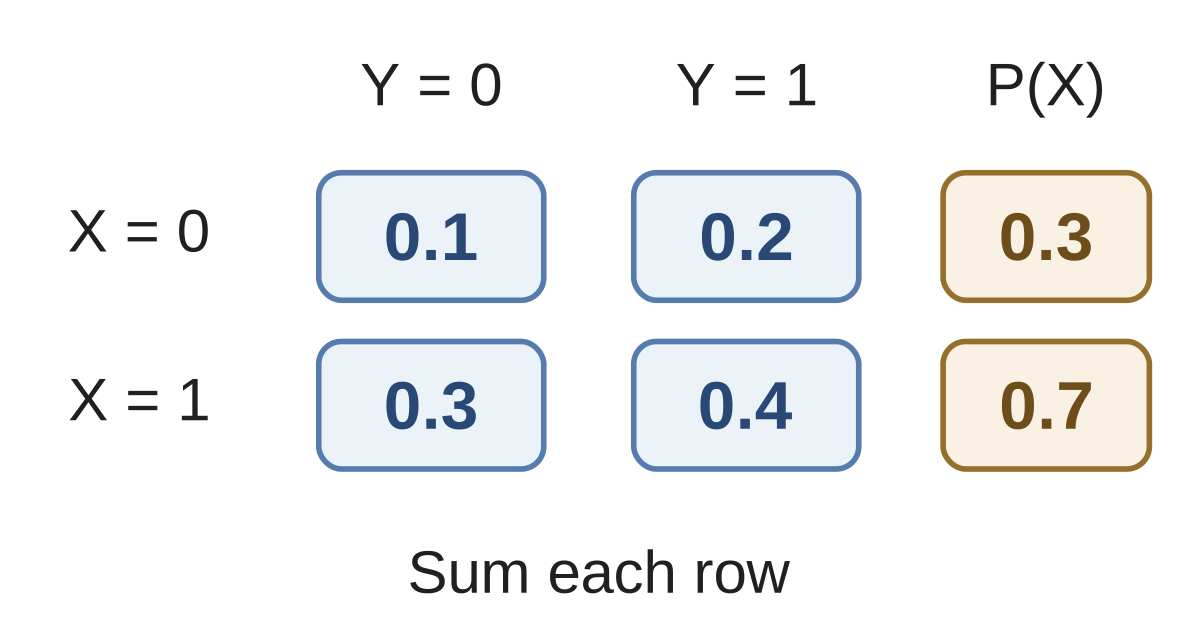
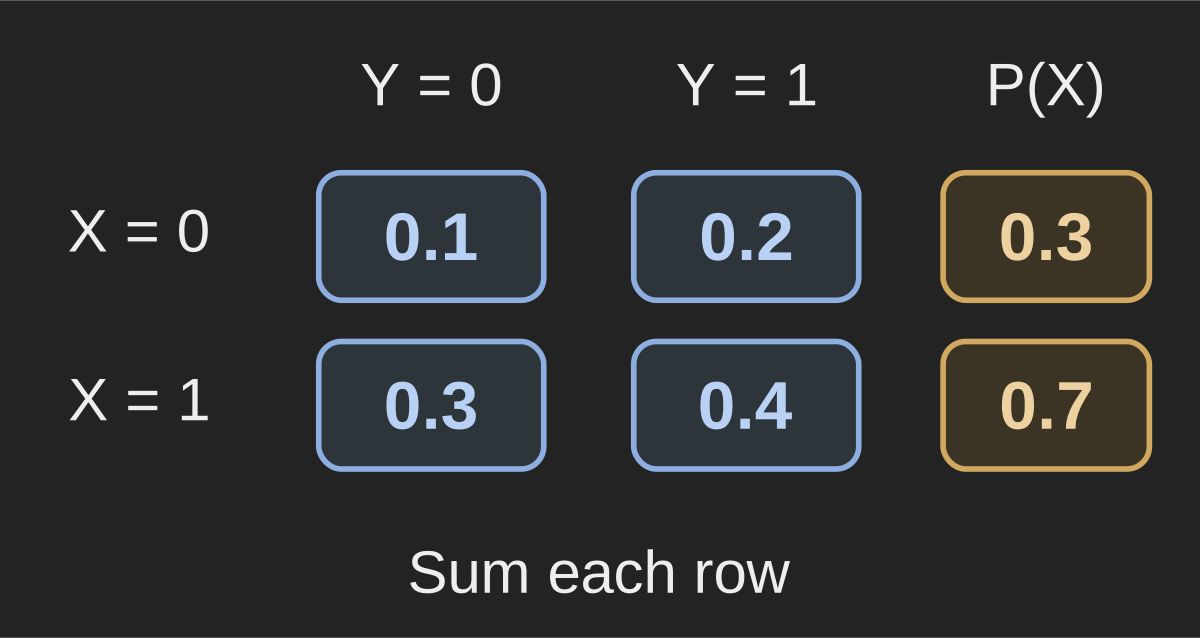
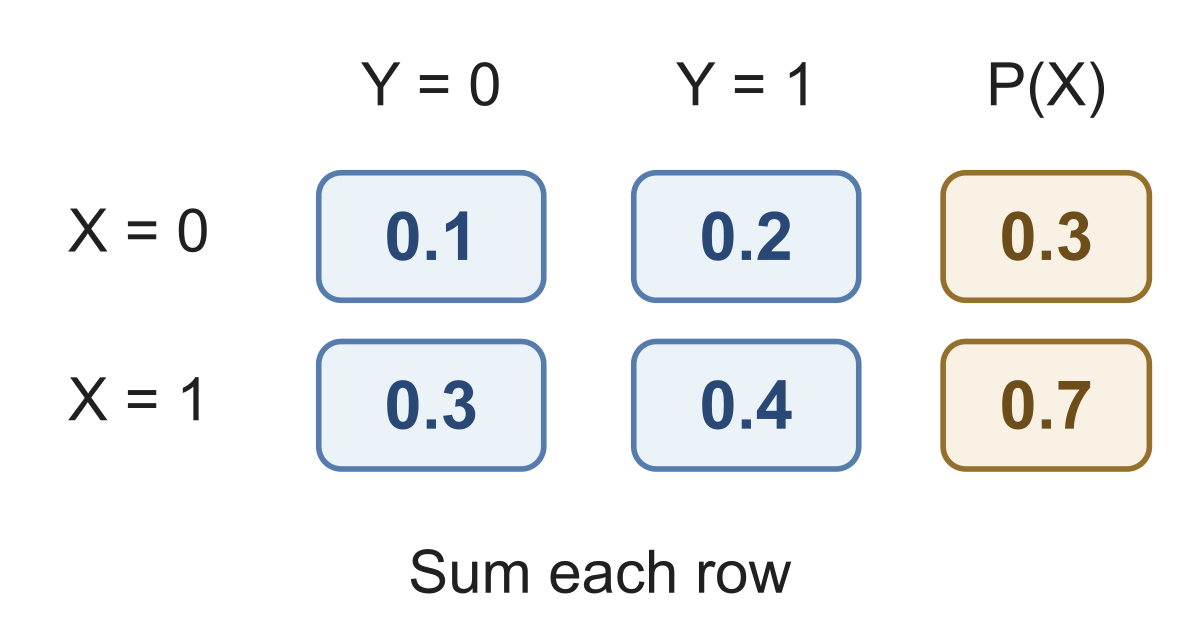
Joint rows have rows . The X probabilities are and .
Check your reasoning
X rows; Y columns; order 0,1. Joint rows: . Find .
Show answer and explanation
Column sums: .
02For joint rows and columns , keeping means adding down columns#
For joint rows and columns , keeping means adding down columns. The marginal is .
Check your reasoning
X rows; Y columns; order 0,1. Joint rows: . Fix row division: find .
Show answer and explanation
Row sums: .
03Marginalization adds probability mass#
Marginalization adds probability mass. No division is needed: the complete marginal already sums to 1. Use the table headings to choose which coordinate to keep.
Check your reasoning
Y: cache flag. X rows; Y columns; order 0,1. Joint rows: . Give the cache flag PMF.
Show answer and explanation
Columns: .
Key takeaway
Keep one variable; sum over the other.
- Marginalize a joint mass table over one variable.
Further questions
Does a marginal depend on which row is observed?
No. It sums over the other variable without observing or fixing it.
Sources & further reading
- [1]
- [2]