Skip to content
Glacius
ProbabilityConcept reference

Joint mass functions

A joint probability mass function assigns each ordered pair its probability of occurring together.

On this page 8 sections
  1. Overview
  2. A joint mass function keeps two values together
  3. Repeated pairs share one cell
  4. The complete table sums to 1
  5. Key takeaway
  6. Further questions
  7. Sources & further reading
  8. Concept connections

01A joint mass function keeps two values together#

A joint mass function keeps two values together. Here each cell gives the probability of its ordered pair.
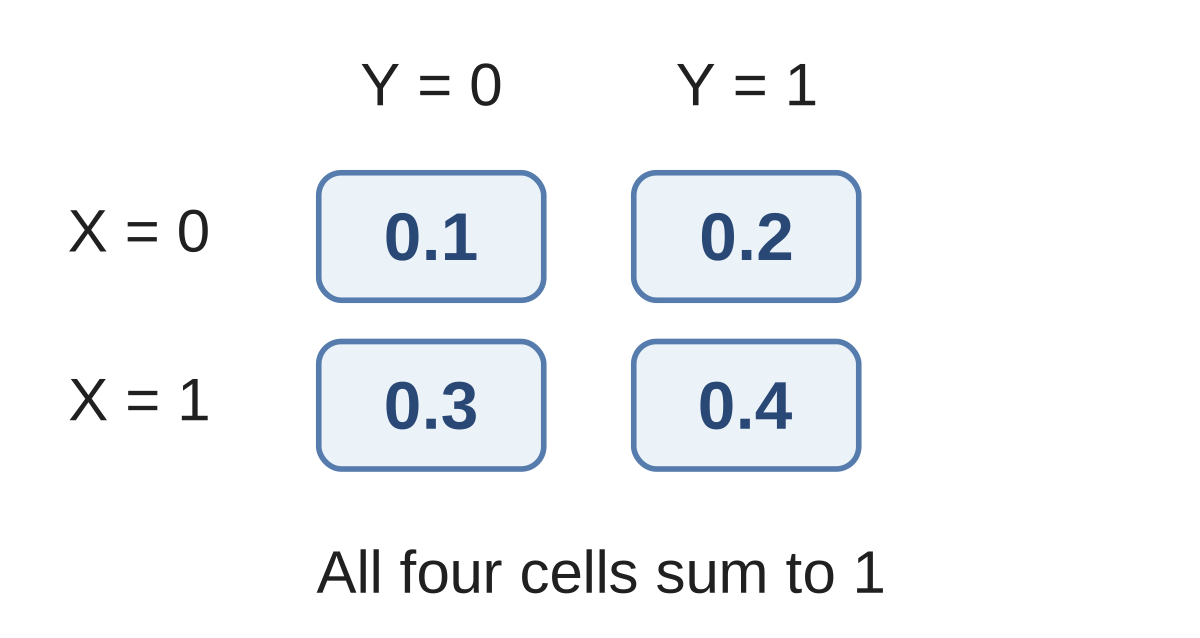
A schematic joint probability table has rows X=0,1 and columns Y=0,1. Ordered rows are (0.1,0.2) and (0.3,0.4); these four nonnegative masses sum to one. Each cell is the probability of both its row and column values together.A schematic joint probability table has rows X=0,1 and columns Y=0,1. Ordered rows are (0.1,0.2) and (0.3,0.4); these four nonnegative masses sum to one. Each cell is the probability of both its row and column values together.
Figure 1A schematic joint probability table has rows X=0,1 and columns Y=0,1. Ordered rows are (0.1,0.2) and (0.3,0.4); these four nonnegative masses sum to one. Each cell is the probability of both its row and column values together.
Link to this figure ↗Download SVGDownload PNG

Suppose a uniform draw from 10 records has paired counts with rows (1,2);(3,4)(1,2);(3,4). Divide every count by 10. The joint rows become (0.1,0.2);(0.3,0.4)(0.1,0.2);(0.3,0.4).

p(x,y)=P(X=x,Y=y)\begin{gathered}p(x,y)\\=P(X=x,Y=y)\end{gathered}
Check your reasoning

X rows; Y columns; order 0,1. Counts: (1,3);(2,2)(1,3);(2,2). Uniform draw; give joint rows.

  1. A(0.25,0.75);(0.5,0.5)(0.25,0.75);(0.5,0.5)
  2. B(1/8,3/8);(0.25,0.25)(1/8,3/8);(0.25,0.25)
  3. C(1/8,0.25);(3/8,0.25)(1/8,0.25);(3/8,0.25)
Show answer and explanation
(1/8,3/8);(0.25,0.25)(1/8,3/8);(0.25,0.25)

Divide counts by 8.

02Repeated pairs share one cell#

Repeated pairs share one cell. Uniform records (0,0),(0,1),(0,1),(1,1)(0,0),(0,1),(0,1),(1,1) give masses 0.25, 0.5 and 0.25. The absent pair (1,0)(1,0) has mass zero.

Check your reasoning

X rows; Y columns; order 0,1. Counts: (2,0);(1,2)(2,0);(1,2). Uniform draw. Row totals were used. Give joint rows.

  1. A(1,0);(1/3,2/3)(1,0);(1/3,2/3)
  2. B(0.4,0.2);(0,0.4)(0.4,0.2);(0,0.4)
  3. C(0.4,0);(0.2,0.4)(0.4,0);(0.2,0.4)
Show answer and explanation
(0.4,0);(0.2,0.4)(0.4,0);(0.2,0.4)

Divide counts by 5.

03The complete table sums to 1#

The complete table sums to 1. Normalizing each row separately would describe a different question. Separate distributions of XX and YY do not specify how their values are paired.

Check your reasoning

Uniform records: (0,0),(0,0),(1,0),(1,1)(0,0),(0,0),(1,0),(1,1). X rows; Y columns; order 0,1. Give joint rows.

  1. A(0.5,0);(0.25,0.25)(0.5,0);(0.25,0.25)
  2. B(1/3,0);(1/3,1/3)(1/3,0);(1/3,1/3)
  3. C(0.5,0.25);(0,0.25)(0.5,0.25);(0,0.25)
Show answer and explanation
(0.5,0);(0.25,0.25)(0.5,0);(0.25,0.25)

Count; divide by 4.

Key takeaway

Keep pairs together; divide every count by the same total.

  • Construct a joint discrete distribution over paired values.

Further questions

Does every joint-table row sum to 1?
No. All cells together sum to 1. A row may carry only part of that mass.

Sources & further reading

  1. [1]
  2. [2]

Reference this concept

Link to this page, a section, or an individual figure.

Glacius. “Joint mass functions.” Math behind ML. /learn/p-joint-pmf