Independent variables
Two discrete random variables are independent when every joint probability equals the product of the corresponding marginal probabilities.
On this page 8 sections
01Understand the idea#
Independence requires every joint cell to equal its row probability times its column probability.
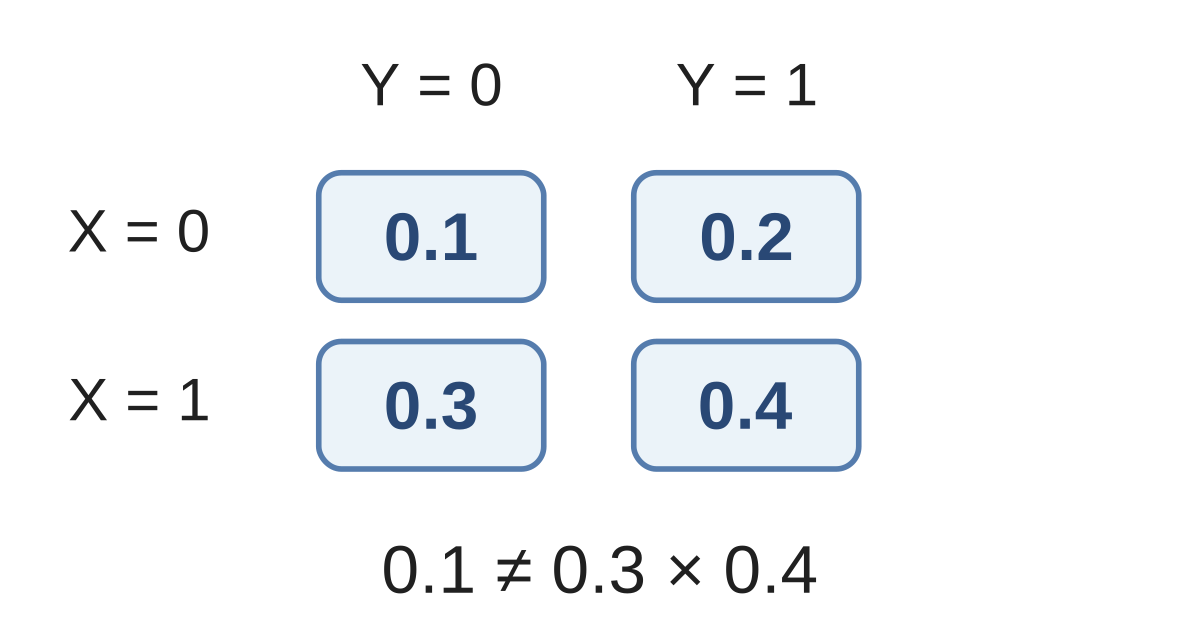
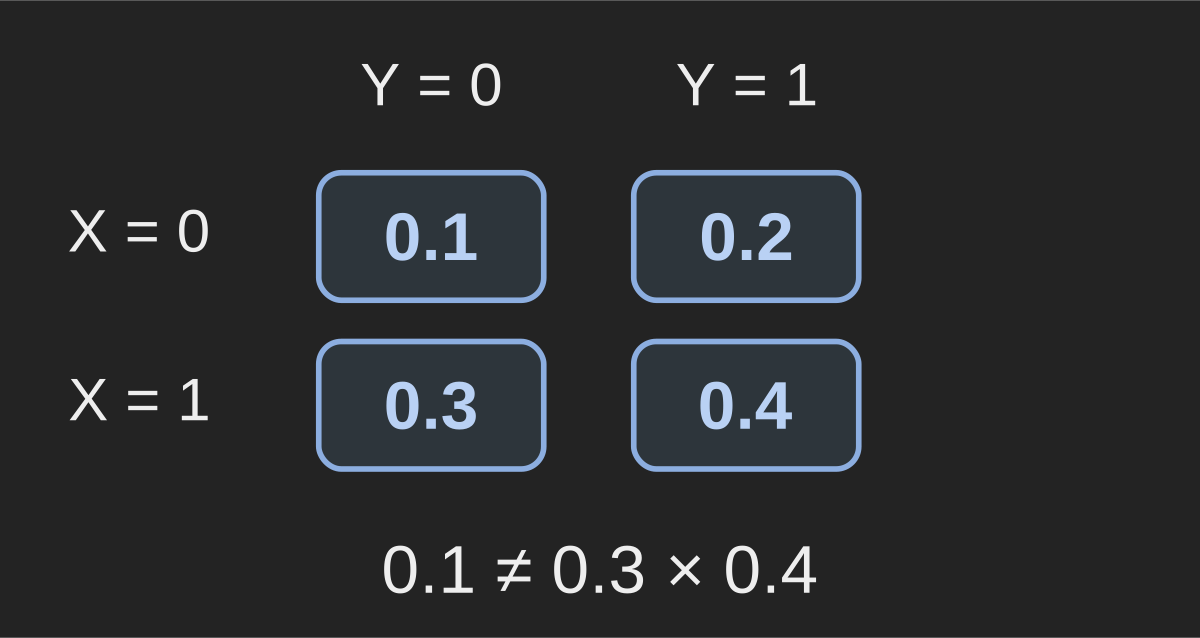
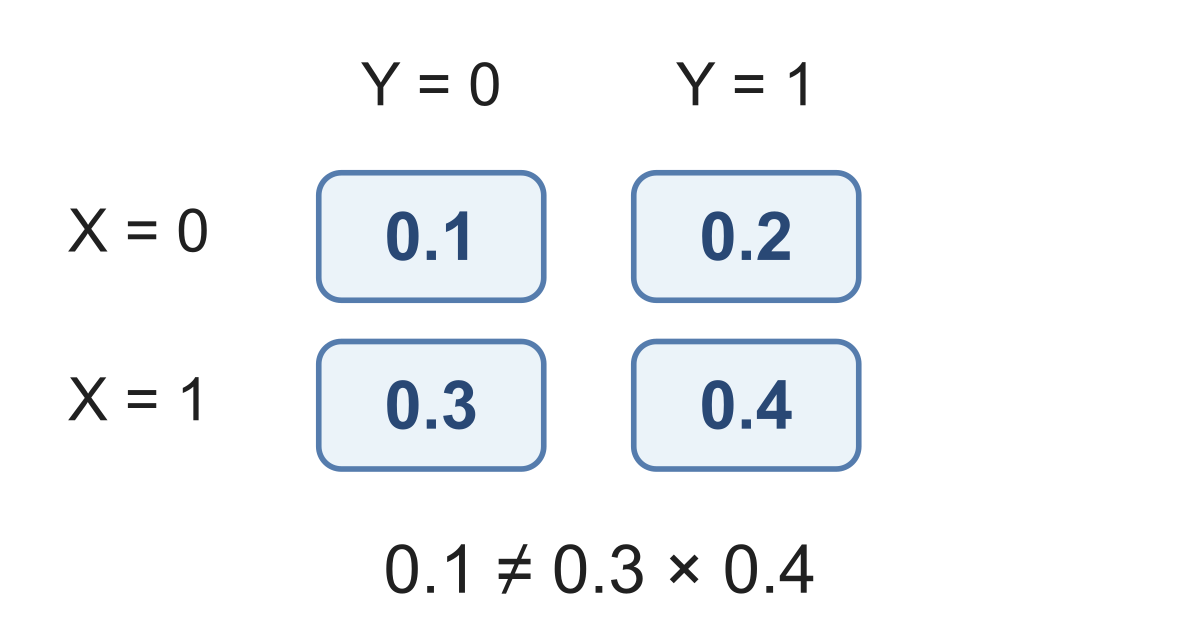
For joint rows , the top-left mass is 0.1. Its row and column totals give . These differ, so the variables are dependent.
X rows, Y cols; each 0,1. Mass rows: . Independent?
Show answer and explanation
All four cells factor.
02Joint rows have row totals and column totals #
Joint rows have row totals and column totals . Multiplying them reproduces all four cells, so these variables are independent.
X rows, Y cols; each 0,1. Mass rows: . Same marginals, so independent?
Show answer and explanation
Cell : .
03Equal-looking marginals do not establish independence#
Equal-looking marginals do not establish independence. A single matching cell is also insufficient: inspect the complete table. These are supplied probability models, not estimates from observed samples.
X,Y: binary flags. X rows, Y cols; each 0,1. Mass rows: . Independent?
Show answer and explanation
All four cells factor.
Every cell must factor; one mismatch is enough to fail.
- Check factorization of a discrete joint distribution into its marginals.
Further questions
Can one matching cell prove independence?
Sources & further reading
- [1]
- [2]Pishro-Nik, 5.1.3 Conditioning and Independence ↗Textbook · Book