Linearity of expectation
Expectation preserves finite linear combinations of random variables and constants.
On this page 7 sections
01Expectations add even when the variables are dependent#
Expectations add even when the variables are dependent. Fixed coefficients and added constants also pass through the expectation.
For and , the mean of is .
![Given E[X]=2 and E[Y]=5, the signed mean contributions are 6 and −5, summing to 1. No joint distribution or independence assumption is introduced.](/visuals/p-linearity/comparison-1113fha.svg)
![Given E[X]=2 and E[Y]=5, the signed mean contributions are 6 and −5, summing to 1. No joint distribution or independence assumption is introduced.](/visuals/p-linearity/comparison-1113fha-dark.svg)
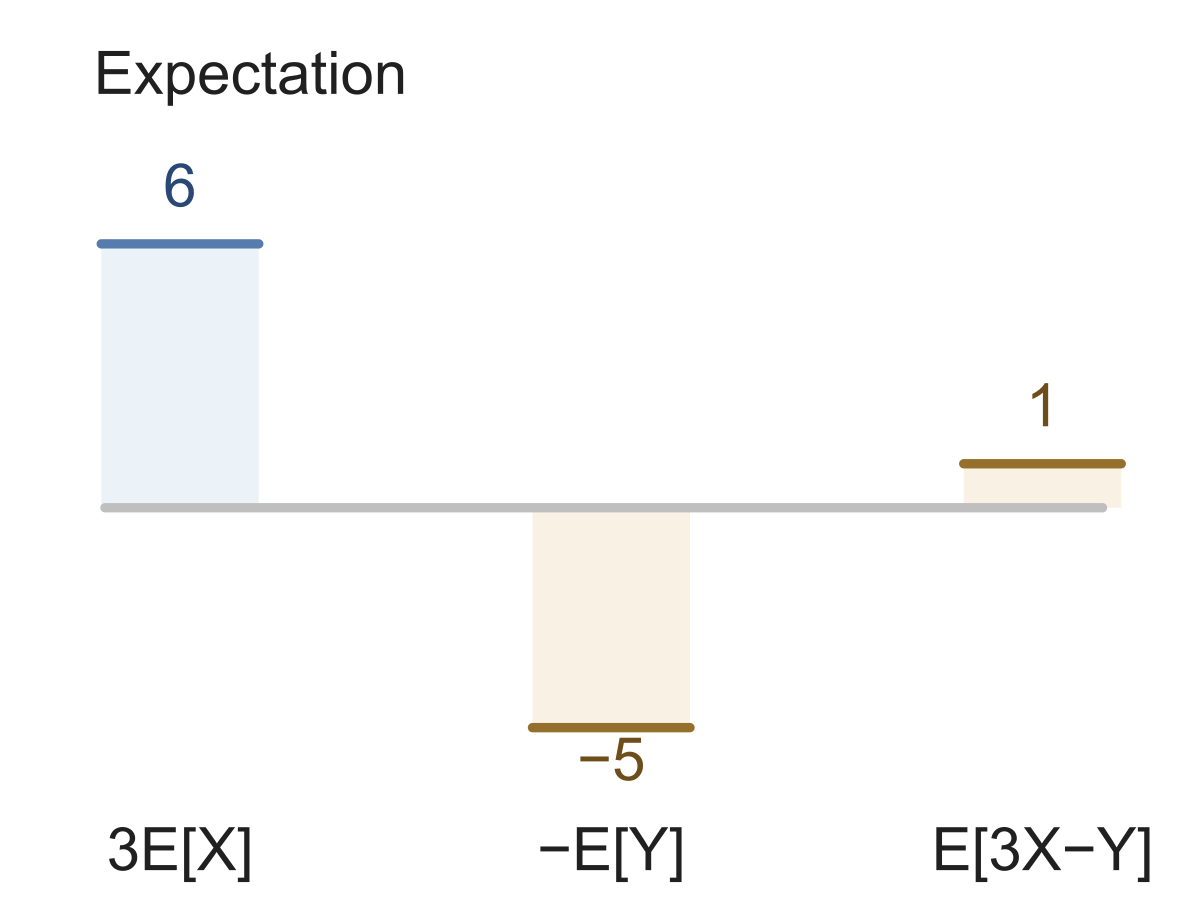
, . Find .
Show answer and explanation
Linearity gives . Independence is unnecessary.
02Two counts may respond to the same underlying event#
Two counts may respond to the same underlying event. That dependence does not prevent you from finding the expected total using their individual means.
A fixed offset contributes itself. A coefficient multiplies the mean of its own variable.
Counts may share a cause. , . Score . Find .
Show answer and explanation
Linearity gives . Independence is unnecessary.
03This rule applies to linear combinations#
This rule applies to linear combinations. It does not say that , or that expectation can move through a square.
For the requested sum or affine score, dependence creates no extra term.
are dependent, with and . A learner says independence is needed. Find .
Show answer and explanation
Linearity gives . Independence is unnecessary.
Apply each coefficient to its mean, add the constant, and keep going even when variables are dependent.
- Compute the expectation of a linear combination without assuming independence.
Sources & further reading
- [1]Pishro-Nik, Introduction to Probability: Expectation ↗Pishro-Nik: Introduction to Probability · Article