Skip to content
Glacius
ProbabilityConcept reference

Variance under scaling

The variance of aX+b is a² times the variance of X.

On this page 7 sections
  1. Overview
  2. Adding a fixed constant shifts the whole distribution without changing its spread
  3. The shift cancels when you center: Y-E[Y]=a(X-E[X])
  4. A negative scale reflects the values, but squaring makes the variance factor nonnegative
  5. Key takeaway
  6. Sources & further reading
  7. Concept connections

01Adding a fixed constant shifts the whole distribution without changing its spread#

Adding a fixed constant shifts the whole distribution without changing its spread. Scaling multiplies every deviation from the mean, so variance uses the square of that scale.

Var(aX+b)=a2Var(X)\begin{gathered}\operatorname{Var}(aX+b)\\=a^2\operatorname{Var}(X)\end{gathered}

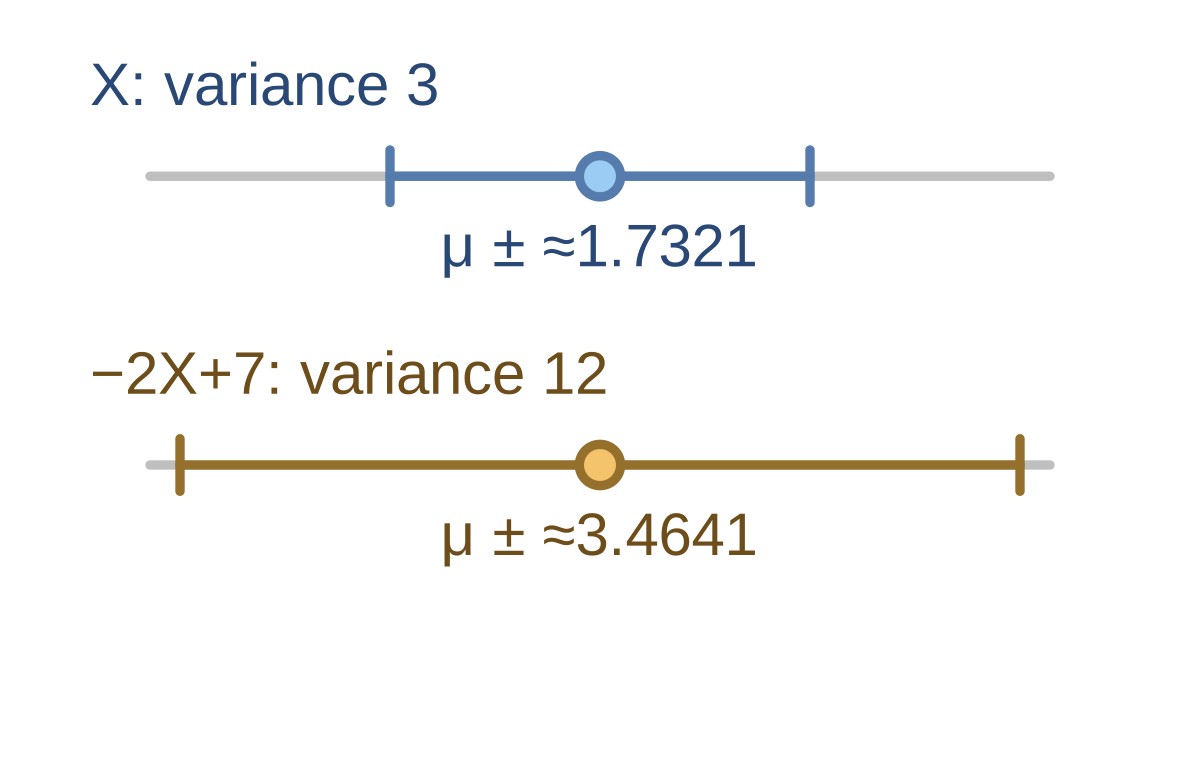
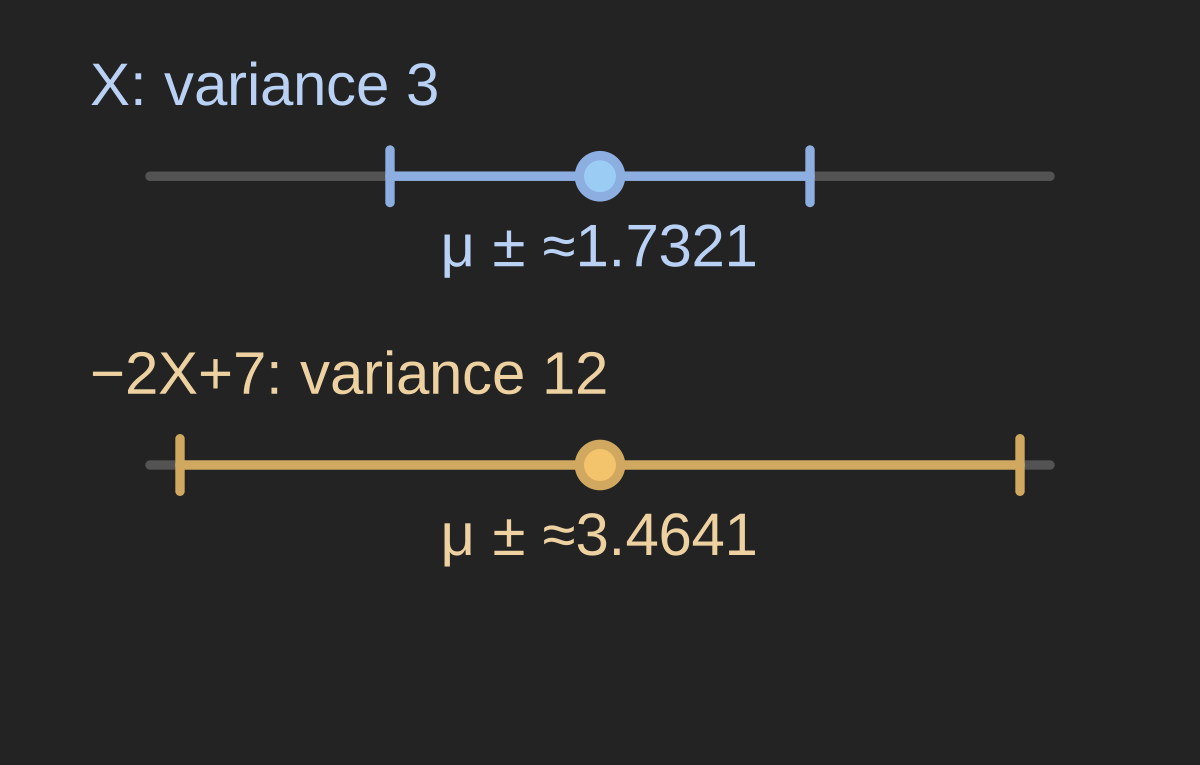
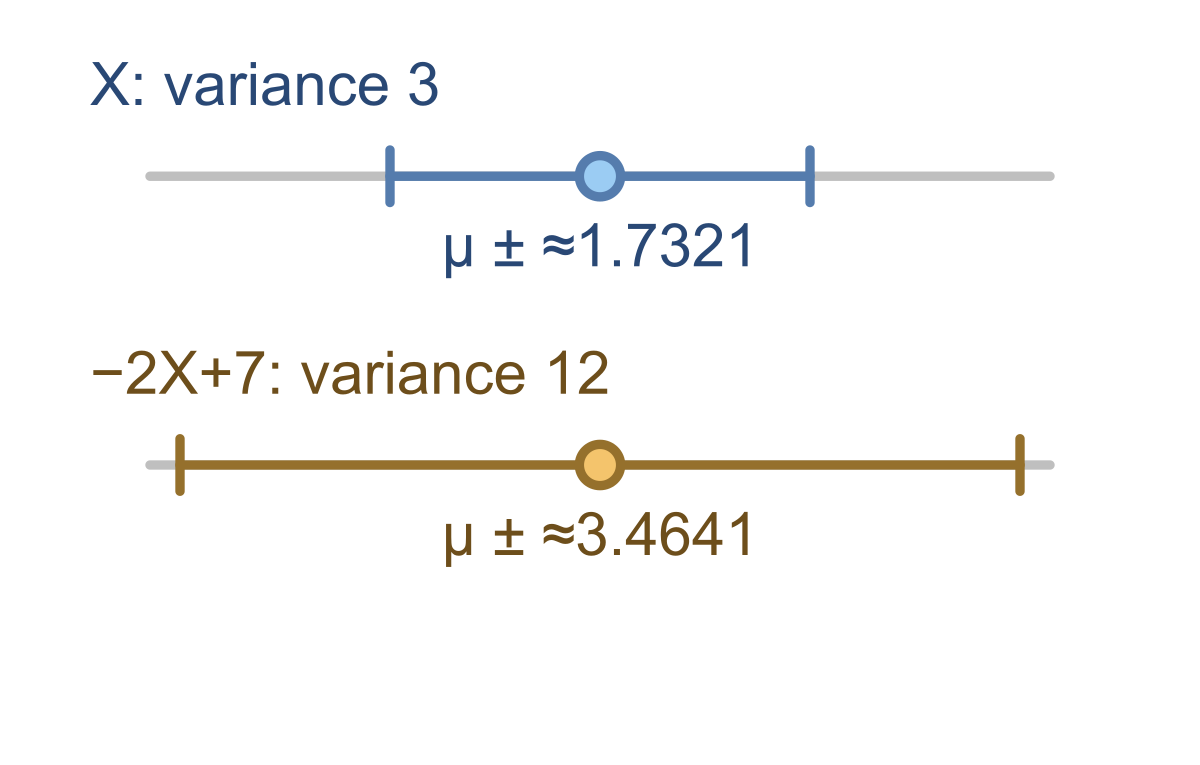
If Y=2X+7Y=-2X+7 and Var(X)=3\operatorname{Var}(X)=3, multiply by (2)2=4(-2)^2=4. The new variance is 1212.

The original variance is 3, with SD sqrt(3). Scaling by −2 doubles every deviation magnitude and gives SD sqrt(12), variance 12. The common reference center represents each variable’s own mean; adding 7 shifts that mean without changing the spread.The original variance is 3, with SD sqrt(3). Scaling by −2 doubles every deviation magnitude and gives SD sqrt(12), variance 12. The common reference center represents each variable’s own mean; adding 7 shifts that mean without changing the spread.
Figure 1The original variance is 3, with SD sqrt(3). Scaling by −2 doubles every deviation magnitude and gives SD sqrt(12), variance 12. The common reference center represents each variable’s own mean; adding 7 shifts that mean without changing the spread.
Link to this figure ↗Download SVGDownload PNG
Check your reasoning

Var(X)=2\operatorname{Var}(X)=2. Let Y=3X+(4)Y=-3X+(4). Find Var(Y)\operatorname{Var}(Y).

Show answer and explanation
18

Square the scale and ignore the fixed shift: (3)2×2=18(-3)^2\times 2=18.

02The shift cancels when you center: Y-E[Y]=a(X-E[X])#

The shift cancels when you center: YE[Y]=a(XE[X])Y-E[Y]=a(X-E[X]). Squaring leaves the factor a2a^2.

A unit conversion follows the same rule. Use the scale squared and report variance in squared output units.

Check your reasoning

Convert a reading by Y=0.5X+(10)Y=0.5X+(10). Original variance is 1616 in squared input units. Find the variance in squared output units.

Show answer and explanation
4

Square the scale and ignore the fixed shift: (0.5)2×16=4(0.5)^2\times 16=4.

03A negative scale reflects the values, but squaring makes the variance factor nonnegative#

A negative scale reflects the values, but squaring makes the variance factor nonnegative. A zero scale makes the new variable constant and its variance zero.

The affine rule for means cannot be reused unchanged for variance. The shift drops out and the scale is squared.

Check your reasoning

Var(X)=3\operatorname{Var}(X)=3, Y=2X+(5)Y=2X+(-5). A draft uses 2Var(X)+(5)2\operatorname{Var}(X)+(-5). Repair Var(Y)\operatorname{Var}(Y).

Show answer and explanation
12

Square the scale and ignore the fixed shift: (2)2×3=12(2)^2\times 3=12.

Key takeaway

Ignore the fixed shift and multiply variance by the square of the scale.

  • Compute variance after a scalar shift and scale.

Sources & further reading

  1. [1]
    Pishro-Nik, Introduction to Probability: VariancePishro-Nik: Introduction to Probability · Article

Reference this concept

Link to this page, a section, or an individual figure.

Glacius. “Variance under scaling.” Math behind ML. /learn/p-affine-moments