Skip to content
Glacius
CalculusConcept reference

Difference quotients

A difference quotient divides the output difference f(a+h) minus f(a) by a nonzero input increment h, with both inputs in the function domain.

On this page 8 sections
  1. Overview
  2. For f(x)=x^2, changing the input from 2 to 2+h changes the output from 4 to (2+h)^2
  3. A nonzero increment may be negative
  4. Both a and a+h must be valid function inputs
  5. Key takeaway
  6. Further questions
  7. Sources & further reading
  8. Concept connections

01For f(x)=x^2, changing the input from 2 to 2+h changes the output from 4 to (2+h)^2#

For f(x)=x2f(x)=x^2, changing the input from 2 to 2+h2+h changes the output from 4 to (2+h)2(2+h)^2. The increment belongs inside the function.

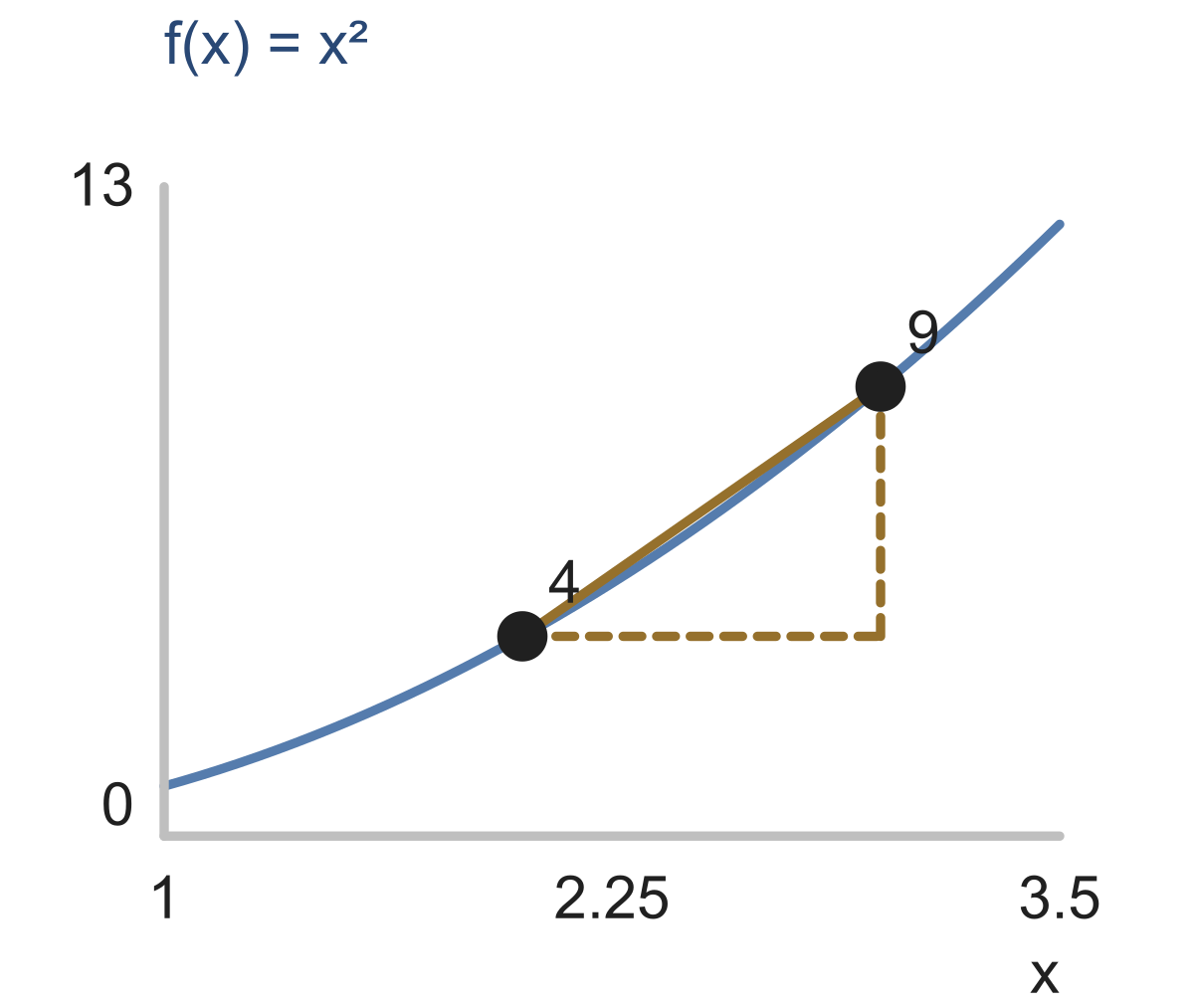
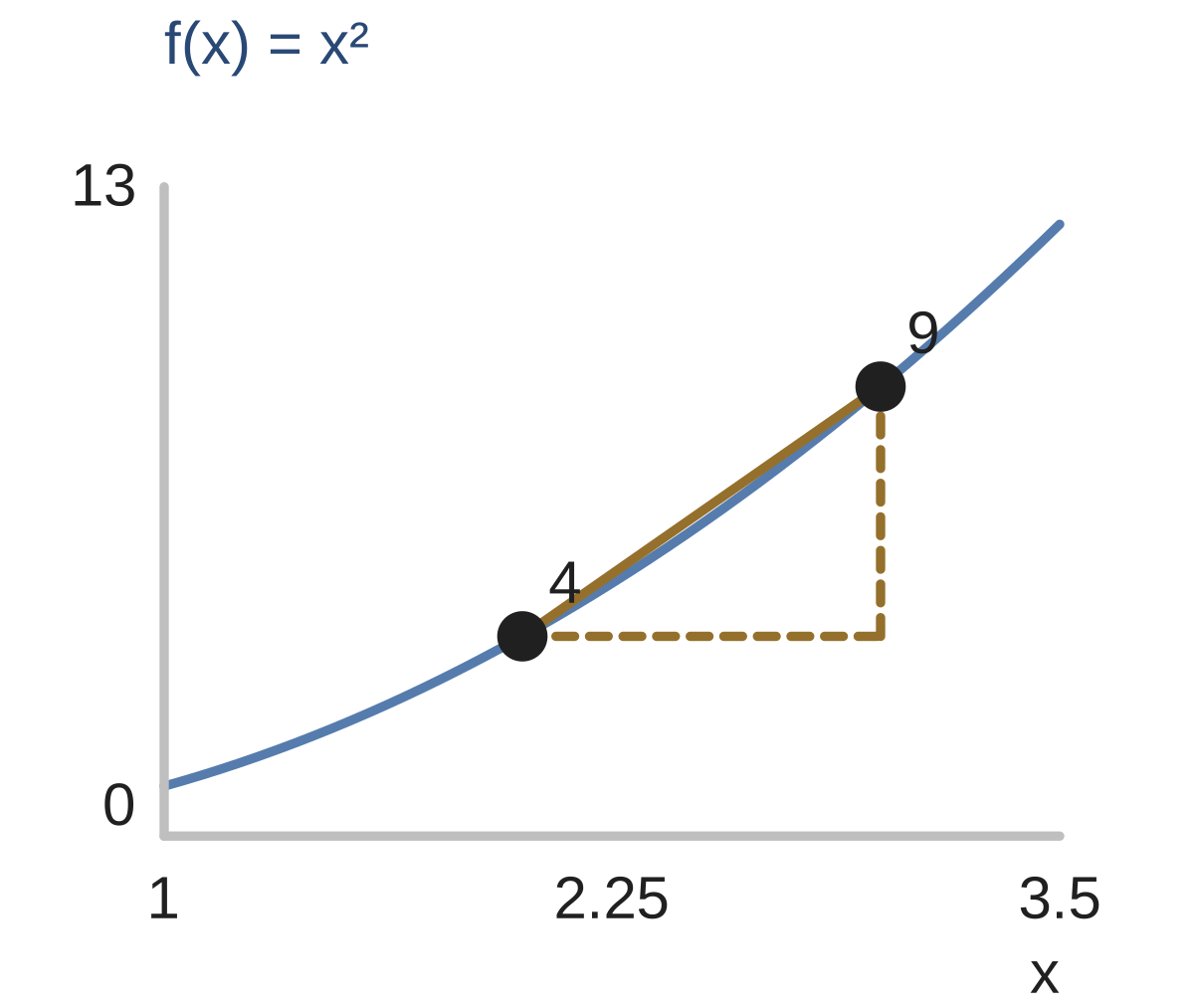
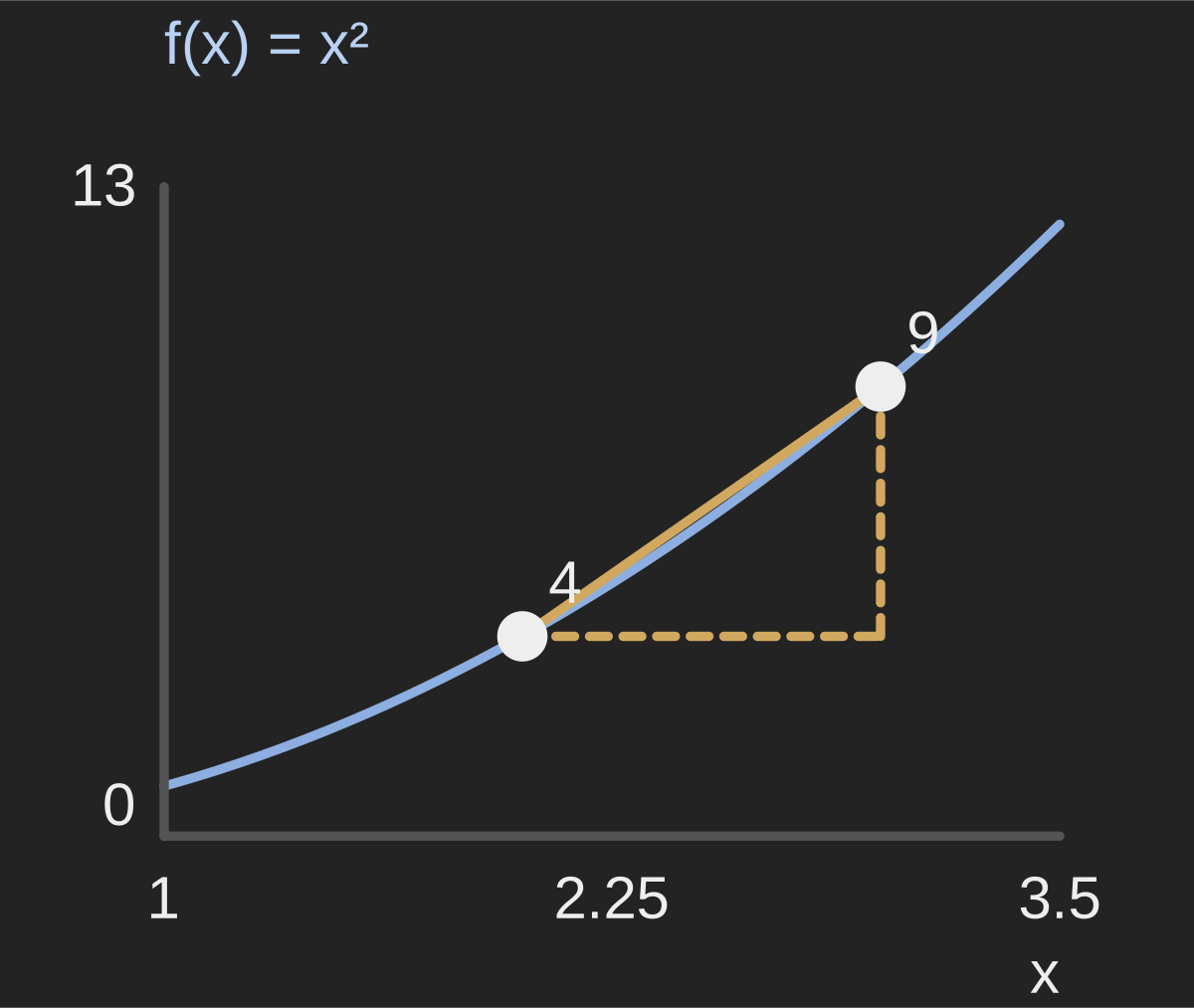
A concrete nonzero increment h=1 moves the input from 2 to 3. Outputs are 4 and 9. The secant rises 5 over run 1, giving quotient 5; this finite quotient is not the derivative at 2.A concrete nonzero increment h=1 moves the input from 2 to 3. Outputs are 4 and 9. The secant rises 5 over run 1, giving quotient 5; this finite quotient is not the derivative at 2.
Figure 1A concrete nonzero increment h=1 moves the input from 2 to 3. Outputs are 4 and 9. The secant rises 5 over run 1, giving quotient 5; this finite quotient is not the derivative at 2.
Link to this figure ↗Download SVGDownload PNG

For f(x)=x2f(x)=x^2 at base 2, subtract 4 from (2+h)2(2+h)^2. The input change is (2+h)2=h(2+h)-2=h. Dividing by h0h\ne0 gives the average change.

Q=f(a+h)f(a)hQ=\frac{f(a+h)-f(a)}{h}
Check your reasoning

f(x)=2xf(x)=2x, a=1a=1, h0h\ne0. Form the quotient.

  1. A[2(1+h)2]/h[2(1+h)-2]/h
  2. B[2+h2]/h[2+h-2]/h
  3. C[22(1+h)]/h[2-2(1+h)]/h
Show answer and explanation
[2(1+h)2]/h[2(1+h)-2]/h

Evaluate at the shifted input, then subtract 2.

02A nonzero increment may be negative#

A nonzero increment may be negative. With a=4a=4 and h=1h=-1, the new input is 3. Use the signed increment in the denominator and the same subtraction order in the numerator.

Check your reasoning

f(x)=x2f(x)=x^2, a=3a=3, h=2h=-2. Evaluate [f(a+h)f(a)]/h[f(a+h)-f(a)]/h.

Show answer and explanation
4

The quotient is (1−9)/(−2)=4.

03Both a and a+h must be valid function inputs#

Both aa and a+ha+h must be valid function inputs. At h=0h=0, this quotient has a zero denominator. Forming it does not require expanding the numerator or taking a limit.

Check your reasoning

M(t)=t2M(t)=t^2 for real t. Form average change from t=1t=1 to t=1+ht=1+h, h0h\ne0.

  1. A[(1+h)21]/(1+h)[(1+h)^2-1]/(1+h)
  2. B[(1+h)21]/h[(1+h)^2-1]/h
  3. C[1+h1]/h[1+h-1]/h
Show answer and explanation
[(1+h)21]/h[(1+h)^2-1]/h

Subtract 1; divide by h.

Key takeaway

Shift the input, subtract outputs, divide by h.

  • Form the difference quotient for a scalar function

Further questions

Is f(a+h) the same as f(a)+h?
Usually not. For f(x)=x squared, f(2+h) is (2+h) squared, whereas f(2)+h is 4+h. The input is shifted before applying the function.
Sources & further reading

  1. [1]

Reference this concept

Link to this page, a section, or an individual figure.

Glacius. “Difference quotients.” Math behind ML. /learn/c-difference-quotient