Limit algebra
Algebraic limit laws evaluate combinations of functions with known finite limits, with a nonzero denominator limit required for a quotient.
On this page 9 sections
01Understand the idea#
If and as inputs approach the same target, their sum approaches 5 and their product approaches 6. Both component limits must exist and be finite.
For finite limits F and G at the same input target, sums become F+G, differences F−G, and products FG. A constant multiple becomes cF; a positive whole-number power becomes F raised to that power.
As , and . Find .
Show answer and explanation
Apply the laws: 2·3−1=5.
02A quotient needs one more check#
A quotient needs one more check. If the numerator approaches 6 and the denominator approaches 2, the quotient approaches 3. The denominator limit must be nonzero before dividing.
As , and . Find .
Show answer and explanation
The denominator limit is nonzero.
03For , factor the numerator as #
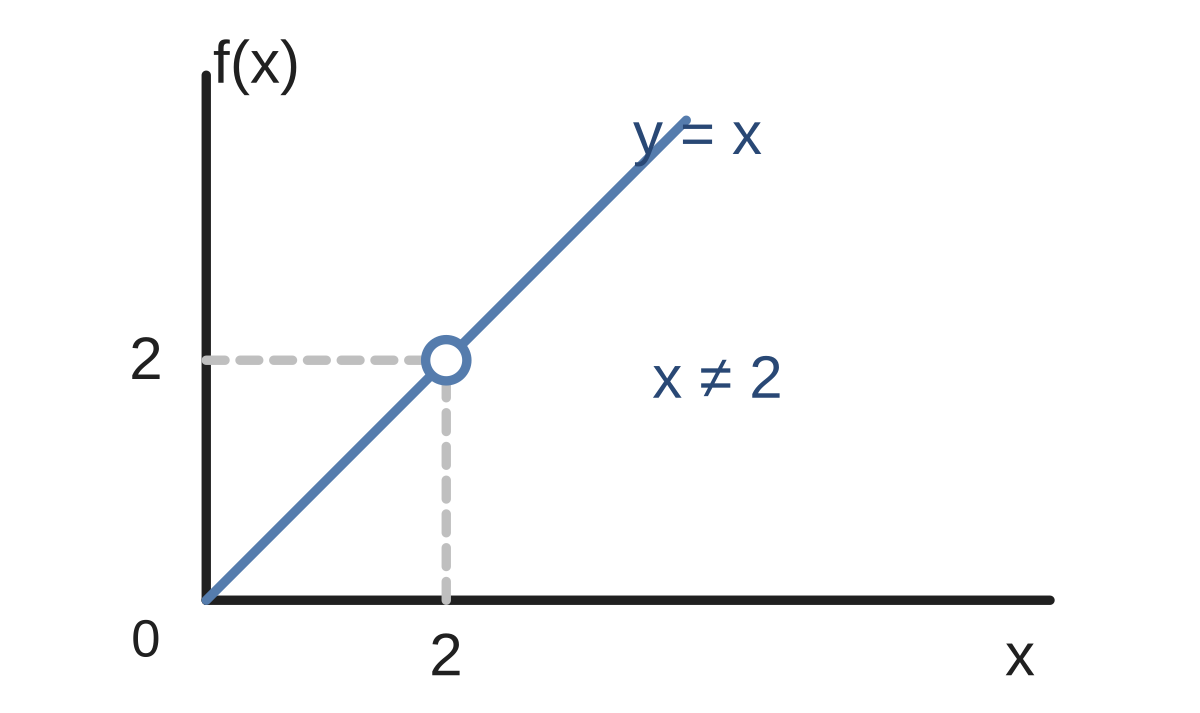
For , factor the numerator as . For x≠2, cancelling gives x. Its limit at 2 is 2; the original endpoint stays undefined.
A learner reports 0 for 0/0. Correct .
Show answer and explanation
For x≠4, the quotient equals x.
04For polynomials, use and constant limits to substitute a#
For polynomials, use and constant limits to substitute a. Rational functions also allow substitution when their denominator is nonzero at a. A 0/0 form alone gives no answer; simplify a common factor if possible.
Check the law’s conditions before substituting limits.
- Evaluate a finite limit using valid algebraic limit laws
Further questions
Does 0/0 mean a limit is zero?
Sources & further reading
- [1]OpenStax Calculus Volume 1, 2.3 The Limit Laws ↗OpenStax · Book