Calculus Concept reference Product rule The derivative of a product is the derivative of the first factor times the second, plus the first factor times the derivative of the second.
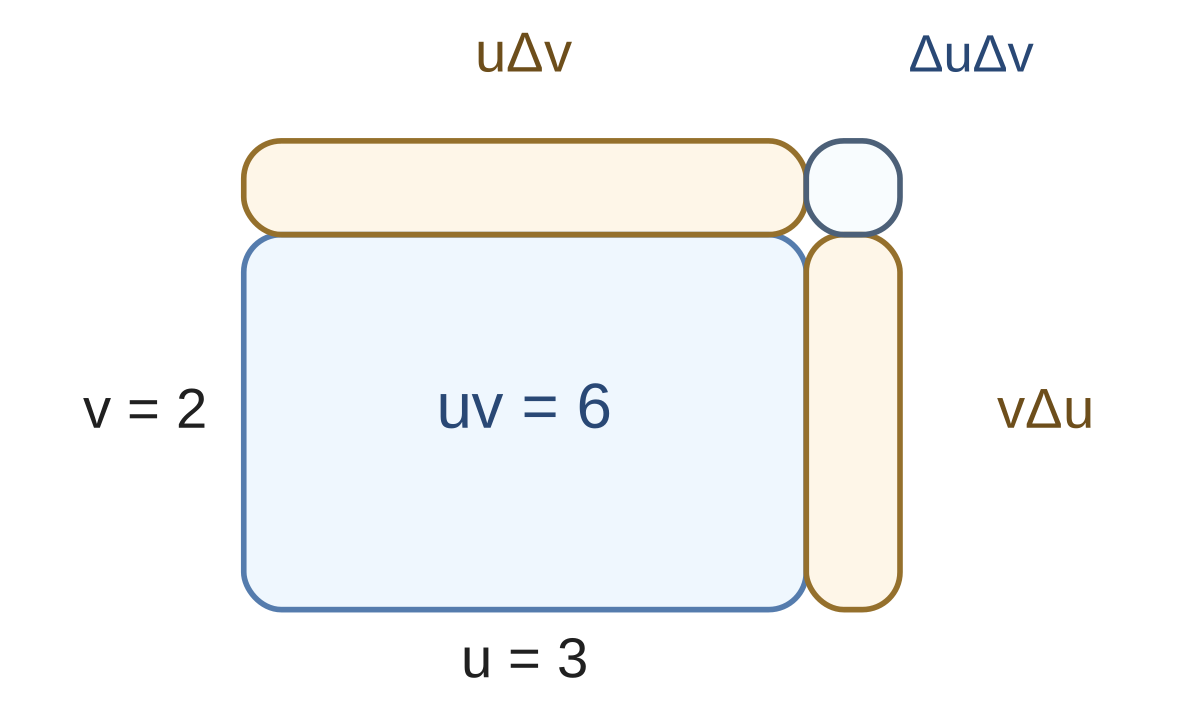
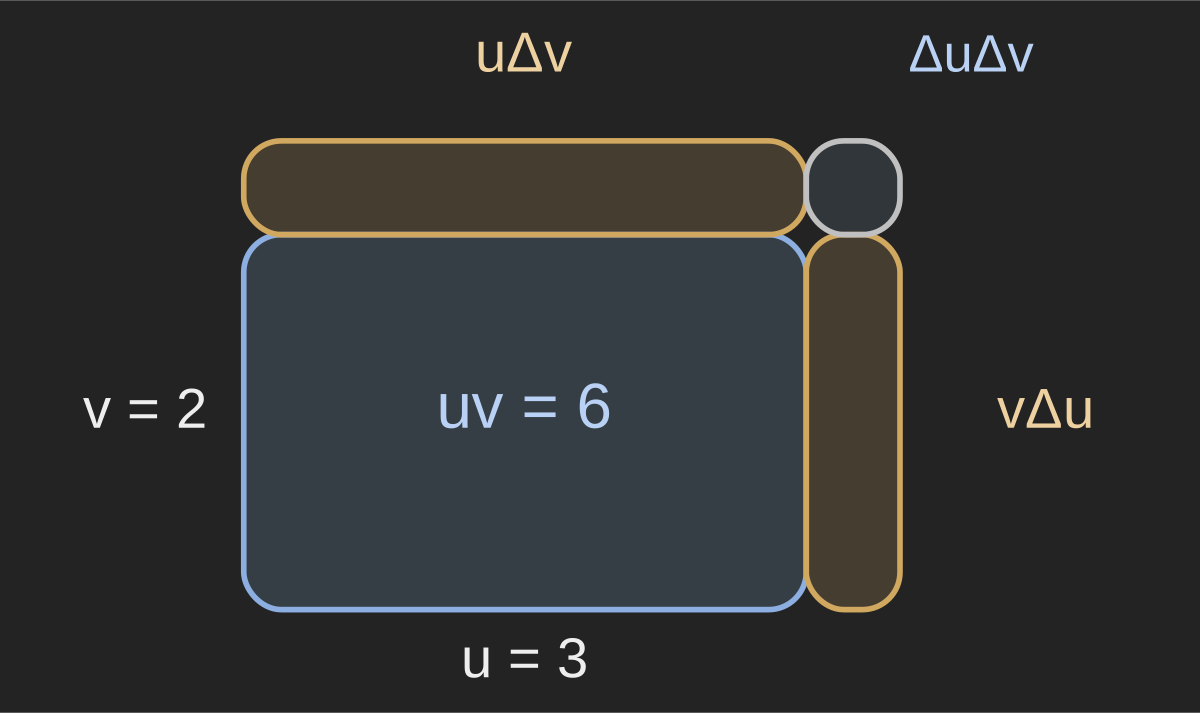
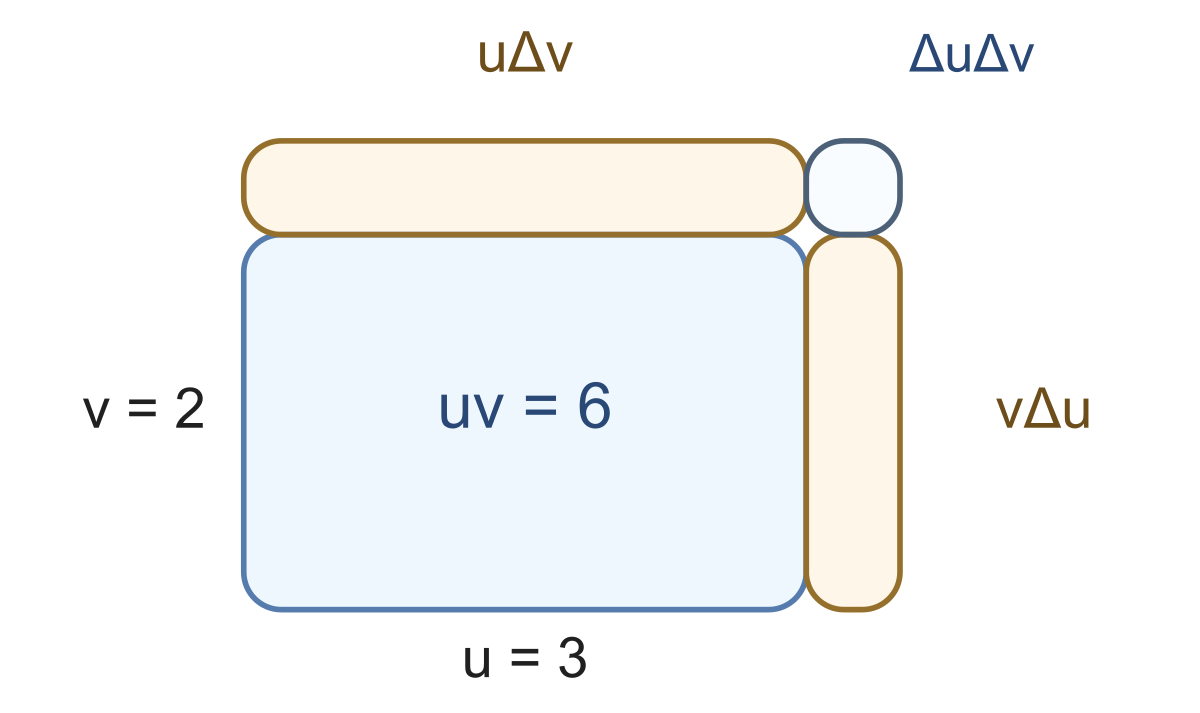
On this page 7 sections Overview When both factors vary, a product changes in two ways For y = ( x 2 + 1 ) ( x + 2 ) y=(x^2+1)(x+2) y = ( x 2 + 1 ) ( x + 2 ) At one input, suppose u = 4 u=4 u = 4 v = 3 v=3 v = 3 u ′ = 4 u\prime=4 u ′ = 4 v ′ = 1 v\prime=1 v ′ = 1 Key takeaway Sources & further reading Concept connections 01 When both factors vary, a product changes in two ways # When both factors vary, a product changes in two ways. This area model starts at u = 3 u=3 u = 3 v = 2 v=2 v = 2 0.5 0.5 0.5
Figure 1 Area diagram at 50 pixels per unit. Original rectangle u=3, v=2 is 150 by 100 pixels. Increasing each side by 0.5 adds a 25 by 100 right strip, a 150 by 25 top strip, and a 25 by 25 corner. The three added areas are 1, 1.5 and 0.25. For P = u v P=uv P = uv Δ u \Delta u Δ u Δ v \Delta v Δ v u v uv uv
Δ P = v Δ u + u Δ v + Δ u Δ v \begin{aligned}\Delta P&=v\Delta u+u\Delta v\\&\quad+\Delta u\Delta v\end{aligned} Δ P = v Δ u + u Δ v + Δ u Δ v The finite change includes the corner Δ u Δ v \Delta u\Delta v Δ u Δ v
For P = u v P=uv P = uv h h h Δ u / h → u ′ \Delta u/h\to u\prime Δ u / h → u ′ Δ v / h → v ′ \Delta v/h\to v\prime Δ v / h → v ′ Δ v → 0 \Delta v\to0 Δ v → 0 ( Δ u / h ) Δ v → 0 (\Delta u/h)\Delta v\to0 ( Δ u / h ) Δ v → 0
P ′ = u ′ v + u v ′ P\prime=u\prime v+uv\prime P ′ = u ′ v + uv ′ Check your reasoning
P ( x ) = u ( x ) v ( x ) P(x)=u(x)v(x) P ( x ) = u ( x ) v ( x ) x = 1 x=1 x = 1 u = 3 u=3 u = 3 v = 5 v=5 v = 5 u ′ = 2 u\prime=2 u ′ = 2 v ′ = − 1 v\prime=-1 v ′ = − 1 P ′ P\prime P ′
Show answer and explanation 7 Cross each rate with the other value: 2 ( 5 ) + 3 ( − 1 ) = 7 2(5)+3(-1)=7 2 ( 5 ) + 3 ( − 1 ) = 7
02 For y = ( x 2 + 1 ) ( x + 2 ) y=(x^2+1)(x+2) y = ( x 2 + 1 ) ( x + 2 ) # For y = ( x 2 + 1 ) ( x + 2 ) y=(x^2+1)(x+2) y = ( x 2 + 1 ) ( x + 2 )
y ′ = 2 x ( x + 2 ) + ( x 2 + 1 ) \begin{aligned}y\prime&=2x(x+2)\\&\quad+(x^2+1)\end{aligned} y ′ = 2 x ( x + 2 ) + ( x 2 + 1 ) Expanding gives 3 x 2 + 4 x + 1 3x^2+4x+1 3 x 2 + 4 x + 1
Check your reasoning
y = ( x 2 + 3 ) ( x + 1 ) y=(x^{2}+3)(x+1) y = ( x 2 + 3 ) ( x + 1 ) y ′ ( x ) y\prime(x) y ′ ( x )
A 2 x 2x 2 x B 3 x 2 + 2 x + 3 3x^{2}+2x+3 3 x 2 + 2 x + 3 C 2 x 2 + 2 x 2x^{2}+2x 2 x 2 + 2 x Show answer and explanation 3 x 2 + 2 x + 3 3x^{2}+2x+3 3 x 2 + 2 x + 3 u ′ v = ( 2 x ) ( x + 1 ) u\prime v=(2x)(x+1) u ′ v = ( 2 x ) ( x + 1 ) u v ′ = ( x 2 + 3 ) ( 1 ) uv\prime=(x^{2}+3)(1) uv ′ = ( x 2 + 3 ) ( 1 )
03 At one input, suppose u = 4 u=4 u = 4 v = 3 v=3 v = 3 u ′ = 4 u\prime=4 u ′ = 4 v ′ = 1 v\prime=1 v ′ = 1 # At one input, suppose u = 4 u=4 u = 4 v = 3 v=3 v = 3 u ′ = 4 u\prime=4 u ′ = 4 v ′ = 1 v\prime=1 v ′ = 1 4 ( 3 ) + 4 ( 1 ) = 16 4(3)+4(1)=16 4 ( 3 ) + 4 ( 1 ) = 16 4 4 4
If u ′ = 0 u\prime=0 u ′ = 0 u v ′ uv\prime uv ′
Check your reasoning
P ( x ) = u ( x ) v ( x ) P(x)=u(x)v(x) P ( x ) = u ( x ) v ( x ) x = 4 x=4 x = 4 u = 7 u=7 u = 7 v = 2 v=2 v = 2 u ′ = 0 u\prime=0 u ′ = 0 v ′ = 3 v\prime=3 v ′ = 3 P ′ P\prime P ′
Show answer and explanation 21 Cross each rate with the other value: 0 ( 2 ) + 7 ( 3 ) = 21 0(2)+7(3)=21 0 ( 2 ) + 7 ( 3 ) = 21
Key takeaway
Add both cross contributions: u′v + uv′. Differentiate a product of two scalar functions. Sources & further reading [1]