Skip to content
Glacius
CalculusConcept reference

Constant multiple rule

The derivative of a fixed scalar multiple is that scalar times the derivative of the original function.

On this page 7 sections
  1. Overview
  2. For differentiable f and fixed k, let g(x)=kf(x)
  3. At x=1, f(x)=x^2 has slope 2
  4. A negative factor reverses the rate: (-5x^3)prime=-15x^2
  5. Key takeaway
  6. Sources & further reading
  7. Concept connections

01For differentiable f and fixed k, let g(x)=kf(x)#

For differentiable ff and fixed kk, let g(x)=kf(x)g(x)=kf(x). Every output change is multiplied by kk, so its derivative has the same multiplier.

g(x)=kf(x)g\prime(x)=kf\prime(x)

Let Δf=f(x+h)f(x)\Delta f=f(x+h)-f(x). For g=kfg=kf with fixed kk, the output change is Δg=kΔf\Delta g=k\Delta f.

Δgh=kΔfh\frac{\Delta g}{h}=k\frac{\Delta f}{h}

As h0h\to0, the right side approaches kf(x)kf\prime(x). The same input increment is used for both functions.

Check your reasoning

f(x)=3x3f(x)=3x^{3}. Find f(x)f\prime(x).

  1. A3x23x^{2}
  2. B9x29x^{2}
  3. C3x33x^{3}
Show answer and explanation
9x29x^{2}

Keep 33 and multiply by the power derivative: 3(3x2)=9x23(3x^{2})=9x^{2}.

02At x=1, f(x)=x^2 has slope 2#

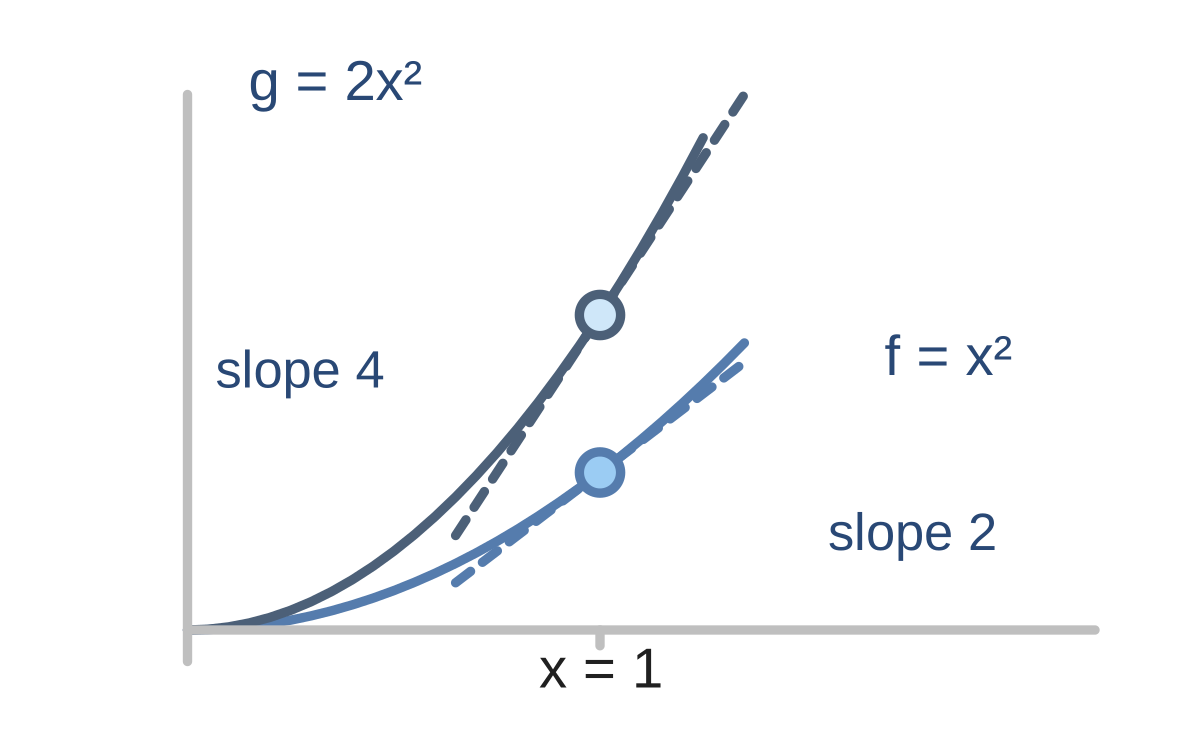
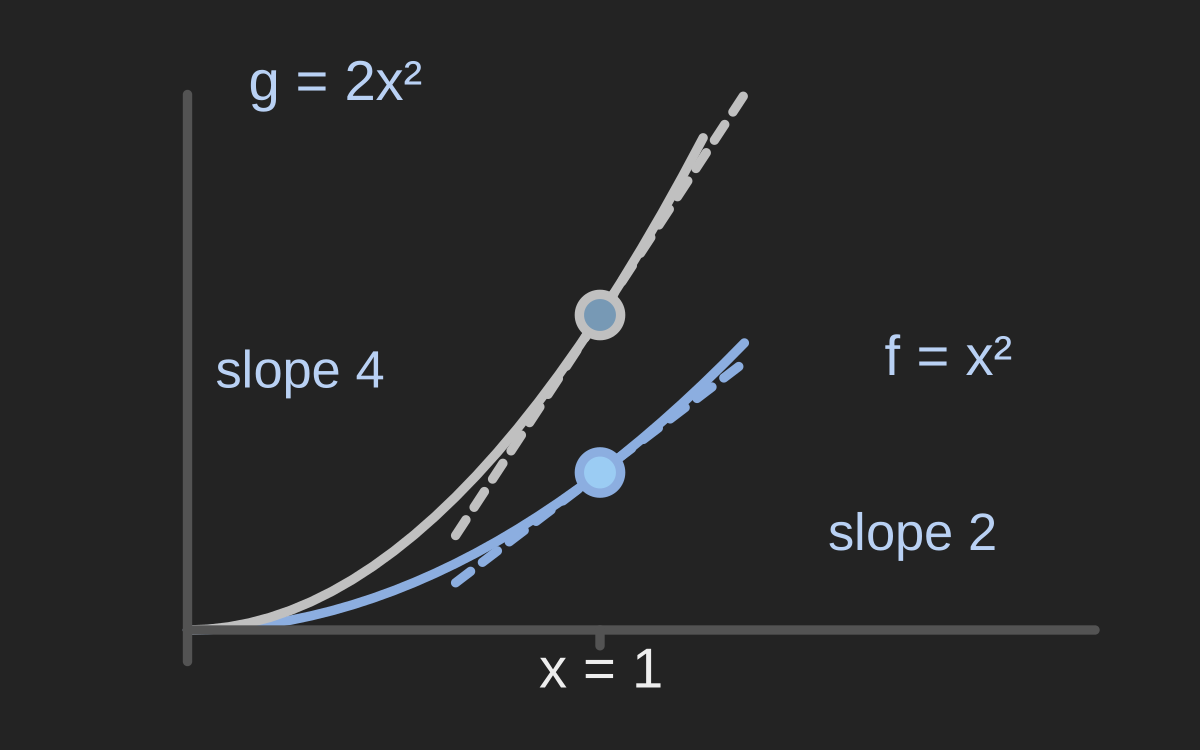
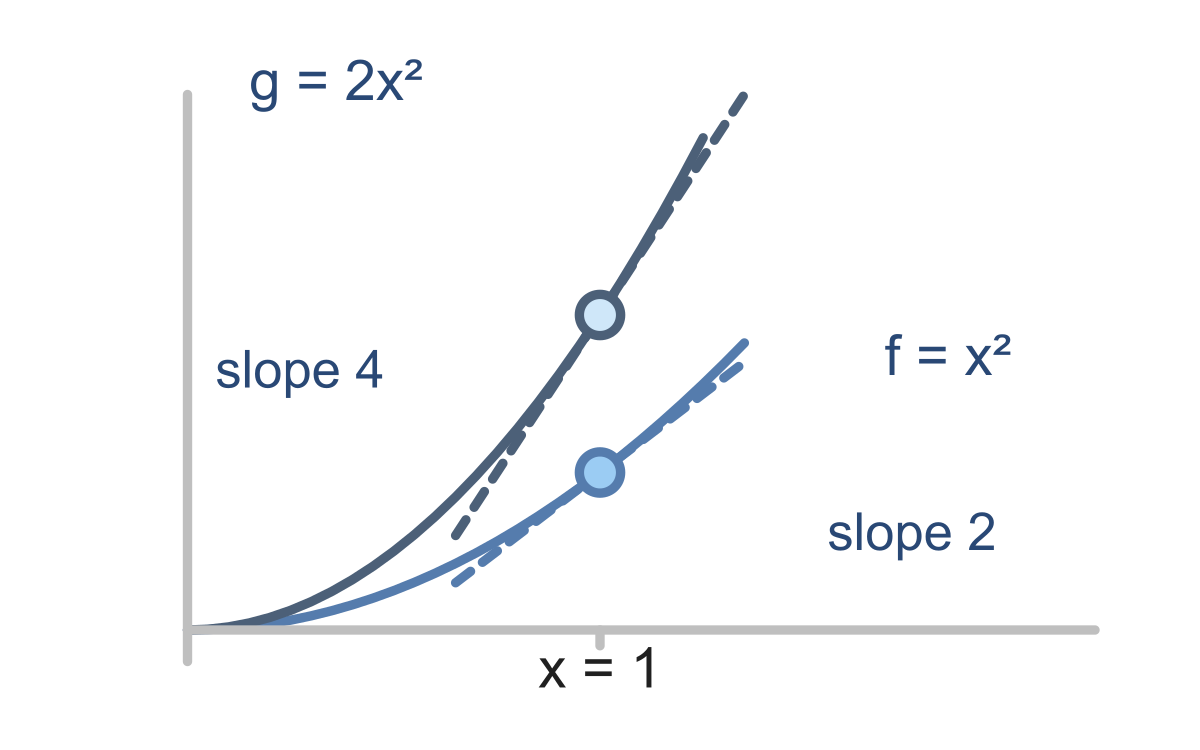
At x=1x=1, f(x)=x2f(x)=x^2 has slope 22. Doubling its outputs gives g(x)=2x2g(x)=2x^2, whose slope is 44 at that input.

Same axes: 110 pixels per x unit and 42 pixels per y unit. Teal f(x)=x² and violet g(x)=2x². At x=1 their points are (1,1) and (1,2); dashed tangents have slopes 2 and 4. Scaling the output by 2 scales its derivative by 2.Same axes: 110 pixels per x unit and 42 pixels per y unit. Teal f(x)=x² and violet g(x)=2x². At x=1 their points are (1,1) and (1,2); dashed tangents have slopes 2 and 4. Scaling the output by 2 scales its derivative by 2.
Figure 1Same axes: 110 pixels per x unit and 42 pixels per y unit. Teal f(x)=x² and violet g(x)=2x². At x=1 their points are (1,1) and (1,2); dashed tangents have slopes 2 and 4. Scaling the output by 2 scales its derivative by 2.
Link to this figure ↗Download SVGDownload PNG
Check your reasoning

A fixed gain gives r(x)=2u(x)r(x)=-2u(x). At x=4x=4, u(4)=5u\prime(4)=5. Find r(4)r\prime(4).

Show answer and explanation
-10

Multiply the base rate by the gain: 2(5)=10-2(5)=-10.

03A negative factor reverses the rate: (-5x^3)prime=-15x^2#

A negative factor reverses the rate: (5x3)=15x2(-5x^3)\prime=-15x^2. A zero factor gives zero output change. The multiplier must stay fixed while xx varies.

For a fractional factor, retain it too: (0.25x4)=x3(0.25x^4)\prime=x^3.

Check your reasoning

f(x)=4x2f(x)=-4x^{2}. A learner drops the fixed factor. Repair f(x)f\prime(x).

  1. A2x2x
  2. B32x32x
  3. C8x-8x
Show answer and explanation
8x-8x

Keep the factor: 4(2x)=8x-4(2x)=-8x.

Key takeaway

Keep the fixed multiplier when differentiating.

  • Differentiate a constant multiple of a differentiable function.

Sources & further reading

  1. [1]

Reference this concept

Link to this page, a section, or an individual figure.

Glacius. “Constant multiple rule.” Math behind ML. /learn/c-scale