Skip to content
Glacius
CalculusConcept reference

Power rule

The power rule differentiates x to a power as the original exponent times x to one lower power, wherever the stated real-domain rule applies.

On this page 8 sections
  1. Overview
  2. Understand the idea
  3. Negative integer powers follow the same rule where xne0
  4. For x>0, write x^1/2=√(x) and x^3/2=(√(x))^3
  5. For x^5, keep both operations: multiplier 5, exponent 4
  6. Key takeaway
  7. Sources & further reading
  8. Concept connections

01Understand the idea#

The power rule gives a shortcut for f(x)=xnf(x)=x^n: use the original exponent as a multiplier, then subtract one from the exponent.

f(x)=nxn1f\prime(x)=nx^{n-1}

For positive integers, this works at every real input.

For f(x)=x3f(x)=x^3, expansion gives f(x+h)f(x)=3x2h+3xh2+h3f(x+h)-f(x)=3x^2h+3xh^2+h^3. After division by nonzero hh:

The difference quotient is

3x2+3xh+h23x^2+3xh+h^2

As h0h\to0, the last two terms vanish, leaving 3x23x^2.

Check your reasoning

f(x)=x4f(x)=x^{4}. Find f(x)f\prime(x).

  1. Ax3x^{3}
  2. B4x34x^{3}
  3. C4x54x^{5}
Show answer and explanation
4x34x^{3}

Multiplier 44; new exponent 33.

02Negative integer powers follow the same rule where xne0#

Negative integer powers follow the same rule where x0x\ne0. For f(x)=x2f(x)=x^{-2}, the multiplier is 2-2 and the new exponent is 21=3-2-1=-3.

f(x)=2x3f\prime(x)=-2x^{-3}

Zero is excluded because the original reciprocal power is undefined there.

Check your reasoning

A response is r(x)=x3r(x)=x^{3}. Find r(2)r\prime(-2).

Show answer and explanation
12

Use 3x23x^{2} at x=2x=-2.

03For x>0, write x^1/2=√(x) and x^3/2=(√(x))^3#

For x>0x>0, write x1/2=xx^{1/2}=\sqrt{x} and x3/2=(x)3x^{3/2}=(\sqrt{x})^3. The rule also works for these fractional exponents.

ddxx1/2=12x1/2\frac{d}{dx}x^{1/2}=\frac12x^{-1/2}

The new exponent is 1/2-1/2: here x1/2=1/xx^{-1/2}=1/\sqrt{x}. Use this formula for x>0x>0.

Check your reasoning

f(x)=x2f(x)=x^{-2}, x0x\ne0. Claim: f(0)=0f\prime(0)=0. Repair.

  1. A00: negative exponent.
  2. B2-2: exponent alone.
  3. CNo derivative: f(0)f(0) is undefined.
Show answer and explanation
No derivative: f(0)f(0) is undefined.

Zero is outside the domain.

04For x^5, keep both operations: multiplier 5, exponent 4#

For x5x^5, keep both operations: multiplier 55, exponent 44. Dropping either changes the derivative.
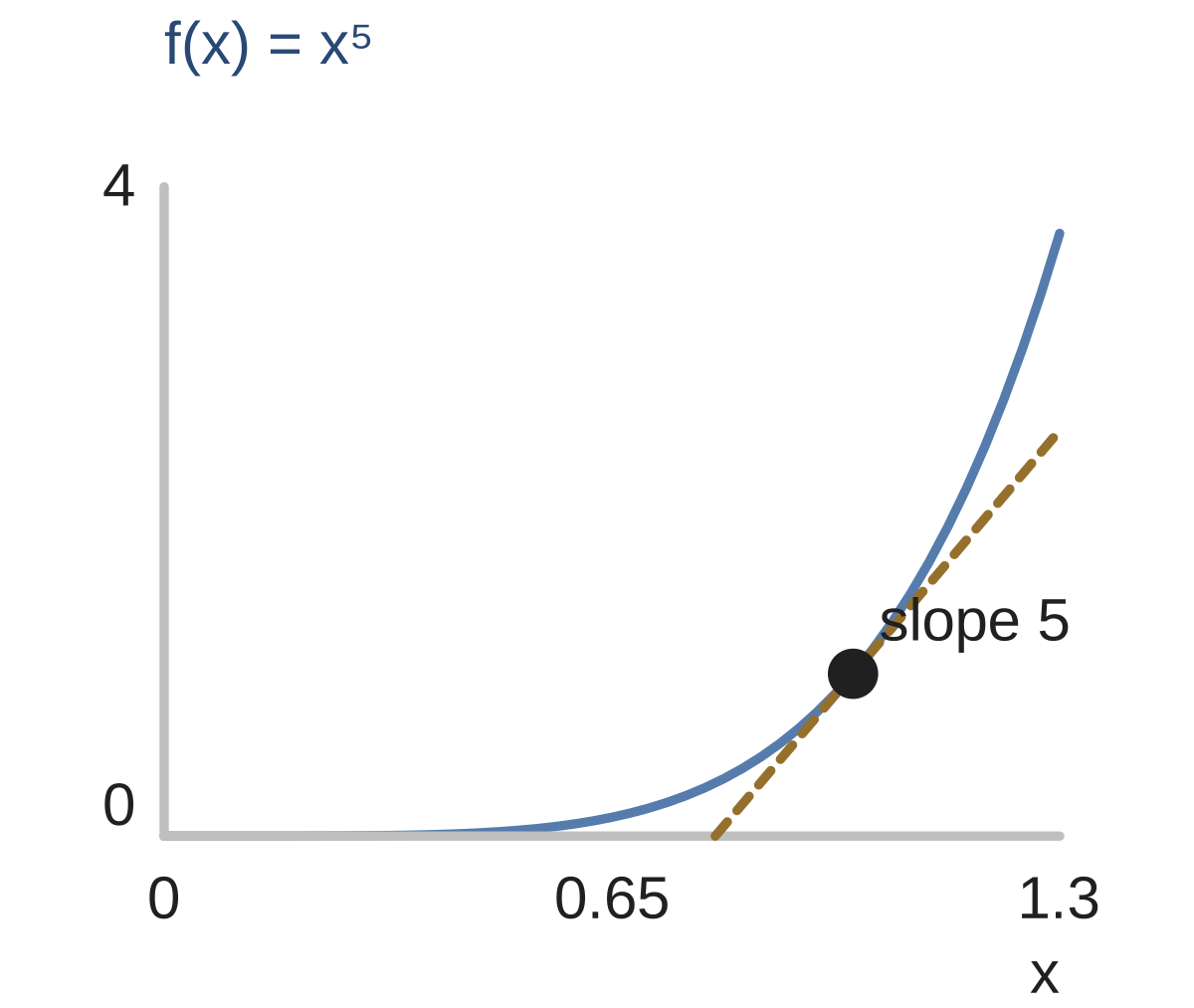
For f(x)=x^5, the derivative is 5x^4. At x=1 the point is (1,1) and the tangent has slope 5. The tangent shown is y=1+5(x−1); a local illustration accompanies the general algebraic rule.For f(x)=x^5, the derivative is 5x^4. At x=1 the point is (1,1) and the tangent has slope 5. The tangent shown is y=1+5(x−1); a local illustration accompanies the general algebraic rule.
Figure 1For f(x)=x^5, the derivative is 5x^4. At x=1 the point is (1,1) and the tangent has slope 5. The tangent shown is y=1+5(x−1); a local illustration accompanies the general algebraic rule.
Link to this figure ↗Download SVGDownload PNG
Key takeaway

Use the original exponent as multiplier, subtract one, and respect the domain.

  • Differentiate a scalar power function on its real domain.

Sources & further reading

  1. [1]
  2. [2]

Reference this concept

Link to this page, a section, or an individual figure.

Glacius. “Power rule.” Math behind ML. /learn/c-power