Skip to content
Glacius
CalculusConcept reference

Sum rule

The derivative of a sum of differentiable functions is the sum of their derivatives.

On this page 7 sections
  1. Overview
  2. If u and v are differentiable, their sum changes at the sum of their rates
  3. For f(x)=x^5+x^3+8, the power rule gives 5x^4 and 3x^2
  4. If uprime(a)=4 and vprime(a)=-1, the total rate is 3
  5. Key takeaway
  6. Sources & further reading
  7. Concept connections

01If u and v are differentiable, their sum changes at the sum of their rates#

If uu and vv are differentiable, their sum changes at the sum of their rates. At the same input xx:

(u+v)=u+v(u+v)\prime=u\prime+v\prime

For T=u+vT=u+v, output increments add. Dividing by the same nonzero hh makes their difference quotients add:

QT=Qu+QvQ_T=Q_u+Q_v

Taking the finite limits adds their derivatives.

Check your reasoning

f(x)=x3+x2+7f(x)=x^{3}+x^{2}+7. Find f(x)f\prime(x).

  1. A3x2+2x1+x3x^{2}+2x^{1}+x
  2. B3x2+2x13x^{2}+2x^{1}
  3. C6x36x^{3}
Show answer and explanation
3x2+2x13x^{2}+2x^{1}

Differentiate each term, then add.

02For f(x)=x^5+x^3+8, the power rule gives 5x^4 and 3x^2#

For f(x)=x5+x3+8f(x)=x^5+x^3+8, the power rule gives 5x45x^4 and 3x23x^2. The constant contributes 00.

f(x)=5x4+3x2f\prime(x)=5x^4+3x^2

Each summand contributes its own derivative.

Check your reasoning

Total score T=u+vT=u+v. Both components are differentiable at 44, with u(4)=5u\prime(4)=5 and v(4)=2v\prime(4)=-2. Find T(4)T\prime(4).

Show answer and explanation
3

Add the signed rates: 5+(2)=35+(-2)=3.

03If uprime(a)=4 and vprime(a)=-1, the total rate is 3#

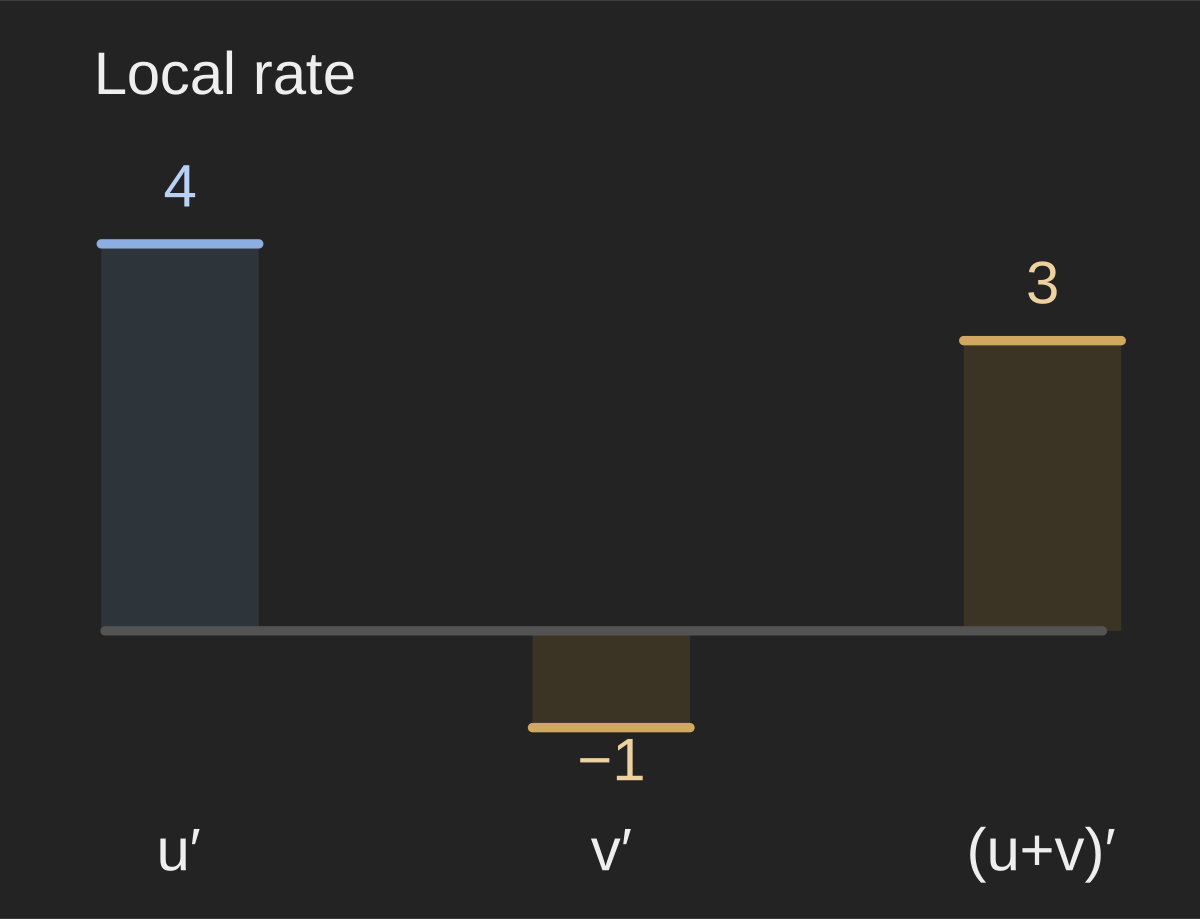
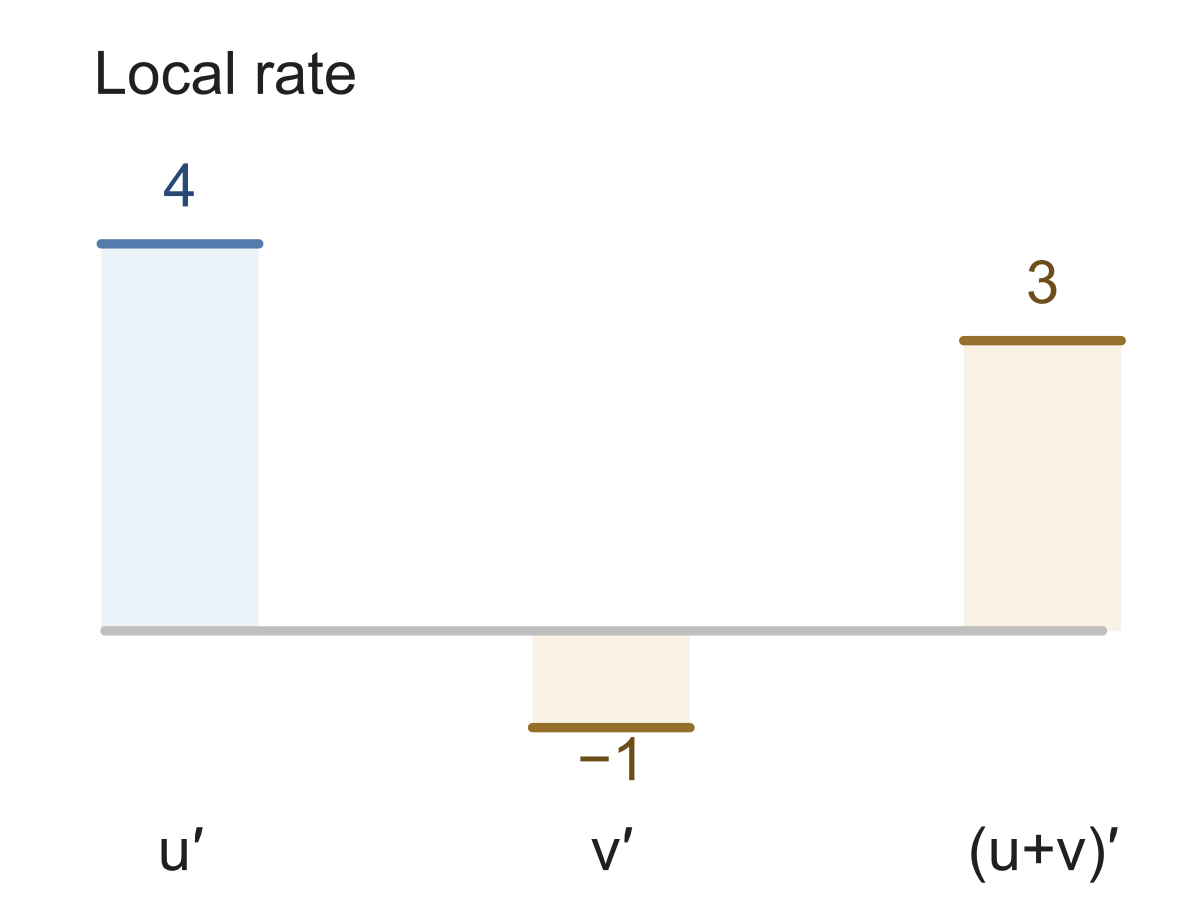
If u(a)=4u\prime(a)=4 and v(a)=1v\prime(a)=-1, the total rate is 33. The negative rate offsets part of the positive rate.
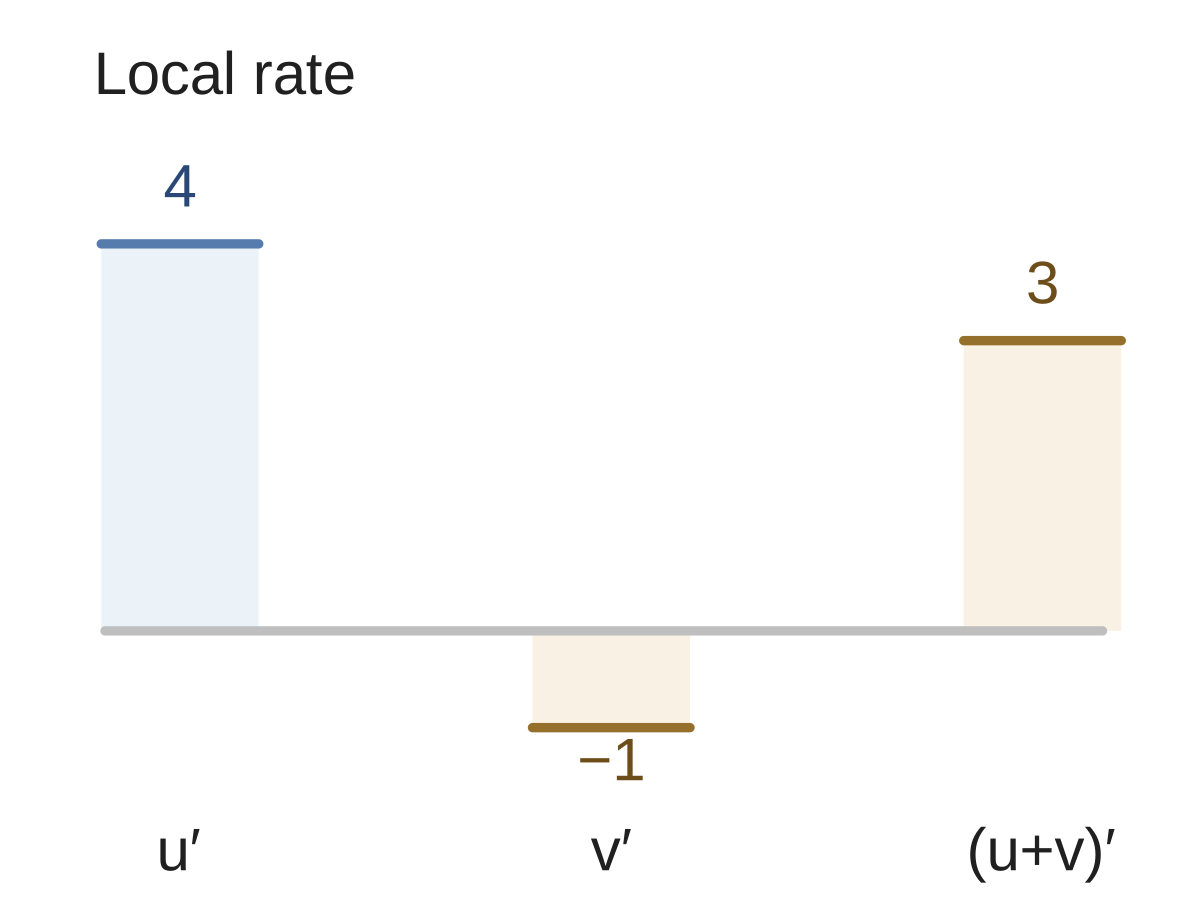
At the same input, u′=4 and v′=−1. The signed contributions share a zero baseline and sum to derivative 3. No function values or intercepts are inferred.At the same input, u′=4 and v′=−1. The signed contributions share a zero baseline and sum to derivative 3. No function values or intercepts are inferred.
Figure 1At the same input, u′=4 and v′=−1. The signed contributions share a zero baseline and sum to derivative 3. No function values or intercepts are inferred.
Link to this figure ↗Download SVGDownload PNG
Check your reasoning

f(x)=x4+x23f(x)=x^{4}+x^{2}-3. A learner adds a cross term to the derivative. Repair f(x)f\prime(x).

  1. A4x3+2x1+x4x^{3}+2x^{1}+x
  2. B8x48x^{4}
  3. C4x3+2x14x^{3}+2x^{1}
Show answer and explanation
4x3+2x14x^{3}+2x^{1}

Differentiate each term, then add.

Key takeaway

Differentiate each summand, then add its signed rate.

  • Differentiate a sum of differentiable scalar functions.

Sources & further reading

  1. [1]

Reference this concept

Link to this page, a section, or an individual figure.

Glacius. “Sum rule.” Math behind ML. /learn/c-sum