Bernoulli trials
A Bernoulli variable records one event as 1 when it occurs and 0 when it does not.
On this page 7 sections
01Model one binary outcome#
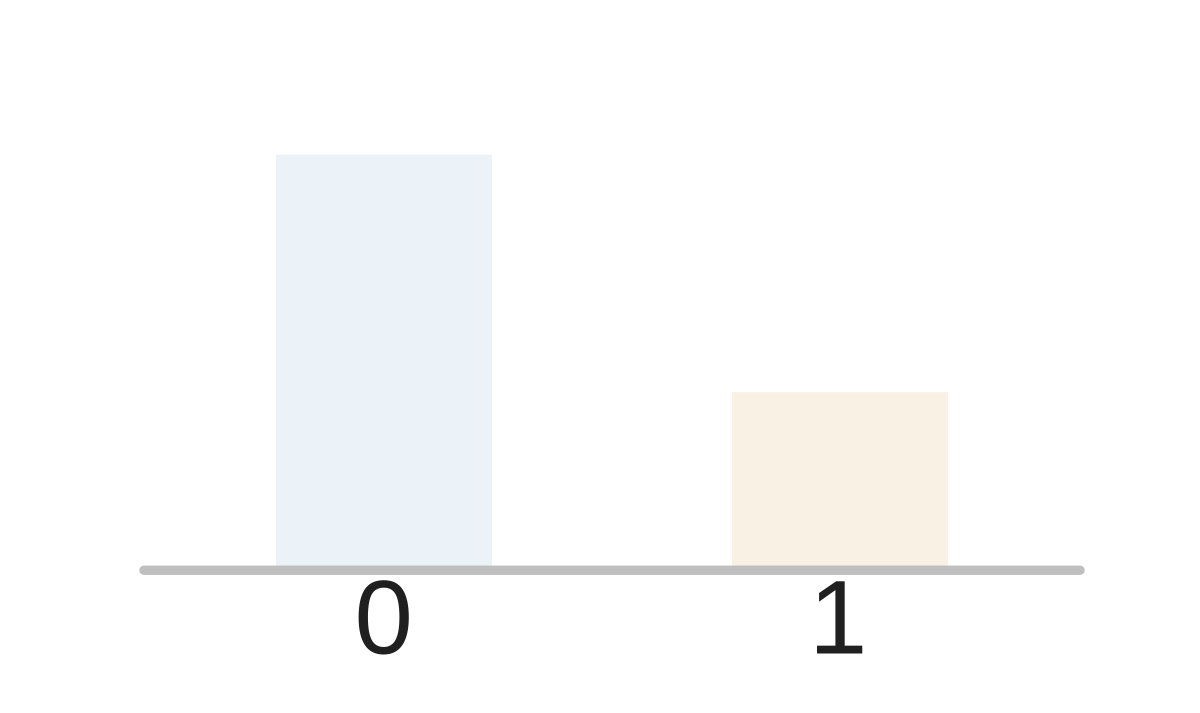
A Bernoulli variable records one event as when it occurs and when it does not. Its parameter is the probability of the event, with .
For a binary classifier's correctness indicator, can mean correct and incorrect. If its correctness probability under a stated sampling model is , then and .
02State what one means#
Writing specifies the two possible values and their probabilities. The meaning of success is chosen by the model; it need not be a desirable outcome. You could instead define as an error, changing the parameter.
If means error with probability , the two masses are at one and at zero. The underlying events have not changed, but the numerical encoding has.
X is Bernoulli(0.3). What are P(X=0), P(X=1)?
Show answer and explanation
Probability p belongs to value one; the remaining mass belongs to zero.
03One outcome versus a count#
A count of successes across several trials generally takes values beyond zero and one, so it is not a single Bernoulli variable. Its individual trial indicators may be Bernoulli variables. Independence assumptions belong to a model of the collection, not to the definition of one indicator.
At , the variable is always zero. At , it is always one. Both boundary cases are valid distributions. A probability outside the interval from zero to one is invalid.
A trial fails with probability 0.2. A draft defines X=1 for failure but sets p=0.8. Repair p.
Show answer and explanation
The parameter must refer to the event encoded as one.
When using a Bernoulli model for a binary label, say what the label represents and which population or condition defines . One binary observation does not establish the probability by itself.
Model a binary outcome with a Bernoulli distribution.
- Model a binary outcome with a Bernoulli distribution.
Sources & further reading
- [1]Dive into Deep Learning, §2.6 Probability and Statistics ↗d2l.ai · Article