Skip to content
Glacius
ProbabilityConcept reference

Cumulative distributions

The CDF F(t) is the probability that X is at most t.

On this page 7 sections
  1. Overview
  2. Understand the idea
  3. Between two possible values, the cumulative probability stays the same
  4. A point mass p(t) asks for exactly t
  5. Key takeaway
  6. Sources & further reading
  7. Concept connections

01Understand the idea#

The cumulative distribution function, or CDF, asks how much probability has accumulated up to a threshold. The endpoint is included: F(t)=P(Xt)F(t)=P(X\le t).

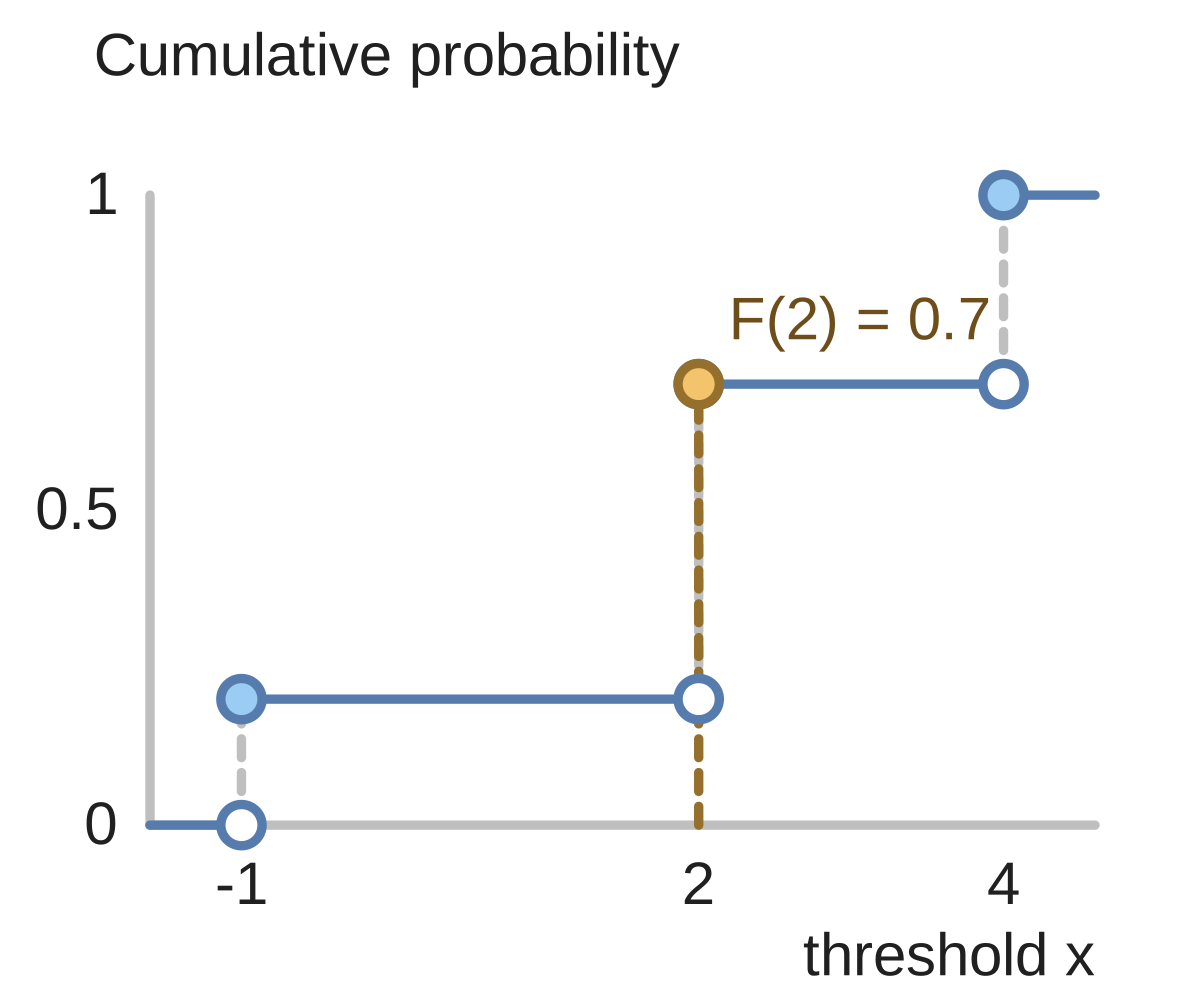
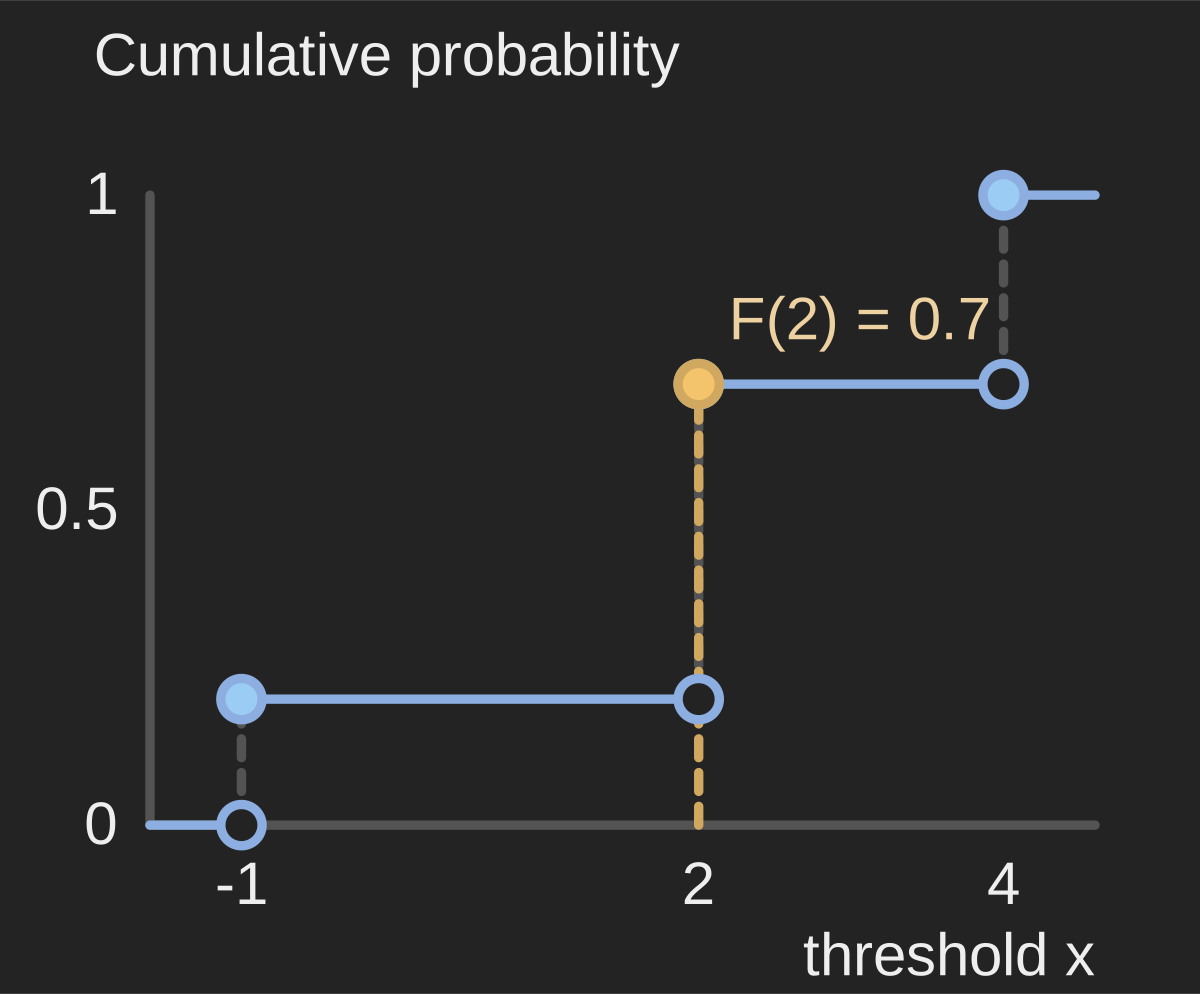
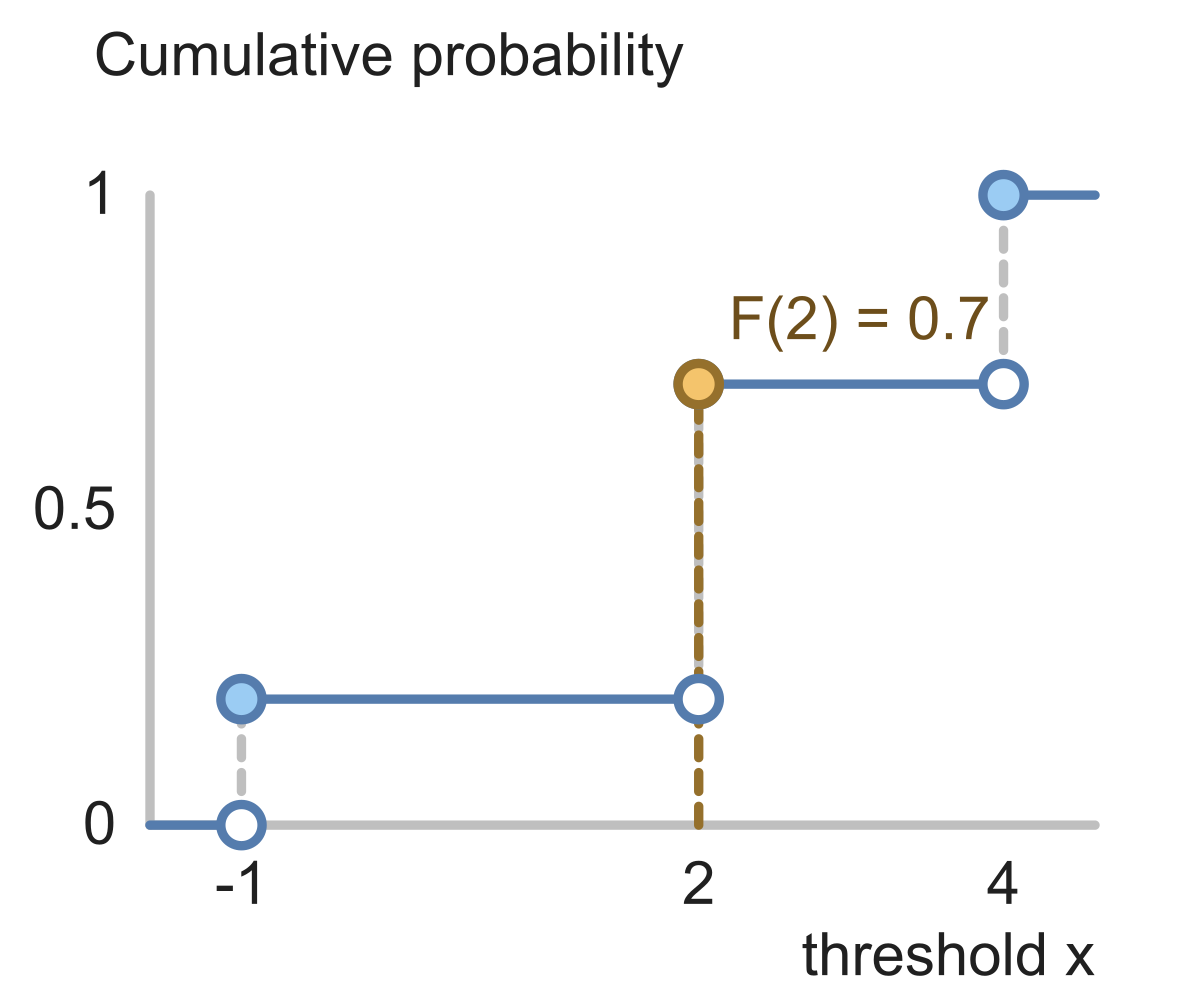
The CDF is 0 below −1, .2 from −1 through inputs below 2, .7 from 2 through inputs below 4, and 1 from 4 onward. Filled endpoints include each jump; open endpoints exclude the previous height. F(2)=.7.The CDF is 0 below −1, .2 from −1 through inputs below 2, .7 from 2 through inputs below 4, and 1 from 4 onward. Filled endpoints include each jump; open endpoints exclude the previous height. F(2)=.7.
Figure 1The CDF is 0 below −1, .2 from −1 through inputs below 2, .7 from 2 through inputs below 4, and 1 from 4 onward. Filled endpoints include each jump; open endpoints exclude the previous height. F(2)=.7.
Link to this figure ↗Download SVGDownload PNG

Here the masses are 0.20.2 at 1-1, 0.50.5 at 22, and 0.30.3 at 44. At threshold 22, include the first two values. Their masses add to 0.2+0.5=0.70.2+0.5=0.7.

F(2)=0.7F(2)=0.7
Check your reasoning

PMF: p(2)=0.2p(-2)=0.2, p(0)=0.4p(0)=0.4, p(3)=0.4p(3)=0.4. Find F(0)=P(X0)F(0)=P(X\le 0).

Show answer and explanation
0.6

Include 2,0-2, 0: 0.2+0.4=0.60.2+0.4=0.6.

02Between two possible values, the cumulative probability stays the same#

Between two possible values, the cumulative probability stays the same. No new mass is crossed.

For this model, F(3)=F(2)=0.7F(3)=F(2)=0.7. Below 1-1, the total is zero. At 44 or above, it is one.

Check your reasoning

A count XX has pmf: p(0)=0.3p(0)=0.3, p(2)=0.5p(2)=0.5, p(5)=0.2p(5)=0.2. Find the probability of at most 44.

Show answer and explanation
0.8

Include 0,20, 2: 0.3+0.5=0.80.3+0.5=0.8.

03A point mass p(t) asks for exactly t#

A point mass p(t)p(t) asks for exactly tt. The CDF F(t)F(t) also includes every possible value below tt.

When the threshold equals a possible value, include its mass. That is where a discrete CDF jumps.

Check your reasoning

PMF: p(2)=0.1p(-2)=0.1, p(1)=0.7p(1)=0.7, p(4)=0.2p(4)=0.2. A learner uses only p(1)p(1) for F(1)F(1). Repair F(1)F(1).

Show answer and explanation
0.8

Include 2,1-2, 1: 0.1+0.7=0.80.1+0.7=0.8.

Key takeaway

Include every mass at or below the threshold.

  • Compute a discrete cumulative distribution at a threshold.

Sources & further reading

  1. [1]

Reference this concept

Link to this page, a section, or an individual figure.

Glacius. “Cumulative distributions.” Math behind ML. /learn/p-cdf