Chi-squared distributions
A chi-squared variable with n degrees of freedom is the sum of squares of n independent standard-normal variables.
On this page 9 sections
01Understand the idea#
A chi-squared distribution describes a sum of squares of independent standard-normal variables. Squaring removes signs, so the result cannot be negative. The number of independent squared inputs is called its degrees of freedom.
This construction appears when aggregating standardized errors or estimating variance under normal assumptions. The degrees of freedom describe the random construction, not how many of the realized values happen to be nonzero.
Each input is standard normal, and the inputs are independent. Squaring each one and adding gives a chi-squared variable.
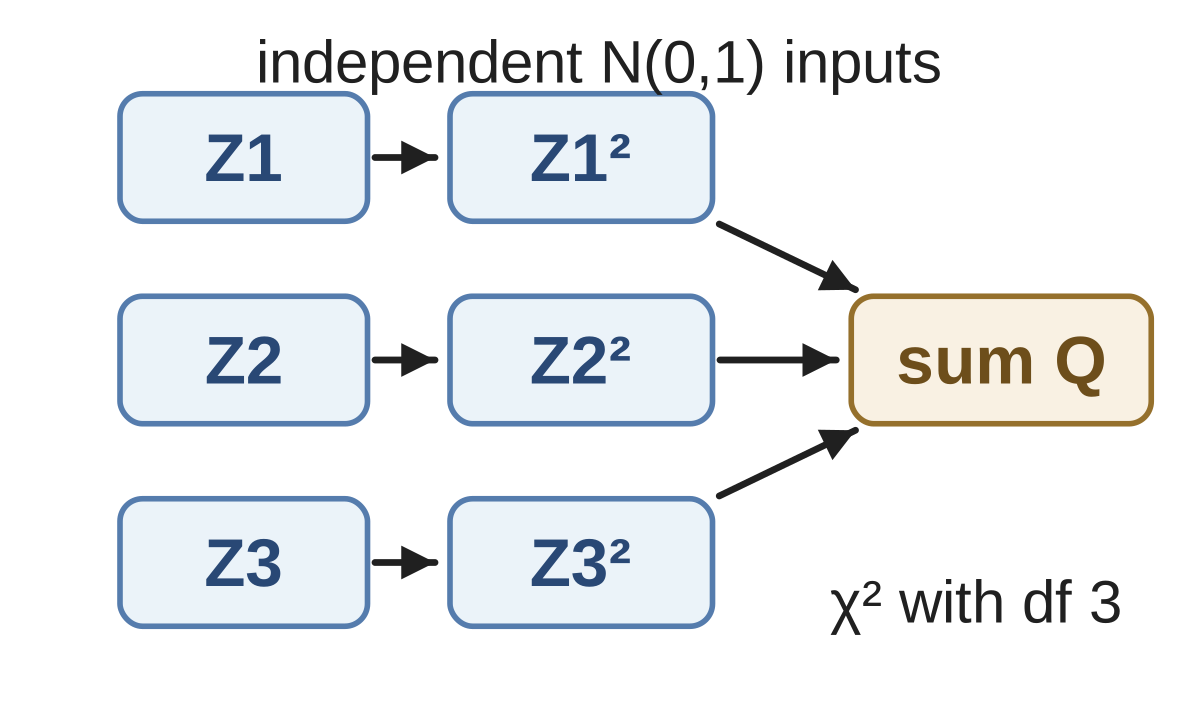
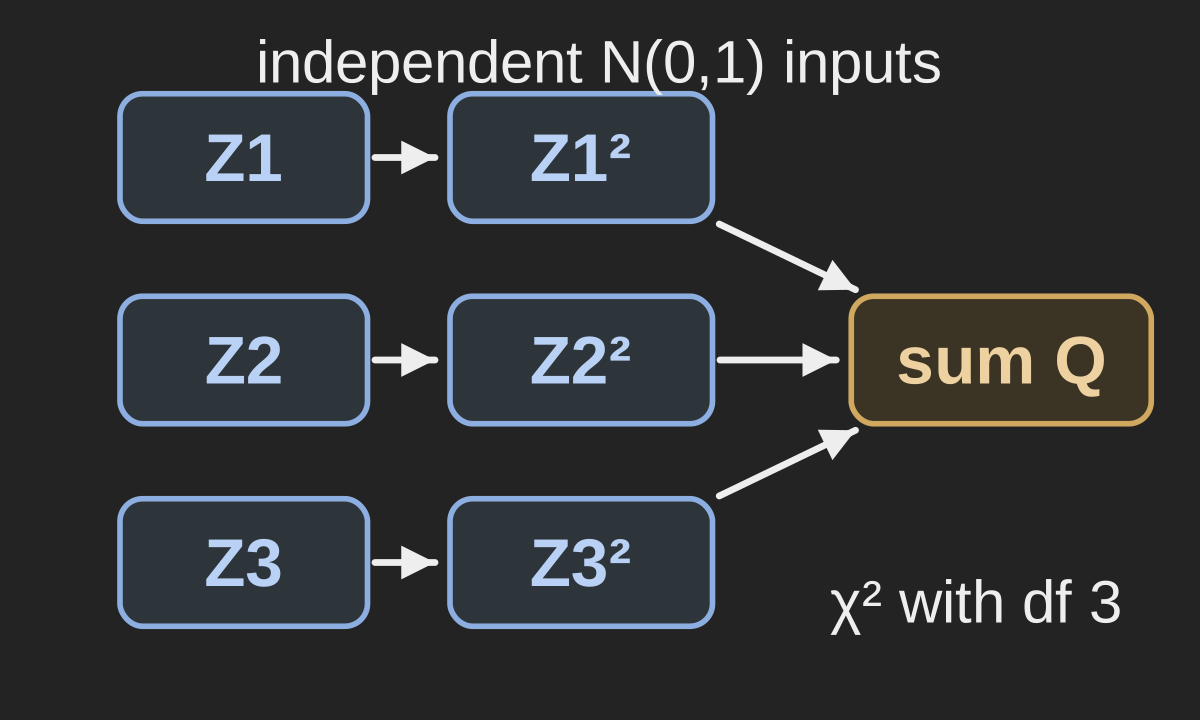
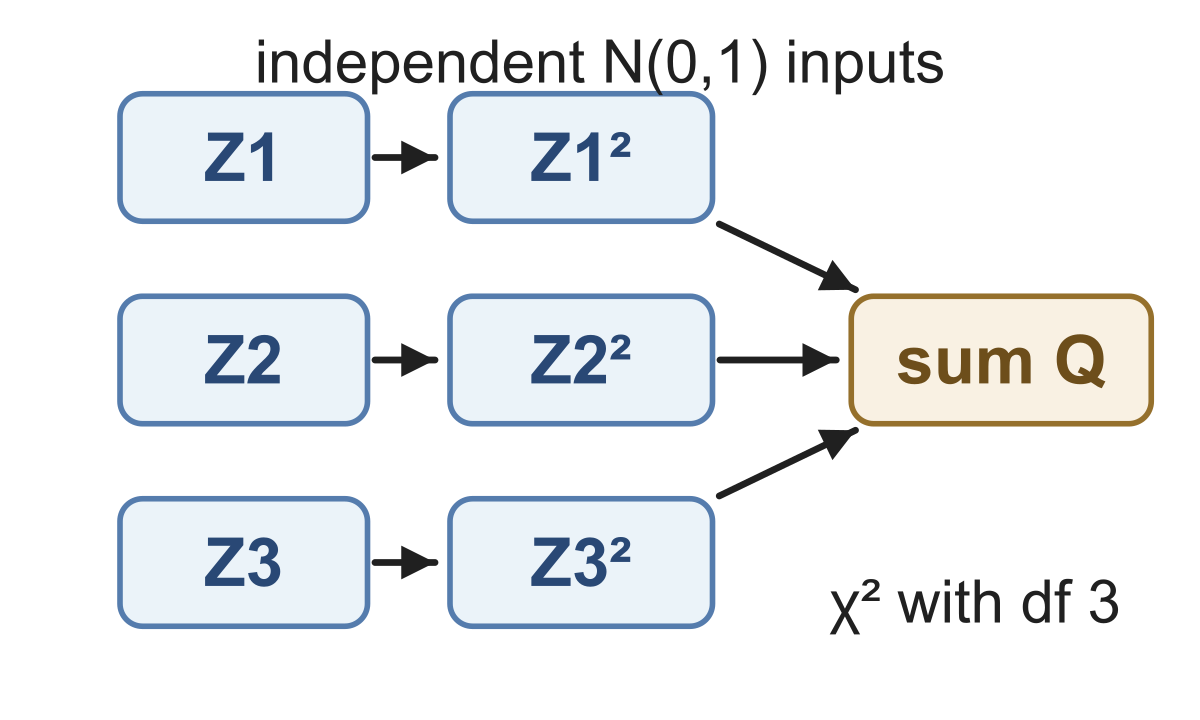
The degrees of freedom count the independent squared inputs. Three inputs give ; their realized numeric values do not change that count.
For independent standard-normal , the sum has three degrees of freedom. If one realization is , its sum is . The observed value is 5 while the degrees of freedom remain 3.
are mutually independent . . Choose its law.
Show answer and explanation
Five independent squares give .
02Square each input before adding#
Square each input before adding. Squaring the sum adds cross terms, and repeating one input does not create another independent input.
Independent . Repair the squared sum for .
Show answer and explanation
Square separately, then add.
03Independent normals use (mean, variance): and #
Independent normals use (mean, variance): and . Subtract each mean and divide by its SD.
For independent and , let and . These are independent standard normals.
Divide by SD, not variance, before squaring.
Independent normals (mean, variance): ; . . Choose its law.
Show answer and explanation
Two squares give .
04A closer look#
Before squaring a nonstandard normal variable, subtract its mean and divide by its standard deviation. Independence is also essential for this stated chi-squared construction. Reusing one variable twice does not create two independent contributions.
Standardize each normal input, square separately, then add. Degrees of freedom count the independent squared inputs.
- Identify a chi-squared variable as a sum of squared independent standard-normal variables.
Further questions
What changes when a normal value is divided by a random chi-squared scale?
Sources & further reading
- [1]
- [2]Pishro-Nik, 4.2.3 Normal Distribution ↗Textbook · Book