Student’s t distributions
A standard Student t variable with nu degrees of freedom is Z/sqrt(V/nu), where Z is standard normal and V is an independent chi-squared variable with nu degrees of freedom.
On this page 9 sections
01Understand the idea#
Student’s t distribution describes a standardized normal quantity divided by an independent estimated scale. The denominator is random, so the ratio is more variable than a standard normal. That extra uncertainty matters when a population standard deviation must be estimated from a sample.
The degrees of freedom belong to the chi-squared variable supplying the scale. Small degrees of freedom give heavier tails. This lesson identifies the construction; a later lesson uses t critical values to build an interval for a population mean.
The numerator is standard normal. Its divisor is a random scale from an independent chi-squared variable. This construction gives a Student t variable.
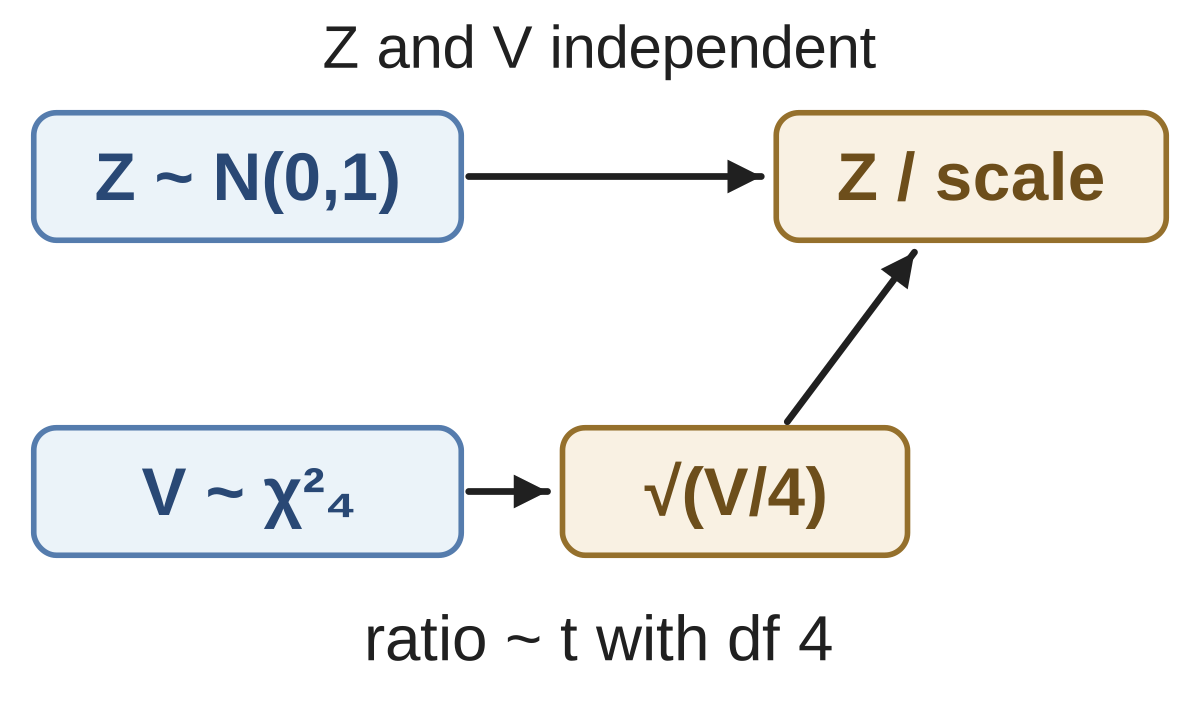
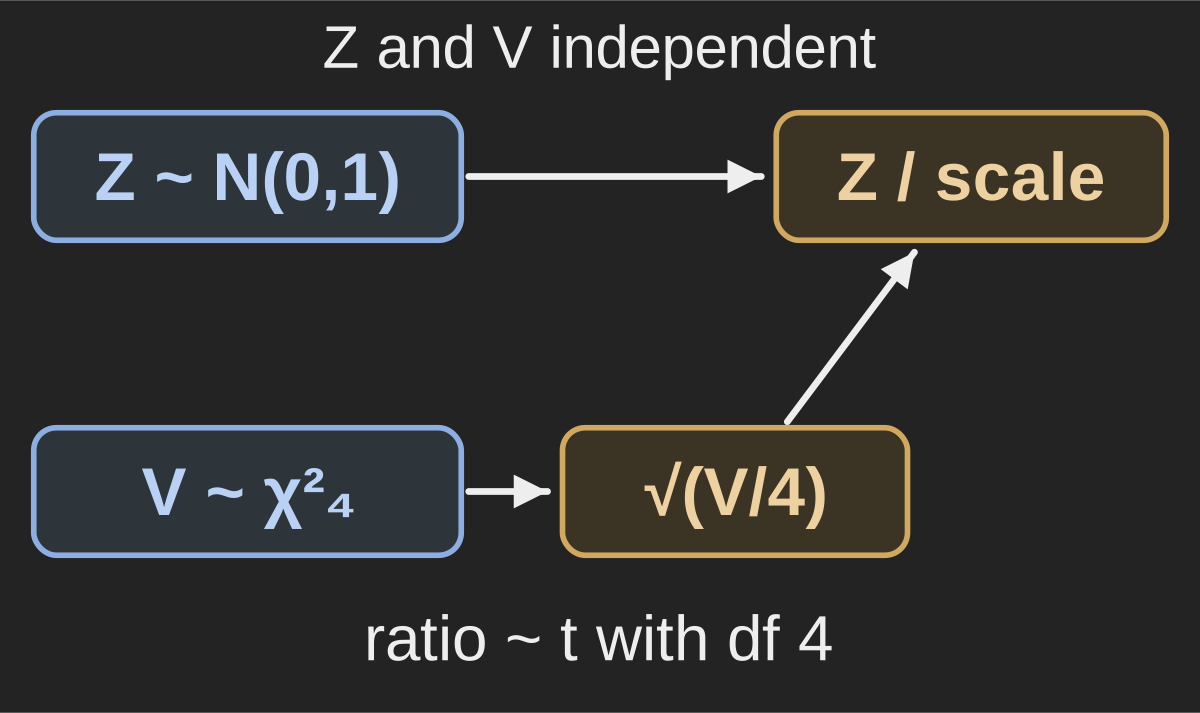
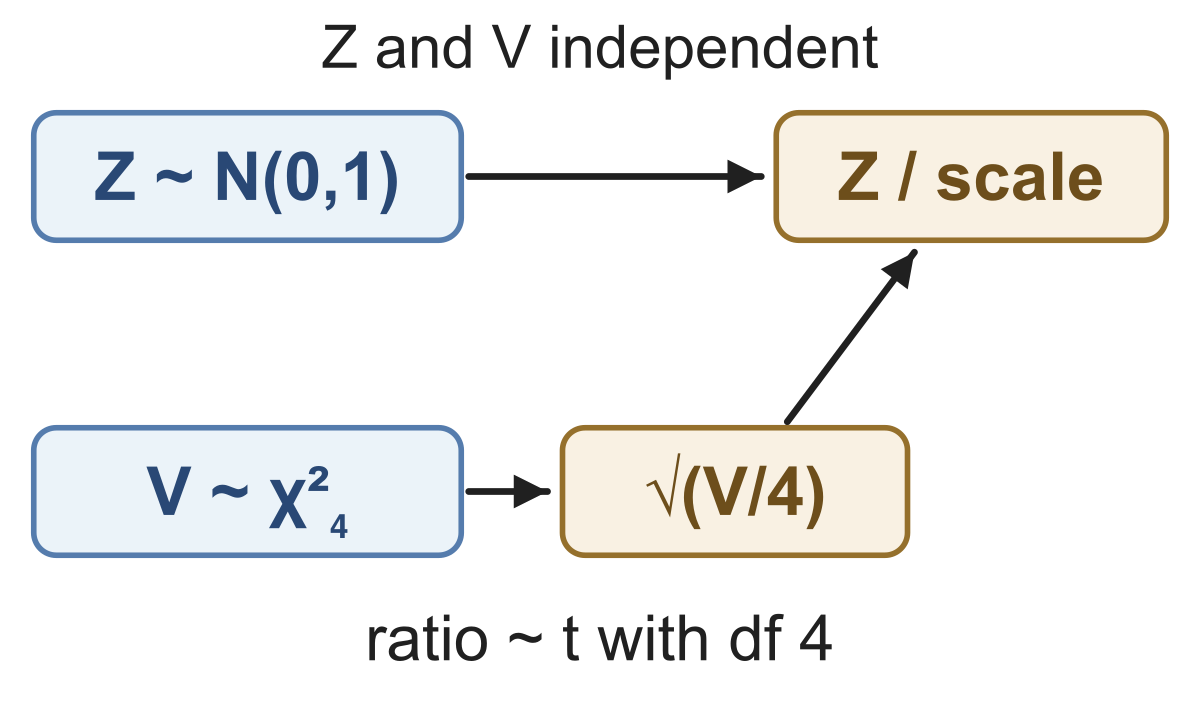
If is independent of , divide by its fixed degrees of freedom, then take the square root.
For independent of , the denominator is . A realization gives divisor and ratio 1. The ratio’s distribution has 4 degrees of freedom; the observed value 16 does not change that parameter.
Independent and . . Choose its law.
Show answer and explanation
Chi-squared df gives .
02The square root encloses the whole ratio #
The square root encloses the whole ratio . Using directly or forgetting the divisor changes the random scale and breaks this standard t construction.
Independent and . Repair to obtain a variable.
Show answer and explanation
Put inside the square root.
03The degrees of freedom belong to the chi-squared law, not to one observed value of #
The degrees of freedom belong to the chi-squared law, not to one observed value of . They affect the t curve’s tails: smaller values give heavier tails, while larger values approach the standard normal.
Error and noise are independent. Which ratio has law ?
Show answer and explanation
Divide by .
04Using would skip the square root and produce a different random variable#
Using would skip the square root and produce a different random variable. The independence and standard-normal assumptions are part of the construction, not optional details justified by the shape of the displayed formula.
Check both input laws and independence. Divide the normal input by the square root of chi-squared input over its degrees of freedom.
- Interpret a supplied standard-normal to scaled-chi-squared ratio as a t variable under independence.
Further questions
How do these reference distributions support statistical inference?
Sources & further reading
- [1]Taboga, Relationships Among Probability Distributions ↗Textbook · Book
- [2]Taboga, Student’s t Distribution ↗Textbook · Book