Standardization
Standardization maps a normal threshold x to z=(x-mu)/sigma, where sigma is the positive standard deviation.
On this page 9 sections
- Overview
- Standardization expresses a value as a signed number of standard deviations from its mean
- A threshold below the mean has a negative score
- If a normal model supplies variance , use SD in the denominator
- A standardized score of 2 means two standard deviations above the mean
- Key takeaway
- Further questions
- Sources & further reading
- Concept connections
01Standardization expresses a value as a signed number of standard deviations from its mean#
Standardization expresses a value as a signed number of standard deviations from its mean. Subtracting the mean changes the origin; dividing by the standard deviation changes the unit. This makes values from different location-and-scale settings comparable.
With mean and SD , a raw value of is one SD above the center. Its standard score is .
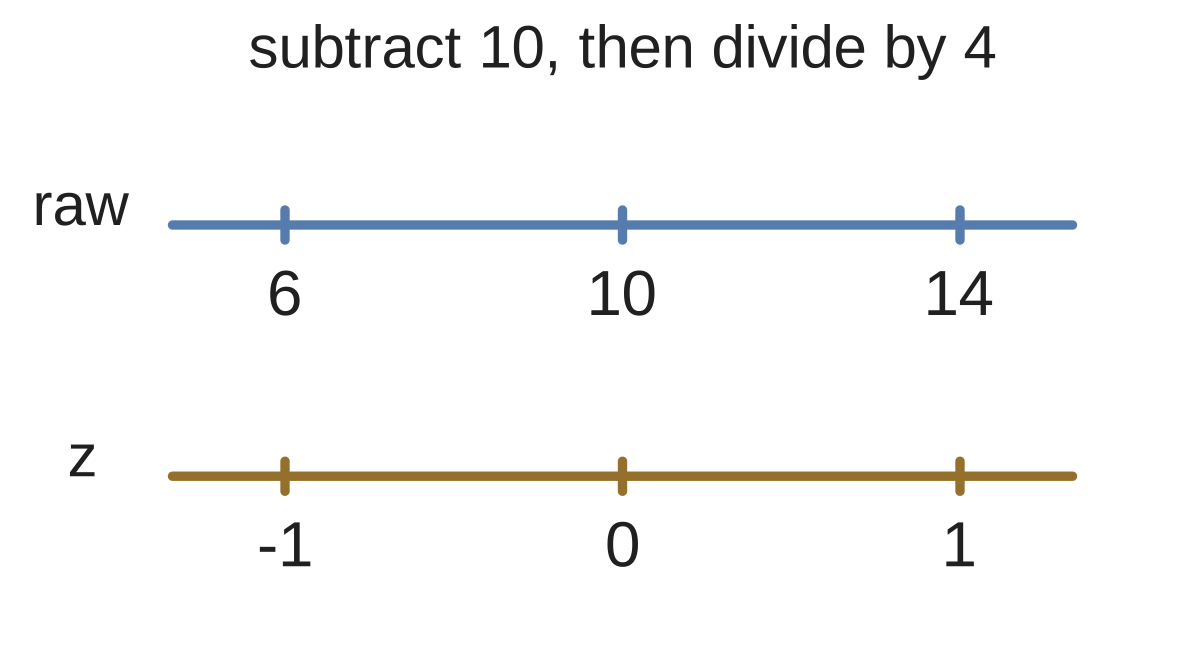
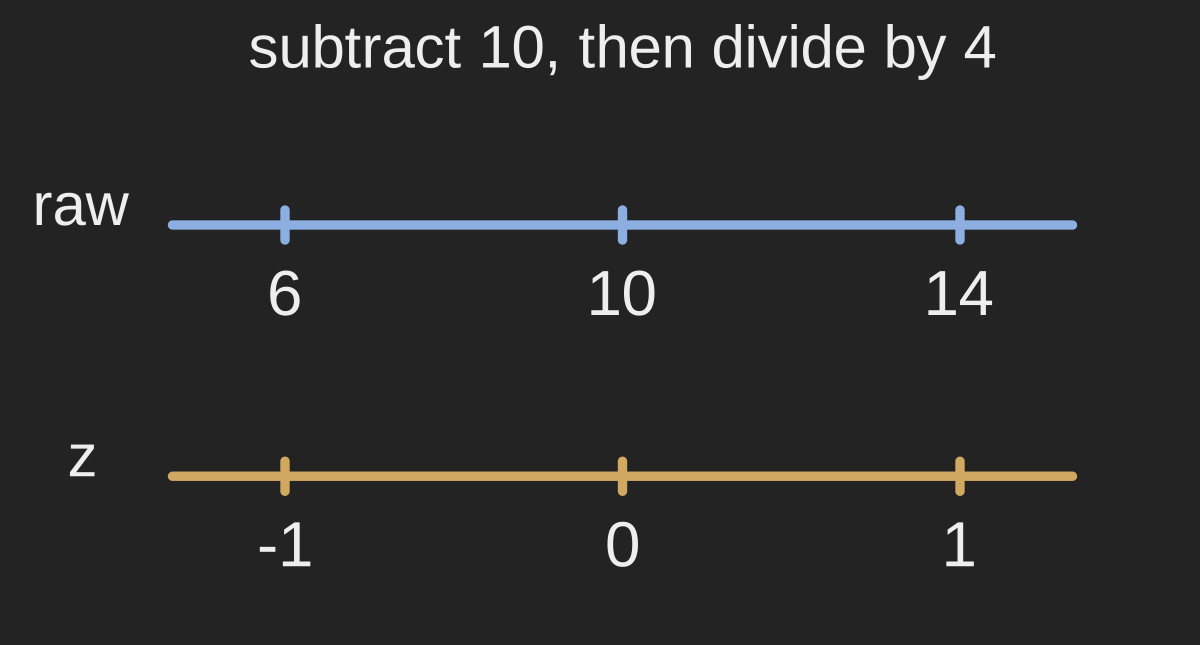
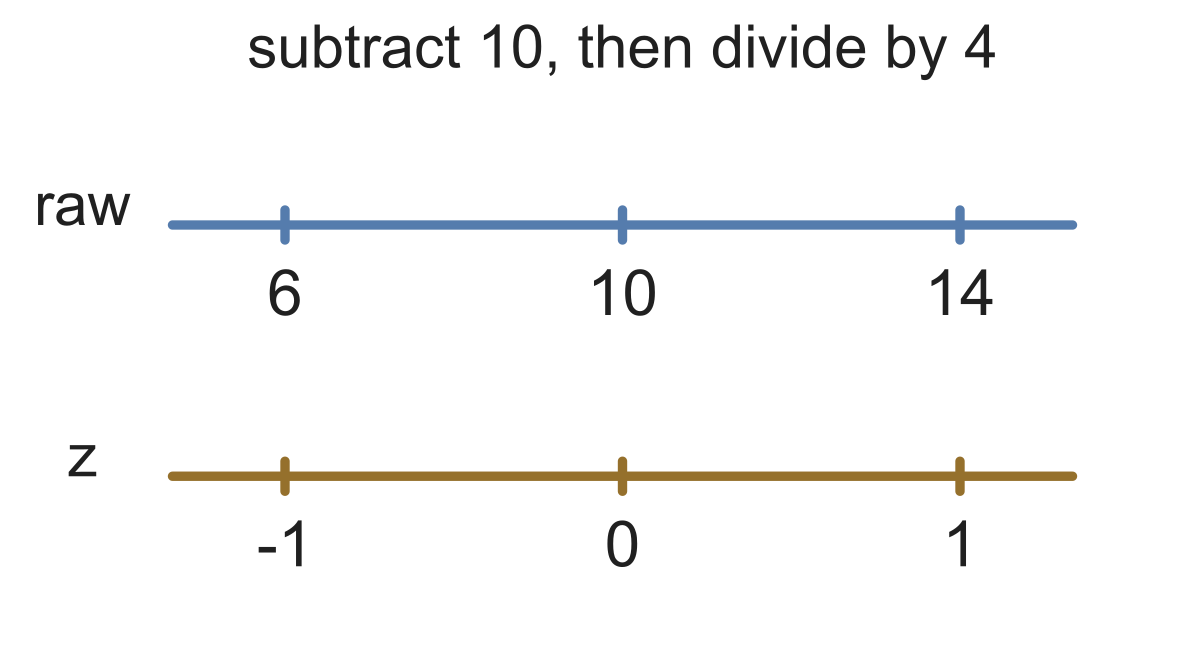
Subtract the mean to measure displacement from the center. Divide by the positive SD to count that displacement in SD units.
For value 16, mean 10, and standard deviation 3, first find the deviation . Dividing by 3 gives standardized value 2. A value of 7 gives . If you are supplied variance 9 instead, take its square root before using the same calculation.
Normal model. Mean , SD ; threshold . Give the standard score.
Show answer and explanation
.
02A threshold below the mean has a negative score#
A threshold below the mean has a negative score. At the mean, the score is zero. Standardizing changes the unit of measurement; it does not turn a negative displacement positive.
Normal model. Mean , SD ; threshold . Repair reported .
Show answer and explanation
.
03If a normal model supplies variance , use SD in the denominator#
If a normal model supplies variance , use SD in the denominator. For mean and threshold , the score is .
A standardized normal variable has mean and SD . Its threshold is now ready for a standard-normal probability table.
Latency. Normal model. Mean , SD ; threshold . Give the standard score.
Show answer and explanation
.
04A standardized score of 2 means two standard deviations above the mean#
A standardized score of 2 means two standard deviations above the mean. It does not have a universal percentile unless the distribution is specified. Under a normal model, standardization lets one standard-normal table serve many different means and scales.
Subtract the mean, then divide by SD. The sign shows which side of the mean contains the threshold.
- Convert a normal threshold to standard-normal units.
Further questions
How can standard scores locate interval probabilities in a CDF?
Sources & further reading
- [1]Pishro-Nik, 4.2.3 Normal Distribution ↗Textbook · Book