Event independence
Two events are independent if their joint probability equals the product of their marginal probabilities.
On this page 7 sections
01Understand the idea#
Two events are independent when their joint probability equals the product of their individual probabilities. Check the actual joint; the product alone is only a candidate.
If P(A)=0.5 and P(B)=0.6, their product is 0.3. A supplied joint of 0.3 matches, so A and B are independent.
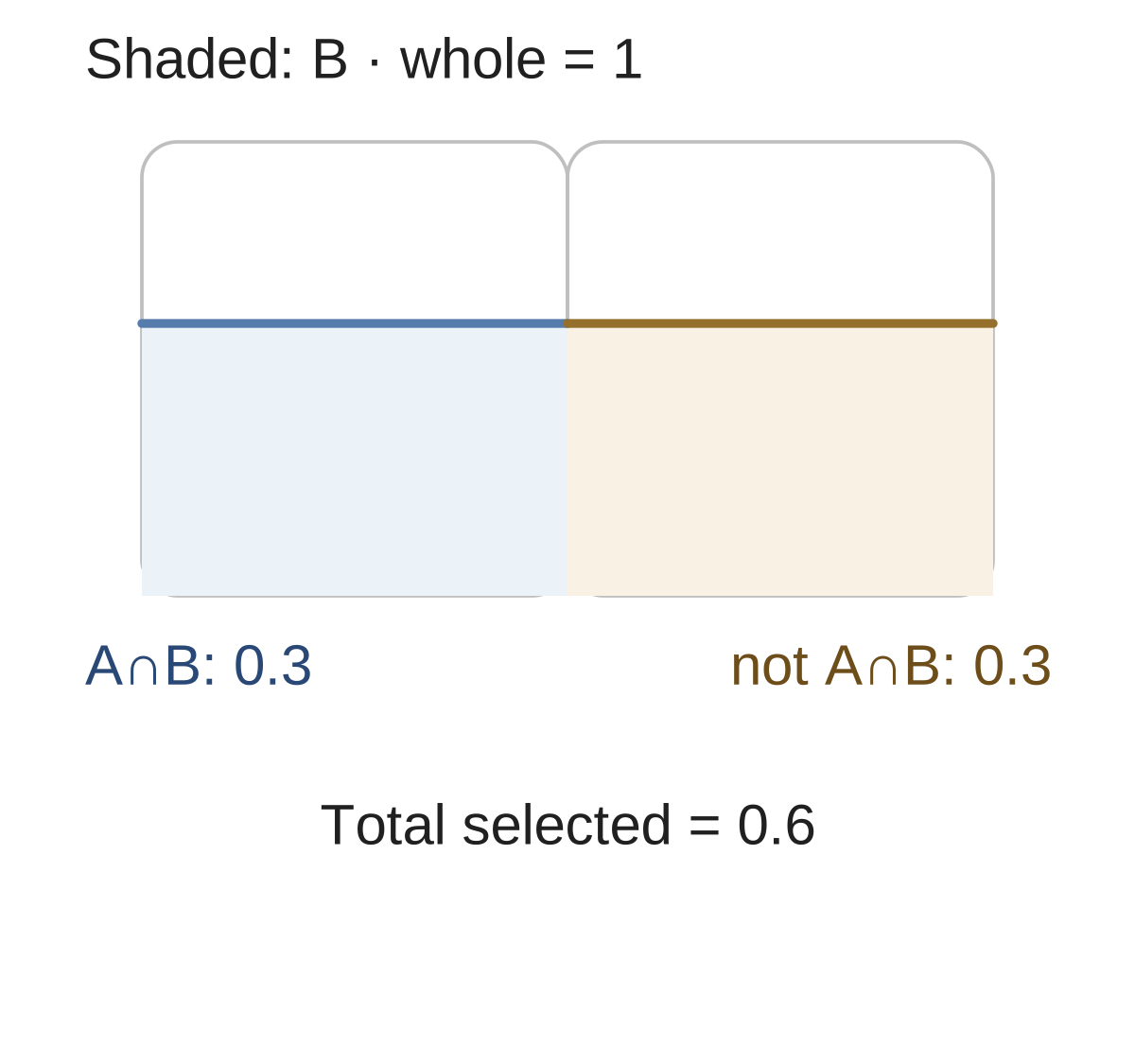
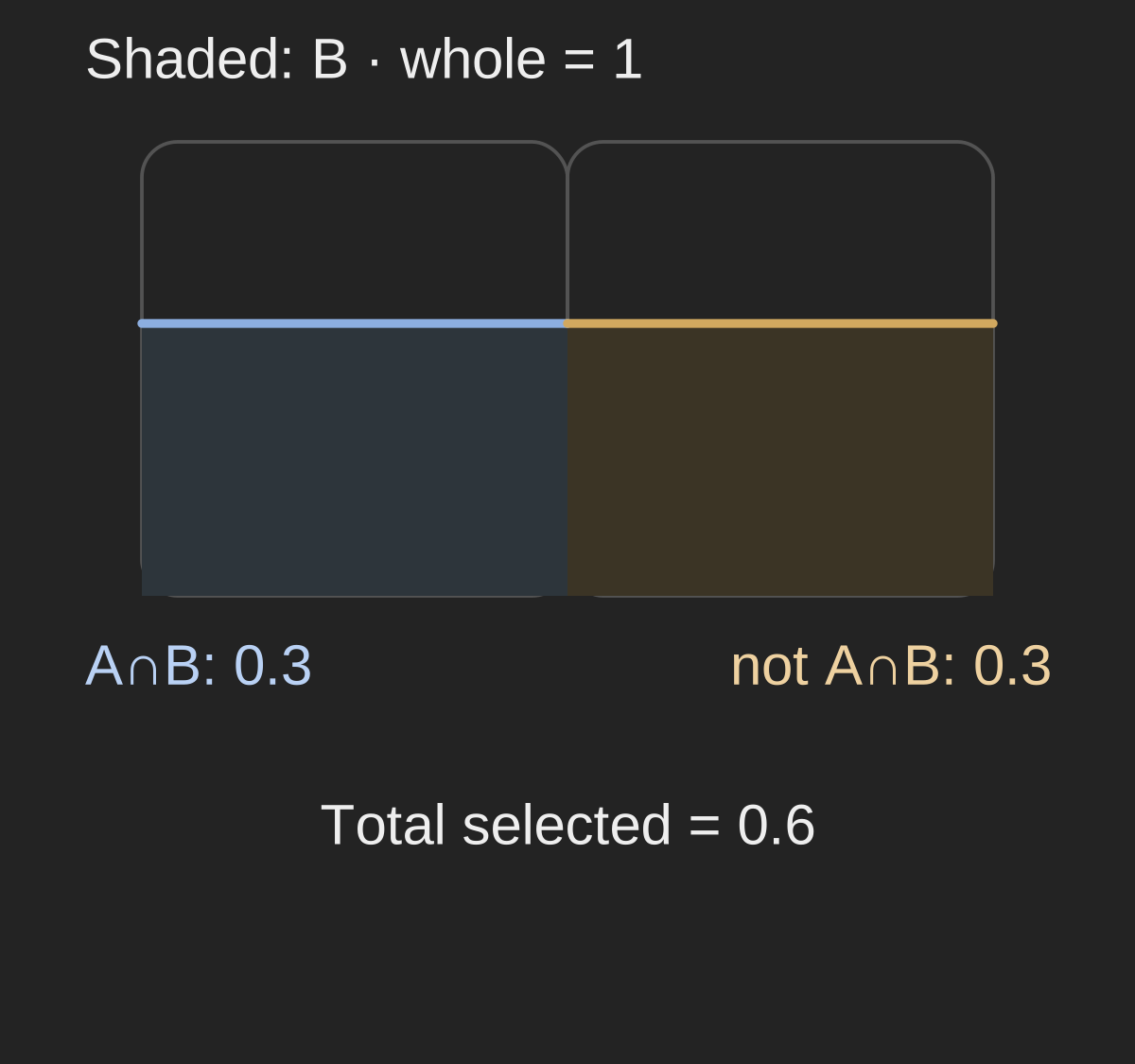
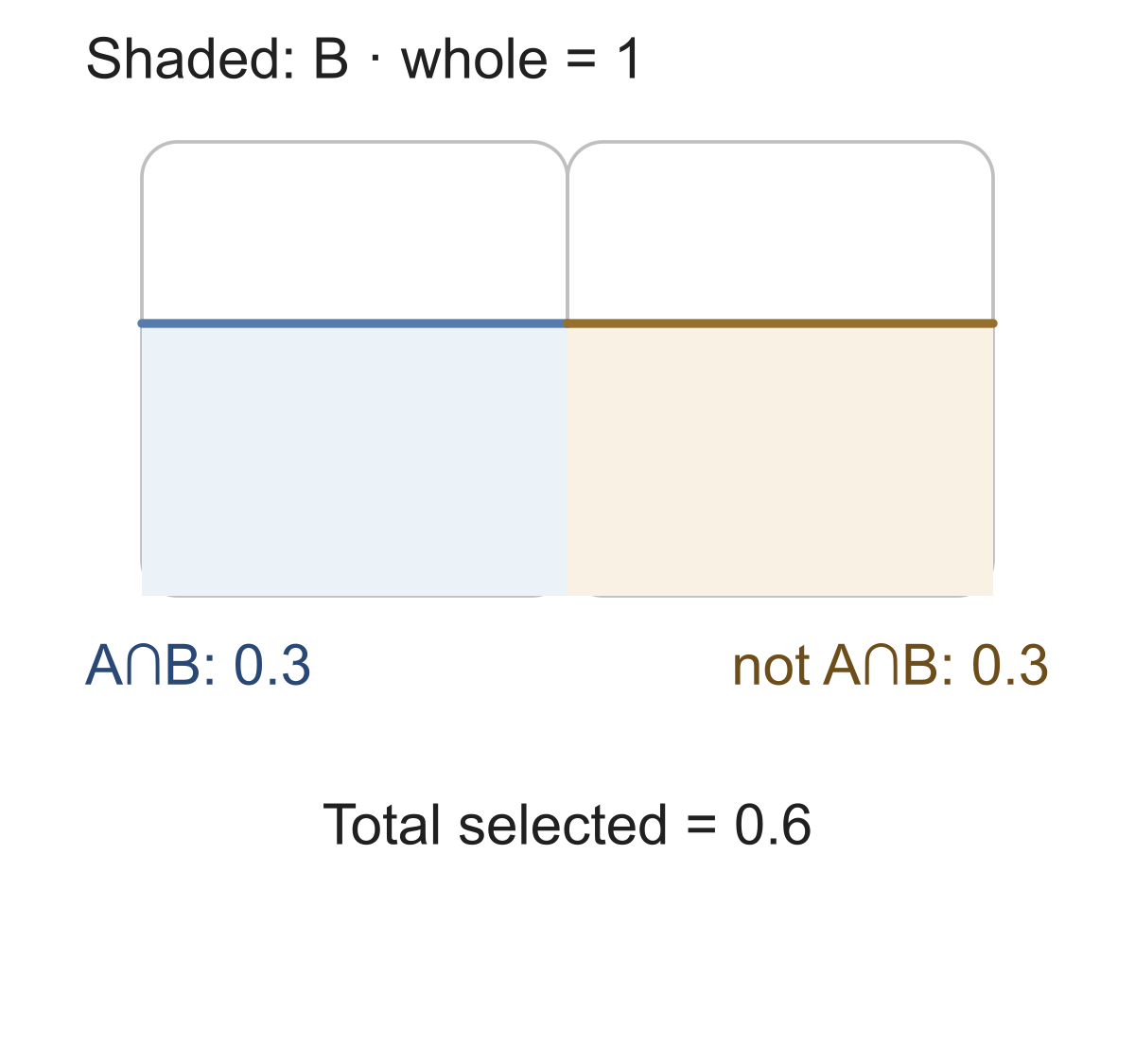
Independence requires to equal:
The product condition also works when a marginal is 0. When P(B) is positive, independence means conditioning on B leaves P(A) unchanged.
P(A)=0.5, P(B)=0.8, P(A∩B)=0.4. Independent?
Show answer and explanation
0.4 = joint 0.4.
02A closer look#
For uniform records, use the same total for both marginal fractions and the overlap fraction. For 20 records with counts A=8, B=5 and both=2, 0.4 × 0.25 = 0.1 matches the joint.
Choose uniformly from 40 records. A: 20; B: 16; both: 4. Independent?
Show answer and explanation
0.2 ≠ joint 0.1.
03A closer look#
Disjoint events with positive probabilities have joint 0 but a positive marginal product, so they are dependent. Independence does allow overlap; equal marginals alone also prove nothing.
P(A)=0.2, P(B)=0.5, P(A∩B)=0. “No overlap, so independent.” Independent?
Show answer and explanation
0.1 ≠ joint 0.
Compute the marginal product and compare it with the joint. Neither overlap nor matching marginals settles independence.
- Check the joint against the marginal product.
Sources & further reading
- [1]Pishro-Nik, Introduction to Probability: 1.4.1 Independence ↗Pishro-Nik, Introduction to Probability · Book