Probability multiplication
The multiplication rule expresses a two-event intersection as a positive conditioning probability times the matching conditional probability.
On this page 7 sections
01An intersection requires both events on the same trial#
An intersection requires both events on the same trial. A conditional probability describes the share inside one event; multiply by that event’s mass to find the joint mass.
A contains mass 0.4. If B takes 0.75 of A, their shared mass is three quarters of 0.4: 0.3.
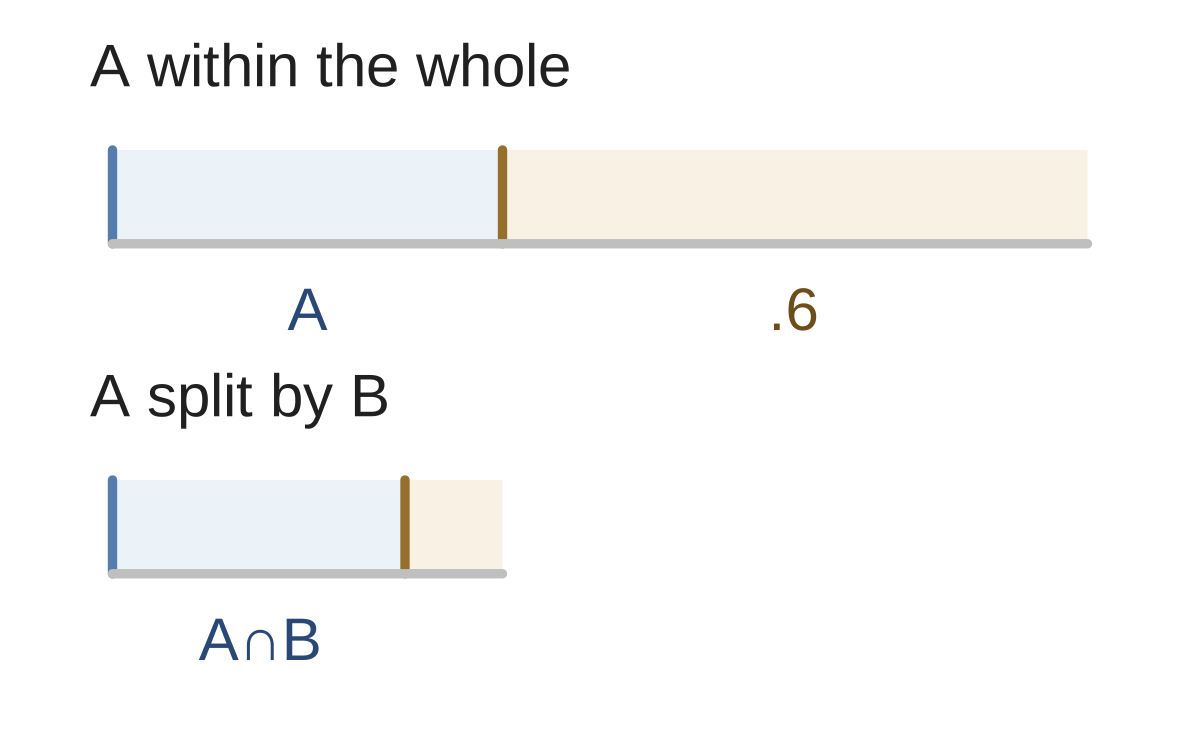
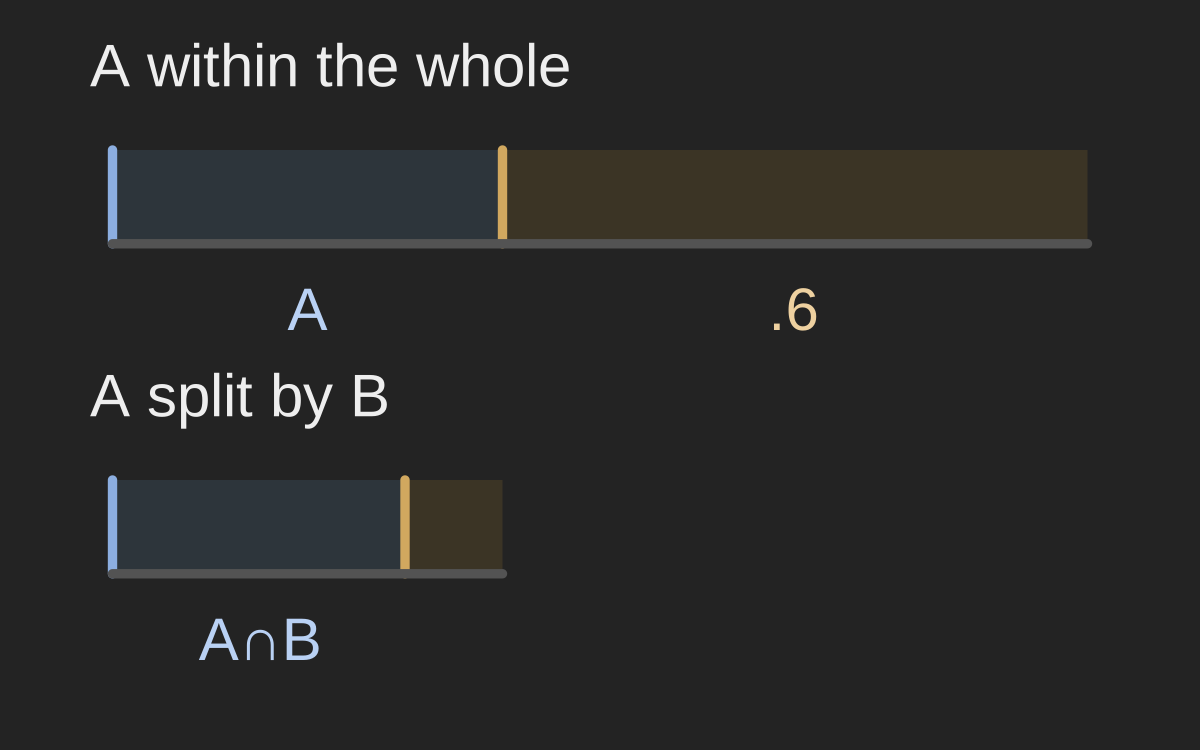
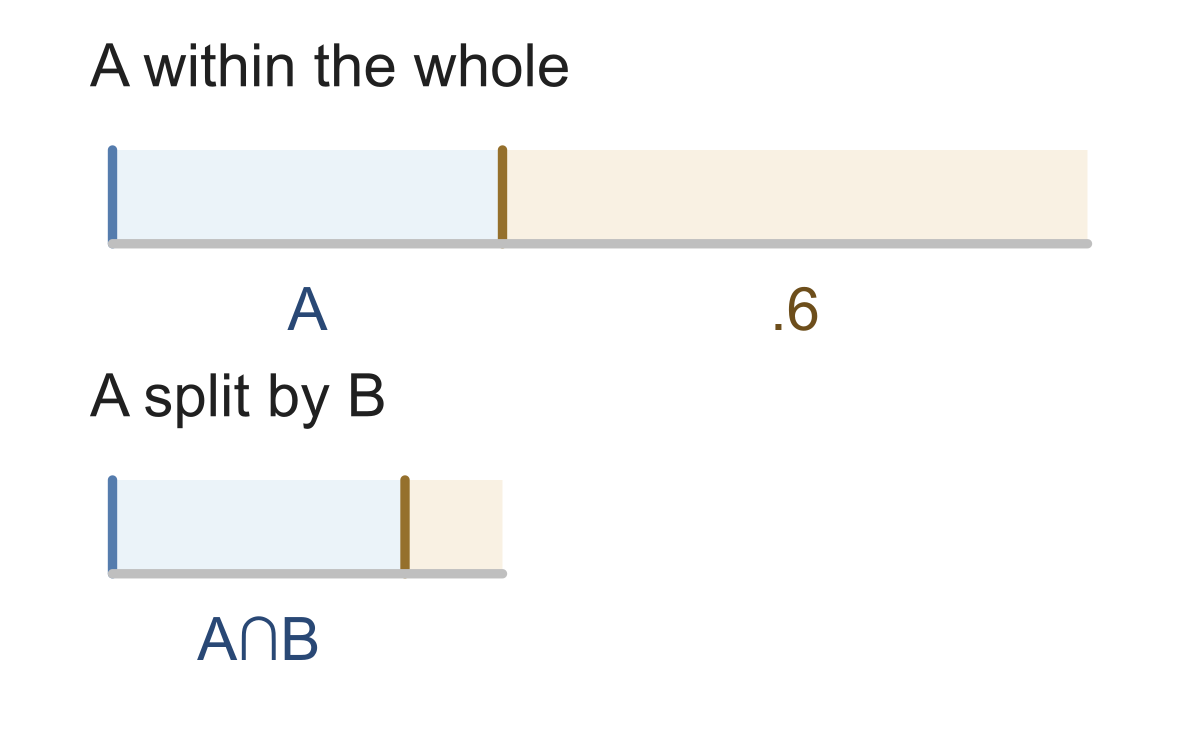
For :
This form uses P(A) > 0. You can reverse the roles when P(B) > 0, using P(B) times P(A | B).
P(A)=0.5, P(B | A)=0.8. Find P(A∩B).
Show answer and explanation
0.5 × 0.8 = 0.4.
02A closer look#
Suppose a record reaches a check with chance 0.8 and passes it with chance 0.25 among records that reach it. Reaching and passing has chance 0.8 × 0.25 = 0.2.
A record passes stage 1 with chance 0.6. Among those passes, stage 2 passes with chance 0.5. Find the chance of passing both.
Show answer and explanation
Scale the within-pass share: 0.6 × 0.5 = 0.3.
03P(B | A) can differ from P(B)#
P(B | A) can differ from P(B). Multiplying two marginal probabilities needs additional information; the matching conditional factor already accounts for the restriction to A.
P(A)=0.3, P(B)=0.5, P(B | A)=0.4. A learner gives joint 0.15. Repair it.
Show answer and explanation
Use P(B | A): 0.3 × 0.4 = 0.12.
Multiply the conditioning event’s probability by the share inside it. Keep the conditional direction matched to that first factor.
- Compute a joint using its conditional factor.
Sources & further reading
- [1]Pishro-Nik, Introduction to Probability: 1.4.0 Conditional Probability ↗Pishro-Nik, Introduction to Probability · Book