Joint expectations
A finite joint expectation sums a function’s value at each ordered pair times that pair’s joint probability.
On this page 8 sections
01For a function of two random variables, keep each output beside its joint probability#
For a function of two random variables, keep each output beside its joint probability. Multiply those pairs of numbers, then add.
![A joint table has rows X=0,1 and columns Y=0,1 with masses (0.1,0.2) and (0.3,0.4). For g(X,Y)=XY, only pair (1,1) has nonzero output, namely 1. Its contribution to E[XY] is 1 times 0.4, so the expectation is 0.4.](/visuals/p-joint-expectation/grid-miw7gs.svg)
![A joint table has rows X=0,1 and columns Y=0,1 with masses (0.1,0.2) and (0.3,0.4). For g(X,Y)=XY, only pair (1,1) has nonzero output, namely 1. Its contribution to E[XY] is 1 times 0.4, so the expectation is 0.4.](/visuals/p-joint-expectation/grid-miw7gs-dark.svg)
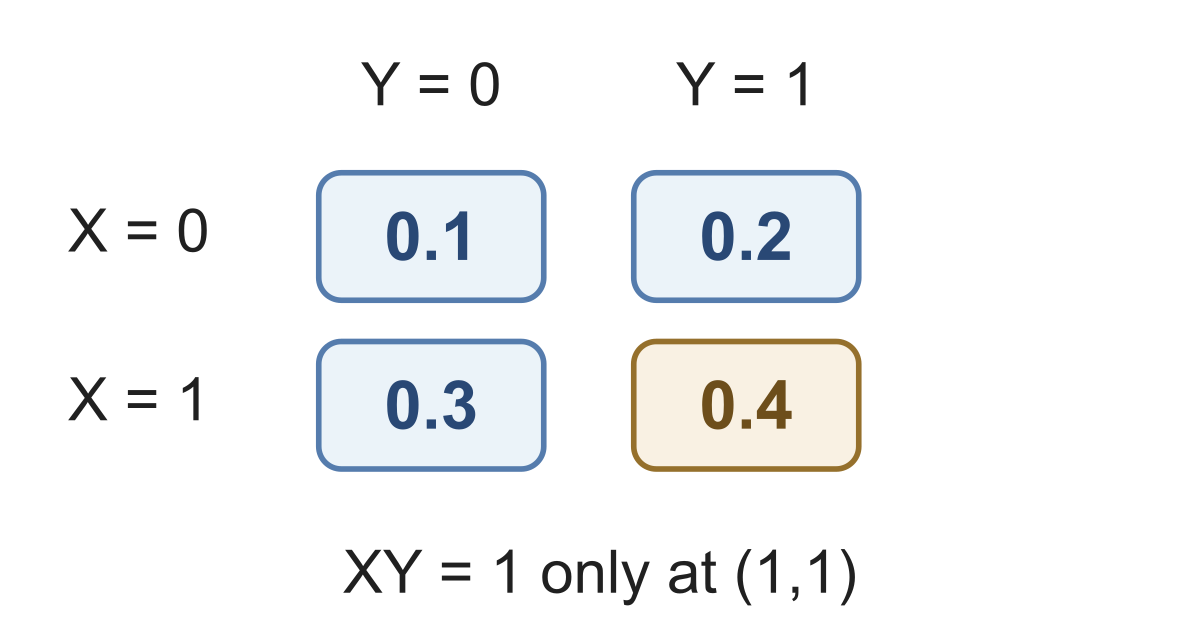
With binary and joint rows , the product is zero at three pairs. At , its value 1 carries probability 0.4.
Rows ; columns . Joint rows: . . Find .
Show answer and explanation
.
02For any supplied function , evaluate at each pair before weighting#
For any supplied function , evaluate at each pair before weighting. The probabilities must sum to 1; the function values need not.
X rows; Y columns; order 0,1. Joint rows: . . Fix separate means. Find .
Show answer and explanation
.
03A closer look#
For binary and joint rows , squared difference is 1 at the two off-diagonal pairs. Its expectation is . In general, applying a nonlinear function to the means gives a different result.
Cost is g. X rows; Y columns; order 0,1. Joint rows: . . Find .
Show answer and explanation
.
Evaluate at each pair, weight by its mass, then add.
- Compute an expectation of a function using a finite joint table.
Further questions
Can I always use g(E[X],E[Y])?
Sources & further reading
- [1]
- [2]Pishro-Nik, 5.1.4 Functions of Two Random Variables ↗Textbook · Book