Partitions
A partition is a collection of nonempty pairwise-disjoint subsets whose union is the whole sample space.
On this page 7 sections
01A partition splits a sample space into nonempty parts#
A partition splits a sample space into nonempty parts. Every outcome belongs to exactly one part: there are no gaps and no overlaps.
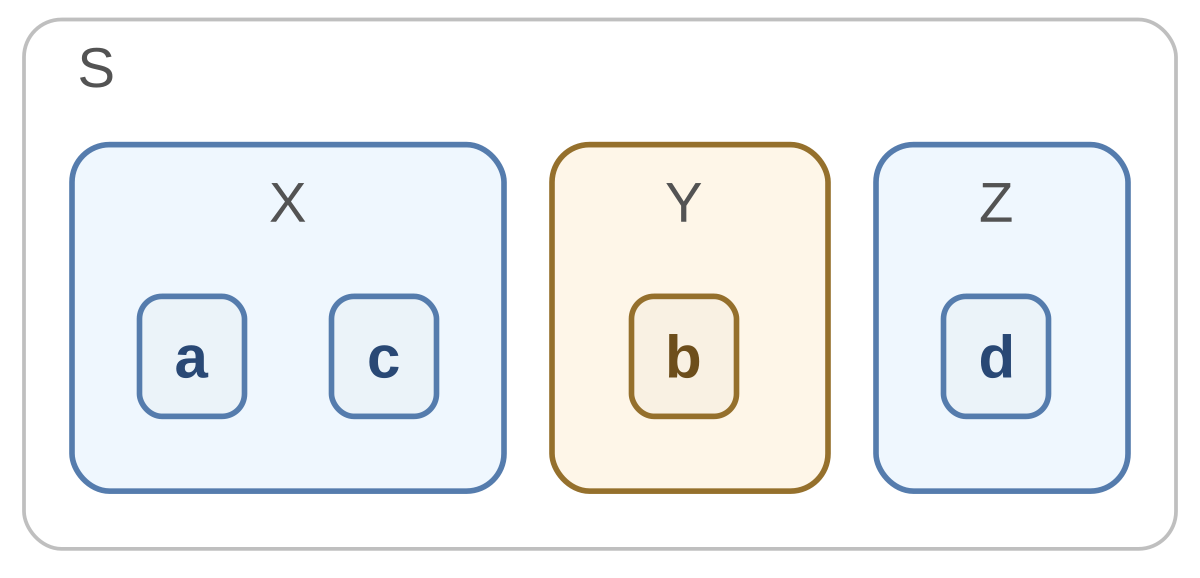
For S = {a, b, c, d}, the parts {a, c}, {b}, {d} cover all four outcomes. None shares a member or is empty.
S={1, 2, 3}. Parts: {1, 2}; {2, 3}. Partition?
Show answer and explanation
Shared outcomes: {2}.
02You can check a partition from record destinations#
You can check a partition from record destinations. Each record must enter one named bin, and every named bin must receive at least one record.
Bins: L, R. Destinations: a→L; b→R; c→R; d→L. Partition?
Show answer and explanation
Each record once; both bins nonempty.
03Check every pair of parts#
Check every pair of parts. Three parts can overlap in pairs even if nothing lies in all three. Empty parts also fail the definition; unequal part sizes are allowed.
S={a, b}. Parts: {a}; {b}; {}. “Every outcome once, so yes.” Partition?
Show answer and explanation
Empty parts are not allowed.
Check nonempty parts, no pairwise overlap and complete coverage. Every outcome must belong to exactly one part.
- Check nonempty parts and exact single membership.
Sources & further reading
- [1]Pishro-Nik, Introduction to Probability: 1.2.2 Set Operations ↗Pishro-Nik, Introduction to Probability · Book