Total probability
The law of total probability sums event contributions over an exhaustive disjoint case split.
On this page 7 sections
01An event can happen through several cases#
An event can happen through several cases. If the cases are disjoint and cover the whole sample space, their separate event contributions add to the total.
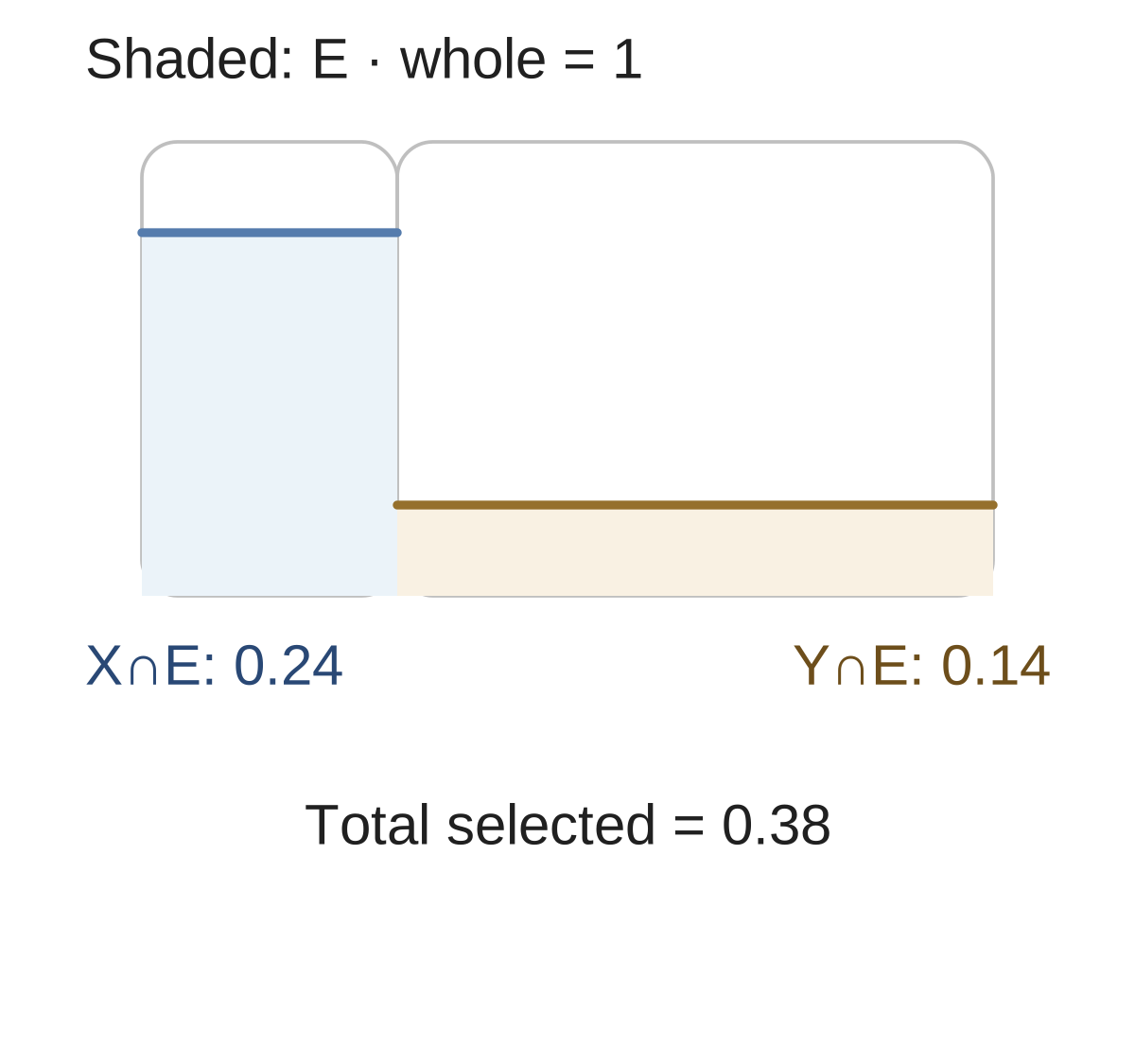
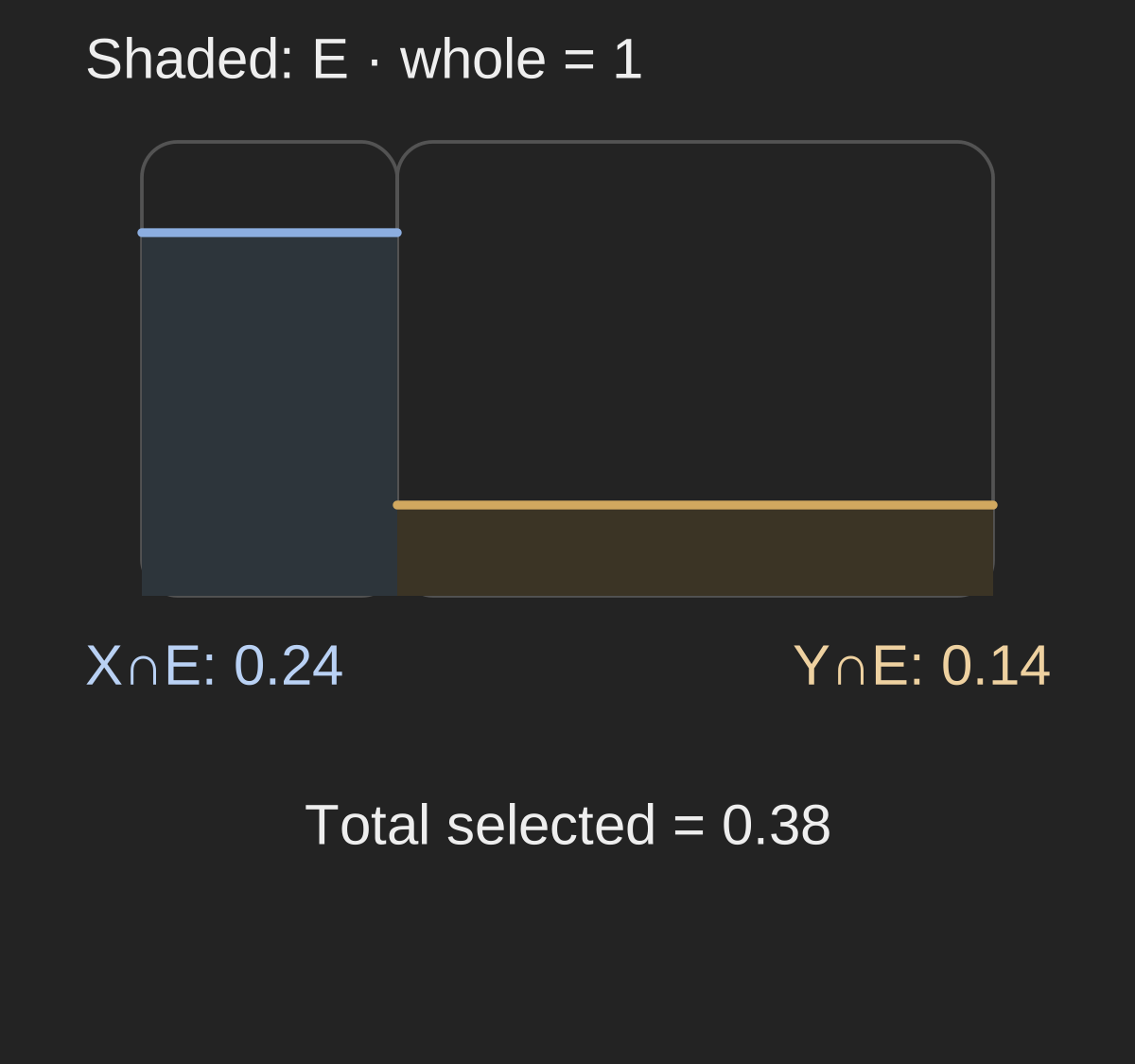
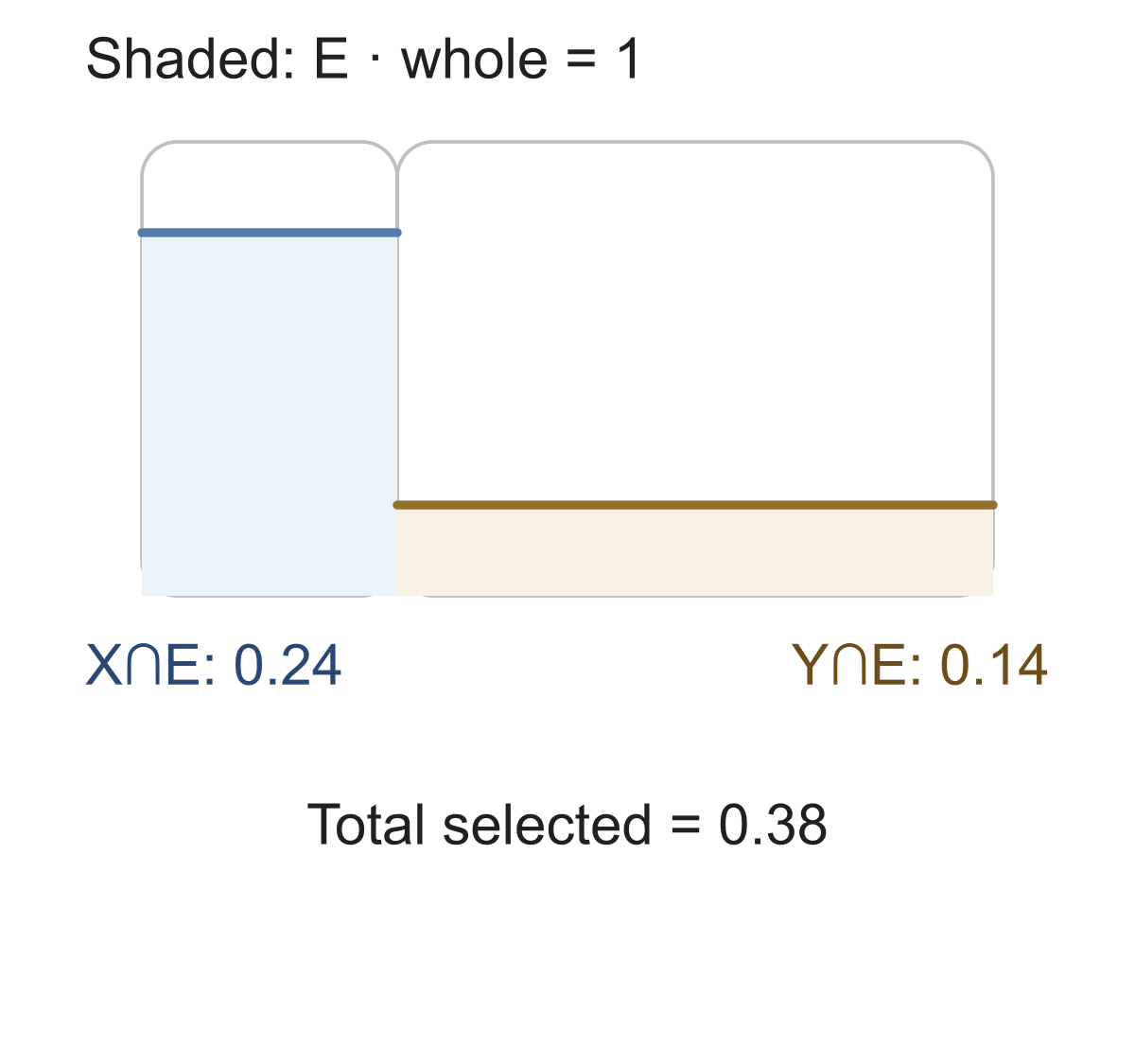
Cases X and Y have weights 0.3 and 0.7. Their A rates are 0.8 and 0.2. The joint contributions are 0.24 and 0.14, so P(A) is 0.38.
For across cases :
Each case weight is positive, so its conditional is defined. Sum the contributions, not the unweighted rates.
Exhaustive disjoint cases. Weights: 0.6, 0.4. Rates of A in the same order: 0.5, 0.25. Find P(A).
Show answer and explanation
0.3 + 0.1 = 0.4.
02A closer look#
If a record uses route X with chance 0.5, otherwise Y, and their alert rates are 0.6 and 0.2, the overall rate is 0.3 + 0.1 = 0.4.
A record uses X with chance 0.4, otherwise Y. Alert rates within X and Y are 0.8 and 0.3. Find the overall alert chance.
Show answer and explanation
0.32 + 0.18 = 0.5.
03Equal case weights justify averaging the rates#
Equal case weights justify averaging the rates. Otherwise, use the weights. A positive rate in a common case contributes more than the same rate in a rare case.
Exhaustive disjoint cases. Weights: 0.25, 0.75. Rates of A in the same order: 0.4, 0.8. “Add rates: 1.2.” Repair it.
Show answer and explanation
0.1 + 0.6 = 0.7.
Multiply each within-case rate by its case probability. Add those disjoint contributions to recover the whole-event probability.
- Weight each case rate before adding.
Sources & further reading
- [1]Pishro-Nik, Introduction to Probability: 1.4.2 Law of Total Probability ↗Pishro-Nik, Introduction to Probability · Book